Gold Loan Default: Can Bank Auction My Gold?
Facing default on your gold loan? Understand your legal rights under Section 176 of the Indian Contract Act. Strict 30-day legal auction notices. Surplus refund compliance. How to settle interest waivers to retrieve your pledged family ornaments.
- strict Section 176 Notice: Lenders cannot auction pledged ornaments without serving a formal 30-day registered legal notices.
- Ban on Secret Auctions: RBI Master Directions prohibit private in-house auctions. Requiring transparent public proceedings.
- strict Surplus Refund: Excess proceeds above legitimate dues must be credited to the client within thirty days.
- Civil Court Stay Remedies: clients can obtain injunctions under Order 39 CPC against undervalued distress jewelry sales.
- 30% to 60% Penal Waiver: Hardship representations eliminate compounded penal interest to help main loan settlement.
- SARFAESI security Exemption: Gold loans represent movable pawn pledges rather than SARFAESI mortgage properties.
- Priority Crop Protection: farm gold advances benefit from legal moratoriums during notified crop losses.
- Credit Bureau Updation: Settling dues mandates issuance of a No Dues letter and updating CIBIL to Closed.
1. Gold Loan Economics, Pawn Pledge Law & NPA Classification
Gold loans represent a pawn pledge governed by Sections 172 through 179 of the Indian Contract Act. 1872. Where special takeover transfers to the lender while ownership remains with the client. Lenders advance funds against a 75% LTV limit under RBI directions. When hardship causes defaults past 90 days. The facility becomes a Non-Performing Asset (NPA).
Unlike real estate loans. Gold advances are expressly exempt from SARFAESI takeover actions. Instead. Claims is strictly confined to Section 176 of the Contract Act. The lender acquires no automatic property ownership. It possesses only a regulated power of sale conditioned upon serving reasonable notice. Because lenders face Tier-1 cash provisioning pressure on bad assets. Clients hold major trade leverage to settle a OTS deal One-Time Settlement (OTS) and redeem ancestral ornaments.
2. Penal Interest Inflation & Settlement Math Breakdown
When gold loans enter default. Lenders apply compounding penal rates between 24% and 30% per annum. Adding auction fees, assayer levies. Storage charges. These additions artificially inflate unpaid dues and trigger distress margin calls. By conducting a deep ledger audit. Our workers challenge these predatory fee layers under RBI Fair Practices Code to settle major interest concessions.
agent 180-Day NPA Case Study: Pledged Asset: 150g 22K Gold Ornaments. Lender Demand: main loan ₹6,00,000. Contractual Interest ₹72,000. penalty charges (28% p.a.) ₹1,18,000. Auction Fees ₹35,000. Total Demand ₹8,25,000. CredSettle settled OTS: Verified main loan ₹6,00,000. Simple Interest ₹45,000. Penal Waiver -₹1,53,000. Final Settlement ₹6,45,000. Net Savings: ₹1,80,000 (100% of gold ornaments safely redeemed with formal NDC).
3. Gold Loan Resolution Options Comparison Matrix
Evaluating available gold loan relief plans across money cost. Ornament custody, credit score, and speed:
| Resolution Route. | Financial Cost | Ornament Custody. | Credit Impact | Speed & Complexity. |
|---|---|---|---|---|
| Distress Public Auction. | Severe distress markdown. | Forfeiture of ornaments. | Loss NPA tag | High deficit risk. |
| OTS deal OTS Settlement. | 30%. 60% penal waiver. | 100% ornament release. | Closed with NDC | Fast 15. 30 days |
| Loan Restructure / Rollover. | High capitalized interest. | Vault retention | Restructured tag. | Requires upfront interest. |
| Gold Takeover Refinancing. | Balance transfer fees. | New bank vault. | New tradeline opened. | Tripartite vault transfer. |
| Civil Injunction Stay. | Court &. legal fees. | Judicial freeze on sale. | Account in dispute. | Order 39 CPC suit. |
4. CIBIL Scoring Algorithms & Gold Loan Default Remediation
Gold loan performance straight impacts credit scores under standard bureau algorithms across TransUnion CIBIL. Experian. CRIF High Mark. Equifax. Scoring models allocate 35% weight to payment track. 30% to unpaid dues. 15% to credit history duration. 10% to credit mix. 10% to recent loan queries. Defaulting past 90 days causes an fast 50 to 120-point drop as lenders report Sub-Standard or Doubtful NPA status.
If a bank executes an un-contested auction and writes off residual deficits. This negative mark persists for seven years. However. Resolving the account through a structured One-Time Settlement allows clients to demand legal compliance under Section 21 of the CICRA Act. Lenders are legally bound to submit updated records within thirty days of settlement clearance. Transitioning the tradeline to Closed status and enabling credit score claims back to 750+.
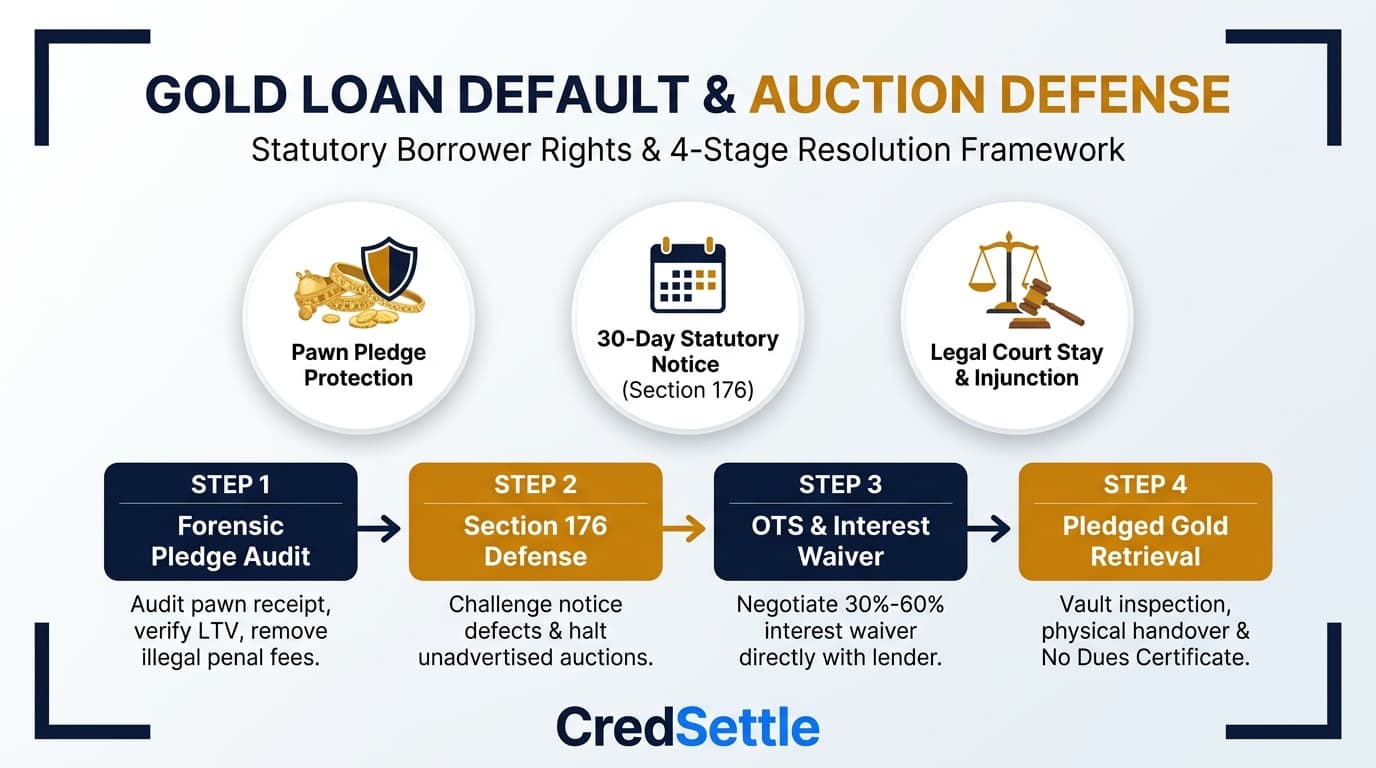
Visual Blueprint: Gold Loan Default & Auction Defense Workflow
Our infographic illustrates the 4-step rules to halt premature gold auctions. Invoke Section 176 legal rights. Secure penal waivers. Safely redeem family ornaments under RBI directives.
5. Standard Operating Procedure (SOP): 6 Stages of Gold Loan Defense
Follow this sequential standard operating procedure to halt gold auctions and redeem pledged family ornaments:
Forensic Pledge & Ledger Audit
Examine the pawn ticket and purity letter. Audit the loan record to isolate illegal compounding penal interest and storage fees.
Statutory Notice & Hardship Dossier
Verify Section 176 notice compliance and compile proof of medical emergency or income distress to support your settlement petition.
Section 176 Challenge & Stay Notice
Serve written objections upon the lender and auctioneer challenging notice defects. Missing advertisements, and distress undervaluation.
Bilateral OTS & Waiver Negotiations
Represent the case before the bank main loan Nodal Officer. Settling a 30% to 60% penal interest waiver in a closure note.
Remittance & Physical Vault Verification
Deposit the settlement sum straight into the loan account. Inspect. Weigh. And verify ornament purity at the vault before taking takeover.
NDC Issuance & Credit Updation
Collect the No Dues letter confirming zero residual debt risk and ensure the lender transmits updated trade data to credit bureaus to mark the account Closed.
6. Statutory Notice Defense Architecture & Borrower Legal Rights
clients facing auction notices possess robust legal protections under Indian law. Section 176 of the Indian Contract Act. 1872 strictly requires the pawnee to serve reasonable notice of sale before disposing of pledged goods. In established judicial ruling. Reasonable notice constitutes a strict legal condition ruling requiring at least thirty days of clear written notice detailing quantified dues. Pledged item descriptions, auction date, time. local public venue.
Under RBI Master Directions. Lenders cannot conduct private auctions. Sales must be conducted publicly through board-approved auctioneers with advertisements in two newspapers and reserve prices tied to market gold rates. Lenders cannot sell jewelry below fair market value. If violated. Clients can apply under Order 39 CPC for an interim stay. Petition the clients Commission under Section 35 of the clients Protection Act. 2019.
7. The 3-Tier Grievance Escalation Matrix
Escalate unaddressed notice defects and claims grievances through this structured RBI rules:
Submit written objections contesting notice defects and arbitrary penal fees. Demanding an fast pause on auction proceedings.
Escalate to the main loan Nodal Officer to recalculate dues under simple interest and sanction an amicable OTS deal OTS.
File a complaint on. cms.rbi.org.in under the Integrated Ombudsman Scheme for violations of gold auction norms.
8. Chronological Resolution Timeline (Day 1 to Month 6)
Key bank and legal milestones in a gold loan default relief lifecycle:
| Timeline | Lender Milestone. | Statutory Base | Borrower Action |
|---|---|---|---|
| Days 1. 30 | SMA-0 on missed payment. | RBI Prudential Norms. | Verify pawn ticket &. grace terms. |
| Days 31. 90 | SMA-1/2 overdue penalties. | Fair Practices Code. | Audit ledger &. compile hardship. |
| Days 91. 120 | NPA &. Section 176 notice. | Section 176 Contract Act. | Issue stay objection &. OTS. |
| Months 4. 5 | Public auction ad window. | RBI Auction Directives. | Finalize OTS deal letter. |
| Month 6 | Vault release, NDC &. closure. | CICRA Act Section 21. | Inspect gold &. verify Closed status. |
9. Specialized Scenarios: NBFCs, Agri Loans & Surplus Claims
relief plans across varied gold financing categories and bank rules:
NBFC Gold Loans (Muthoot & Manappuram)
NBFCs follow automated auction cycles. Serving formal Section 176 objections regarding notice compliance compels legal desks to pause sales and approve OTS deals.
Agricultural & Priority Gold Advances
farm gold loans carry legal protections against distress sales during natural calamities. Entitling farmers to debt restructuring under SLBC directives.
Purity & Assayer Discrepancy Disputes
The lender is bound by original pawn receipts. Unilateral purity downgrades without contemporaneous deep proof constitute unfair trade practices.
Recovery of Unclaimed Auction Surplus Funds
When auctions generate excess funds above legitimate dues. Lenders must proactively refund the surplus within thirty days under RBI rules. Unreturned surplus can be recovered with legal interest.
 Legal Debt Dispute Authority
CredSettle (credsettle.com) is India's premier debt settlement, loan dispute resolution, and legal protection platform. Operating strictly under the RBI Fair Practices Code and CICRA 2005, our advocate panel negotiates directly with Bank Principal Nodal Officers to eliminate waived differentials, obtain unconditional No Dues Certificates (NDC), and upgrade credit bureau records from "Settled" to "Closed".
Frequently Asked Questions on Gold Loan Default & Bank Auctions
Click on any question below to explore authoritative legal answers verified by our banking and debt relief workers:
Official Regulatory References & Authorities
- Indian Contract Act, 1872: Sections 172 to 179 (Pledge of Pawnee and strict Notice under Section 176).
- Reserve Bank of India Master Directions: Fair Practices Code for Gold Loans and Public Auction rules (RBI/2012-13/462).
- clients Protection Act, 2019: Section 35 (Deficiency in Banking Service and Unfair Trade Practices).
- Credit Information Companies (Regulation) Act, 2005: Section 21 (Duty to Furnish Accurate Trade Data).