Can You Get a Loan or Credit Card
After Settlement?
Worried you will never get a loan again? Learn which banks offer loans to individuals with a past settlement and how to qualify for them.
Settling a loan or credit card via a One-Time Settlement (OTS) is an irrefutable legal relief mechanism that shields borrowers from ongoing recovery litigation, Section 138 cheque bounce proceedings, and aggressive collection harassment. However, the subsequent "Settled" status tag reported across TransUnion CIBIL, Experian, Equifax, and CRIF High Mark triggers automated rejections across prime commercial bank algorithms.
Contrary to persistent myths propagated by recovery agencies, a past settlement does not result in a permanent financial blacklist. Borrowers can systematically rebuild prime creditworthiness within 6 to 24 months by following a structured 4-phase trajectory: establishing secured trade-lines, optimizing debt-to-income ratios, utilizing credit-worthy co-borrowers, or executing a differential payoff to permanently convert "Settled" status into "Closed".
- Secured Credit Rebuilding is 100% Guaranteed: Fixed Deposit-backed credit cards and gold loans require zero credit history checks, bypass automated bureau filters, and report positive monthly repayment data to all four credit bureaus.
- Mandatory 90-Day Cooling-Off Rule: Applying for retail unsecured loans immediately after settlement guarantees hard rejection inquiries that severely depress credit scores.
- The Differential Payoff Advantage: Paying the historical waived principal balance converts your CIBIL record to "Closed", completely restoring eligibility for tier-1 home loans and prime personal loans.
1. Can You Get a Loan or Credit Card After Settlement?
The short answer is an unequivocal yes, but approval depends entirely on the type of credit facility you seek, the lending institution you approach, and the time elapsed since your settlement was executed. When a borrower completes a One-Time Settlement (OTS), the lending bank agrees to accept a discounted lump sum and write off the remaining balance as an operational loss.
While this legal compromise fully extinguishes your civil debt liability, the bank reports a "Settled" status flag to India's four credit information companies (CIBIL, Experian, Equifax, and CRIF High Mark). Automated Loan Origination Systems (LOS) employed by top scheduled commercial banks treat this flag as an indicator of past default risk, rejecting automated unsecured applications during the initial 12 to 24 months.
However, Indian retail credit architecture is divided into distinct lending tiers. Collateralized credit, risk-priced non-banking financial company (NBFC) loans, and co-applicant mortgage facilities operate under entirely different underwriting criteria that remain accessible to post-settlement individuals immediately.
| Credit Product Category | Approval Probability | Minimum CIBIL Needed | Max LTV / Credit Limit | Ideal Timeframe to Apply |
|---|---|---|---|---|
| Secured Gold Loans (NBFC / Banks) | 99% (Guaranteed) | No Minimum (300+) | Up to 75% of Gold Appraised Value | Immediate (Day 1 post-NDC) |
| FD-Backed Credit Cards (Secured) | 99% (Guaranteed) | No CIBIL Check | 80% – 100% of Fixed Deposit | Month 1 – 3 (Rebuilding Phase) |
| Co-Borrower Home / Auto Loans | 75% – 85% (High) | 650+ (Co-applicant 750+) | 60% – 75% Property / Vehicle LTV | Month 6 – 12 post-settlement |
| Fintech NBFC Unsecured Loans | 50% – 65% (Moderate) | 650 – 700+ | ₹25,000 – ₹3,00,000 (Risk-Priced) | Month 9 – 15 post-settlement |
| Tier-1 Bank Prime Loans & Cards | Low initially; 80%+ later | 750+ (Clean Bureau) | Full Prime Limit (Standard ROI) | Month 18 – 24 (or upon Differential Payoff) |
Strategic Rule: Do not submit random applications to scheduled commercial banks immediately after settlement. Every rejected application triggers a hard inquiry, causing compounding damage to your rebuilding credit profile.
2. Why Loan Algorithms Auto-Reject & How Bank Decisioning Works
To overcome loan rejections, one must understand how Indian banking systems process loan applications. Modern retail credit underwriting is no longer decided by branch managers over personal discussions; it is governed by algorithmic Loan Origination Systems (LOS) connected via real-time APIs to credit bureaus.
When you apply online for a personal loan or credit card at HDFC Bank, ICICI Bank, Axis Bank, or SBI, the LOS executes a two-stage filter:
The algorithm scans the CIR (Credit Information Report) for derogatory tags within the last 36 months, including "Settled", "Post-Write-off Settled", "Written Off", or "Suit Filed". If detected on unsecured facilities, the application is rejected automatically without human review.
The specific lending bank where you settled preserves your PAN card in an internal "Sacrifice / Loss Ledger". Even if your CIBIL score recovers to 800+ years later, that specific bank will never sanction fresh unsecured credit unless the past waived loss is reimbursed in full.
3. Credit Scoring Breakdown & Financial Math Calculations
Credit scores in India range from 300 to 900 and are calculated using sophisticated proprietary statistical algorithms. Understanding the mathematical weighting of each credit pillar allows you to engineer rapid score recovery post-settlement:
CIBIL Score Weight Distribution & Post-Settlement Recovery Levers
TransUnion CIBIL Scoring Engine V3.0 Weight Architecture
Most critical component. Every on-time payment on a new secured card rebuilds this foundation month-by-month.
Total balance divided by total limit. Keeping CUR below 20%–30% delivers immediate algorithmic score boosts.
Average age of active accounts. Older active accounts provide structural stability to your overall rating.
Healthy balance between collateralized loans and revolving credit demonstrates versatile financial management.
Hard pulls within 12 months. Each hard loan rejection shaves 5–15 points off your composite score.
Total Monthly EMIs / Net Monthly Income ≤ 40%–50%. A zero-debt post-settlement status optimizes your FOIR.
Underwriting Takeaway: Because loan settlement completely extinguishes your past monthly EMI obligations (bringing existing active EMIs to ₹0), your FOIR becomes 0%. This massive disposable income margin makes you highly attractive for manual credit appraisal.
4. The 4 Categories of Lenders in India: Who Lends After Settlement?
Not all financial institutions treat past settlements the same way. In India's regulated banking ecosystem, lenders fall into four distinct operational tiers based on their credit risk appetite:
Category A: Gold Loan Companies & Secured NBFCs
Instant Approval (99%)Lenders such as Muthoot Finance, Manappuram Finance, and SBI Gold Loans extend capital strictly against physical gold jewelry collateral. Because the loan is secured by liquid precious metals (up to 75% LTV under RBI directives), these lenders do not disqualify applicants based on past CIBIL settlements. Furthermore, servicing a 6-month gold loan on time establishes an active positive repayment track record on your credit report.
Category B: FD-Backed Credit Card Issuers (The Ultimate Rebuilder)
Guaranteed ApprovalBanks offering secured credit cards—including IDFC FIRST WOW, Kotak Mahindra 811 DreamDifferent, SBM Gild, and Axis Bank Insta Easy—issue credit cards against a fixed deposit (minimum ₹5,000 to ₹25,000). There is zero CIBIL score requirement. These cards function identically to standard credit cards, reporting monthly on-time payments to all 4 credit bureaus, serving as the single fastest vehicle to jump from 580 to 730+ CIBIL.
Category C: Second-Tier NBFCs & Fintech Digital Lenders
Risk-Based PricingFintech NBFCs like MoneyView, InCred, KreditBee, CASHe, and Tata Capital utilize alternative data underwriting models. Instead of relying solely on bureau flags, their proprietary algorithms evaluate monthly bank cash flows, salary credits, utility payment history, and current employment stability. Once you show 6 months of steady income and a zero-bounce bank statement post-settlement, they offer personal loans with risk-adjusted interest rates (18%–26% APR).
Category D: Tier-1 Scheduled Commercial Banks & HFCs
Prime Rates (750+ CIBIL)Institutions like HDFC Bank, ICICI Bank, SBI, LIC Housing Finance, and PNB Housing provide India's lowest interest rates on home loans and unsecured personal credit. To qualify post-settlement, you require either 18–24 months of pristine repayment history on new trade-lines with a 750+ score, a strong co-applicant, or converting your past "Settled" status to "Closed" by extinguishing the historical waiver differential.
How to Get Fresh Loans & Credit Cards After Settlement
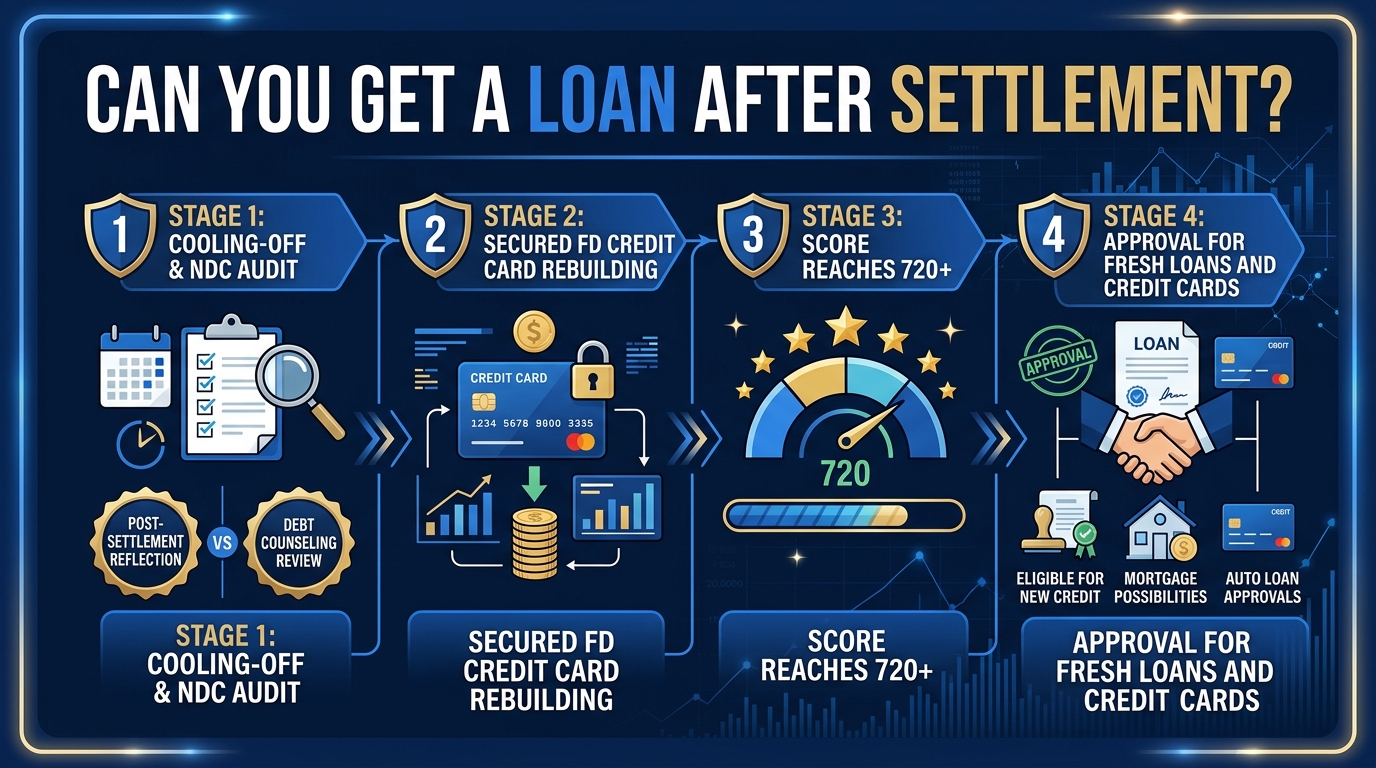
5. Step-by-Step Roadmap: 6 Stages to Qualify for New Credit Post-Settlement
Qualifying for loans after settlement requires strategic precision. Do not rely on luck or automated applications. Follow this battle-tested 6-stage operational protocol:
Stage 1: Post-Settlement Bureau Audit & NDC Verification
Within 30–45 days of completing your One-Time Settlement, obtain official No Dues Certificates (NDC) from all lenders. Download fresh credit reports from all four bureaus (CIBIL, Experian, Equifax, CRIF). Verify that the outstanding balance reflects exactly ₹0 and amount overdue is ₹0. If any bank left an active overdue balance, file an immediate online bureau dispute with your NDC attached.
Stage 2: Observe a Strict 90-Day Credit Cooling-Off Period
Cease all new loan and credit card inquiries for at least 90 to 180 days. Submitting multiple loan applications right after a settlement signals desperate credit hunger to risk scoring models, creating hard inquiry records that depress your CIBIL score by an additional 20 to 50 points.
Stage 3: Establish a Secured Credit Rebuilding Trade-Line
Open a fixed deposit of ₹20,000 to ₹50,000 with IDFC FIRST Bank, Kotak Mahindra Bank, or Axis Bank and obtain a secured credit card. Use this card for routine monthly utility expenses (groceries, fuel, electricity bills) to generate fresh, positive monthly trade-line data feeds across all credit bureaus.
Stage 4: Maintain Sub-30% Utilization with Automated Autopay
Never utilize more than 20% to 30% of your credit limit (e.g., spend no more than ₹6,000 on a ₹20,000 limit card). Set up an automated ECS/NACH mandate to debit the total amount due 5 days before the payment due date. This builds a 100% on-time repayment track record, driving your score towards 720+ within 6 to 9 months.
Stage 5: Leverage Co-Applicants & Higher Down Payments for Big Loans
If you require a home loan, car loan, or business loan within 12 months of settlement, apply jointly with a co-borrower who possesses a 750+ CIBIL score and stable salary. Additionally, offering a 30%–40% equity down payment substantially lowers the lender's Loan-to-Value (LTV) risk, securing manual credit committee approval.
Stage 6: Upgrade "Settled" to "Closed" via Differential Payoff
For unconstrained access to tier-1 unsecured credit cards and prime bank personal loans, contact your historical lending bank and request a payoff calculation for the waived principal balance. Upon clearing the difference, obtain a clean closure NDC. The bank is legally mandated under RBI rules to update your status to "Closed" with zero loss reported.
6. Formal Representation Template: Applying for Manual Credit Appraisal Post-Settlement
When applying for a high-value loan (home loan, auto loan, or commercial line) where automated algorithms flag a past settlement, submit this formal written representation directly to the Bank Credit Sanctioning Committee:
To,
The Credit Sanctioning Committee / Head of Retail Credit Underwriting,
[Target Bank / NBFC Name],
[Branch / Central Processing Centre Address],
Email: [retailcredit@bankname.com]

Subject: Application for Manual Credit Appraisal & Underwriting Review for Loan Application No: [Insert Application Ref No.] in light of Past Lawful One-Time Settlement (OTS)

Respected Members of the Credit Committee,

I, [Borrower Full Name], residing at [Borrower Address], holding PAN: [Insert PAN] and Aadhaar: [Insert Aadhaar], have submitted an application for [Specify: Home Loan / Car Loan / Business Loan / Credit Facility] amounting to ₹[Requested Amount].

1. Past Context & Lawful Debt Extinguishment:
   That in [Year of Settlement], owing to bona fide unforeseen financial distress [mention cause: e.g. severe medical emergency / corporate layoff / market downturn], I entered into a mutual One-Time Settlement (OTS) for my past facility [Previous Bank Name, A/C No. XXXXXXXX]. Said settlement was fully satisfied on [Date of NDC], and an unconditional No Dues Certificate was issued (enclosed as Annexure-A).

2. Current Financial Rehabilitation & Enhanced Repayment Capacity:
   a) Current Employment & Income: I am currently employed as [Designation] at [Company Name] with a stable net monthly remuneration of ₹[Monthly Net Salary] (latest 6 months salary slips enclosed as Annexure-B).
   b) Bank Statements: My primary banking account demonstrates zero cheque/NACH returns and a robust average monthly balance exceeding ₹[Average Balance] over the past 12 months (Annexure-C).
   c) Debt-to-Income / FOIR: My current total fixed monthly EMI obligations stand at exactly ₹0, resulting in a healthy Fixed Obligation to Income Ratio (FOIR) well below the regulatory threshold of 40%.

3. Rebuilt Credit Discipline:
   Subsequent to the settlement, I have maintained a 100% on-time repayment track record on my secured facility [Specify: FD Credit Card / Gold Loan] with a Credit Utilization Ratio maintained strictly below 20%.

4. Request for Manual Underwriting Discretion under RBI Fair Lending Framework:
   Pursuant to the RBI Master Direction on Fair Practices Code for Lenders, I respectfully submit that my profile presents a low credit risk profile. I request the Credit Committee to exercise manual underwriting discretion to approve the subject facility based on my current debt-free cash flows, collateral security, and verified financial stability.

Thanking you,

Yours sincerely,

___________________________
[Signature]
[Borrower Name]
[Mobile Number]
[Email Address]
Date: [DD/MM/YYYY]
Place: [City, State]
7. 3-Tier Escalation Matrix for Unjustified Bureau Data Errors & Delays
If your previous bank fails to update your credit report to ₹0 balance after receiving settlement funds, or if an erroneous "Written-Off" status is reported instead of "Settled", use this 3-tier statutory escalation matrix:
Branch Credit Manager & CRM Desk
Submit written representation enclosing your NDC and settlement receipt. Demand immediate correction in the monthly credit bureau tape.
Principal Nodal Officer (PNO)
Escalate to the bank's apex grievance desk. The PNO has administrative authority to issue manual bureau rectification files directly to CIBIL and Experian.
RBI Integrated Ombudsman
File a statutory complaint at cms.rbi.org.in. Under RBI Circular RBI/2023-24/72, banks must pay ₹100/day compensation for every day of delay beyond 30 days.
8. Chronological 24-Month Credit Recovery & Loan Eligibility Timeline
Credit restoration is a predictable, mathematical process. Here is the realistic chronological roadmap of loan and card eligibility post-settlement:
| Phase & Timeline | Bureau Status Event | Score Trajectory | Credit Facilities Unlocked |
|---|---|---|---|
| Months 1 – 3 (Cooling Off) | Settlement logged; Balance updated to ₹0; DPD historical counter freezes. | 580 – 640 | Secured Gold Loans (Muthoot/SBI), FD-Backed Credit Cards (IDFC/Kotak). Zero hard loan inquiries. |
| Months 4 – 6 (Foundation) | Fresh positive trade-lines reported; Credit Utilization Ratio maintained below 20%. | 650 – 690 | Micro NBFC Consumer Durable Loans (Bajaj Finserv/Home Credit), Two-Wheeler Secured Loans. |
| Months 7 – 12 (Acceleration) | Continuous 6+ months of clean on-time repayments; past default impact dilutes. | 700 – 740 | Fintech Personal Loans (MoneyView/InCred), Used Car Loans, Co-Borrower Home Loans (HFCs). |
| Months 13 – 24 (Prime Restoration) | Established mature credit history; optional conversion to "Closed" status completed. | 750 – 800+ (Prime) | Prime Bank Home Loans (SBI/HDFC), Premium Unsecured Credit Cards, Low-ROI Personal Loans. |
9. Complex Scenarios: Credit Cards, ARCs, and Digital Fintech Loan Apps
Credit Card Settlements
Credit cards carry compounding 42%+ APR interest. When paying the balance to convert to "Closed", insist on calculating the waiver based on the principal at default, stripping out all accumulated finance charges.
Debt Assigned to ARCs
If your loan was assigned to an Asset Reconstruction Company (ARCIL, Phoenix, CFM, Edelweiss ARC) under SARFAESI Section 5, you must settle the differential with the ARC directly, as the ARC now owns the legal right to issue the NDC.
Digital Fintech NBFC Apps
For app-based digital loans (KreditBee, MoneyView, CASHe, PaySense), obtain the NDC from the underlying RBI-registered NBFC lender, not the digital lending front-end app.
 Legal Debt Dispute Authority
CredSettle (credsettle.com) is India's premier debt settlement, loan dispute resolution, and legal protection platform. Operating strictly under the RBI Fair Practices Code and CICRA 2005, our advocate panel negotiates directly with Bank Principal Nodal Officers to eliminate waived differentials, obtain unconditional No Dues Certificates (NDC), and upgrade credit bureau records from "Settled" to "Closed".
Frequently Asked Questions on Getting a Loan or Credit Card After Settlement
Click on any question below to explore technical answers verified by banking compliance and debt resolution experts:
All legal procedures, timelines, and rights described on this page are grounded in official Indian statutory frameworks: