Credit Card Blocked for Rent Rotation: Legal Debt Exit
Did your bank freeze or cancel your credit card for MCC 6513 rent transfers or wallet rotation? Learn RBI card-blocking rules, avoid fake rent deed traps and Income Tax AIS alerts, and settle your dues legally.
- Why Cards Get Blocked: Banks flag repeated rent transfers under code MCC 6513 and wallet loads under MCC 6540 when money loops back to pay your own card bill.
- RBI Notice Mandate: Under the March 2024 RBI Master Direction update, banks must send an instant SMS or email giving the exact reason for blocking your card.
- Civil Default, Not a Crime: Failing to pay a blocked card is a civil contract issue. However, never send fake rent agreements to the bank, as forged papers invite fraud risk.
- Rs 10 Lakh Tax Alert: Rotating Rs 1 Lakh monthly logs Rs 12 Lakh of card payments on your Income Tax AIS under Rule 114E, even though no new income was earned.
- Legal One-Time Settlement: Blocked personal cards remain eligible for structured One-Time Settlement (OTS) under the June 2023 RBI Compromise Settlement framework.
1. RBI Crackdown on MCC 6513 & Fintech Rent Routing
For years, salaried borrowers in India used fintech apps to pay house rent with credit cards. Apps like CRED, PhonePe, Paytm, Housing, and NoBroker let users send card money straight to any bank account. Card networks tagged these transfers under Merchant Category Code (MCC) 6513 for real estate rentals.
Many stressed borrowers soon used this feature as an emergency cash loop. Instead of paying a real landlord, they sent money to a spouse, parent, or friend. That person sent the cash right back via UPI to pay off the previous month's credit card bill.
On February 15, 2024, the Reserve Bank of India issued Press Release 2023-2024/1885 to stop unapproved payment routing. The RBI warned that routing card money to non-merchant bank accounts without full Know Your Customer (KYC) checks violated Section 4 of the Payment and Settlement Systems Act, 2007.
At the same time, the RBI enforced strict Payment Aggregator (PA) rules. Payment gateways can now settle funds only to verified merchants who hold direct contracts. As a result, major fintech apps halted unverified rent transfers, while banks rolled out automated blocks on suspected card rotation.
2. How Banks Detect Circular Credit Card Rent Rotation
Personal credit cards are meant only for buying retail goods and services. Under Paragraph 7(c) of the RBI Credit Card and Debit Card Master Direction (updated March 7, 2024), banks must also monitor the end use of business cards and prevent cash misuse.
Every major bank in India uses automated Transaction Monitoring Systems (TMS) to spot circular fund rotation. You do not need a manual complaint to get flagged. Bank software spots four clear red flags within seconds.
First, the system flags accounts where 80% to 95% of the credit limit goes toward MCC 6513 (rent), MCC 6540 (wallet loads), or MCC 8299 (education fees) with almost zero grocery or retail spends. Second, it detects multiple rent payments in a single month, which makes no sense for one tenant.
Third, if you hold a savings account at the same bank, the system sees your card bill paid on Monday and the exact same amount swiped out as rent on Tuesday. Fourth, banks cross-check surname matches, shared addresses, and device IDs between you and your recipient.
3. Fee Bleed Math: Why Rent Rotation Causes Sudden Default
Rotating a credit card feels cheaper than missing a bill at first. You think you are paying only a small app fee to buy another 45 days of time. In reality, double fees silently drain your savings without cutting a single rupee of debt.
Fintech apps charge a 1.8% to 2.2% fee plus 18% GST on every rent swipe. On top of that, banks like HDFC, ICICI, SBI Card, and Axis charge an extra 1% rent surcharge plus 18% GST. Look at what happens when a borrower rotates a ₹2,00,000 card bill for one year before a sudden block.
| Rotation Stage | App + Bank Fees (Incl. 18% GST) | Principal Reduced | Cumulative Cash Lost / Balance Due |
|---|---|---|---|
| Month 1 (First Cycle) | ₹4,248 App + ₹2,360 Bank = ₹6,608 | ₹0 Reduced | ₹6,608 Fee Lost | ₹2,00,000 Due |
| Month 6 (Half Year Loop) | ₹6,608 x 6 Cycles | ₹0 Reduced | ₹39,648 Lost | ₹2,00,000 Due |
| Month 12 (Full Year Loop) | ₹6,608 x 12 Cycles | ₹0 Reduced | ₹79,296 Lost | ₹2,00,000 Due |
| Month 13 (Sudden Card Block) | MCC 6513 Swipe Declined | Instant Cash Crunch | ₹2,00,000 Immediate Bill Shock |
| Day 90 Post-Block (NPA Stage) | 3.5%/Mo APR + Late Fee + GST | Eligible for RBI OTS | ~₹2,32,000 Bill (Settle via OTS) |
4. What Happens When a Bank Blocks Your Card for Rotation
When a bank flags your card for commercial use or cash rotation, it acts in two steps. First, the bank places a temporary block on outgoing swipes and sends an audit email asking for invoices or a registered rent agreement.
Under the RBI Master Direction (March 7, 2024 update), a bank cannot silently kill your card. It must follow a Board-approved Standard Operating Procedure (SOP) and immediately alert you by SMS or email with the clear reason for blocking the card.
If you cannot prove genuine personal spending, the bank moves to permanent closure. Your credit limit drops to zero, and any reward points earned from non-retail transactions are forfeited under Most Important Terms and Conditions (MITC) rules.
Most importantly, the loop stops overnight. Because you paid last month's bill by swiping out your salary or savings, you have no cash left to pay the final bill. Any active merchant EMIs on that card may also foreclose early and merge into one large payable balance.
5. Visual Blueprint: Rent Block & Legal Debt Exit Flow
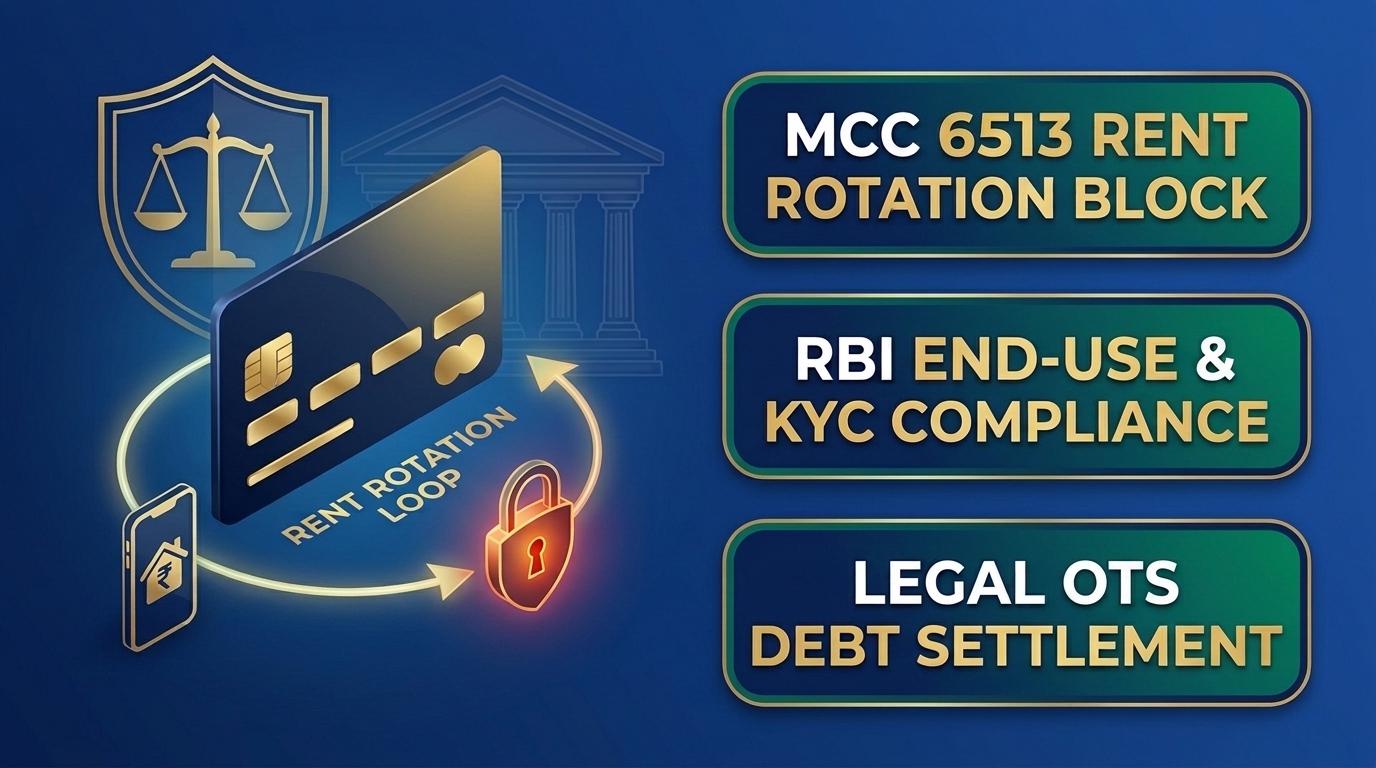
This visual guide shows how MCC 6513 rent rotation blocks happen, what RBI rules protect you, and how to exit blocked credit card debt safely through legal One-Time Settlement.
6. Supreme Court Law: Civil Debt Default vs Forgery Risks
When a blocked card goes unpaid, recovery agents often scare borrowers. They claim that rotating rent payments is "bank fraud" or "money laundering" and threaten a police FIR. Knowing actual Indian law protects you from panic.
Using your own approved credit limit in ways prohibited by card rules is a civil breach of contract, not a crime. However, one panicked mistake can create real legal trouble: making fake documents. Review these four legal rules carefully.
The Supreme Court held that failing to repay a loan or credit line does not amount to criminal cheating unless dishonest intent existed at the very start when taking the credit.
The Supreme Court ruled that police FIRs and criminal courts cannot be used as recovery tools for unpaid civil dues or breaches of commercial terms.
Do not print a fake backdated rent deed on stamp paper to unblock your card. Submitting forged papers to a bank can attract real charges under Sections 318 and 336 of BNS 2023.
Under RBI Circular DoR.FIN.REC.65 (August 12, 2022), recovery agents cannot call, message, or shame the friend or family member whose bank account received your transfer.
7. Income Tax Rule 114E: The Rs 10 Lakh AIS & SFT Trap
Credit card rotation creates a hidden tax headache that few borrowers expect. Under Section 285BA of the Income Tax Act, 1961 and Rule 114E of the Income Tax Rules, banks must report high credit card bill payments every year.
If you pay ₹10,00,000 or more via online modes (or ₹1,00,000 in cash) toward one bank's credit cards in a financial year, the bank files a Statement of Financial Transactions (code SFT-006). That total appears straight on your Annual Information Statement (AIS).
Suppose your annual salary is ₹6,00,000, and you rotate a ₹1,00,000 card bill twelve times in a year. Even though you cycled the exact same ₹1,00,000 each month, your AIS shows ₹12,00,000 in credit card repayments! Worse, if you entered a relative's PAN as a landlord, the tax portal may question them for undeclared rent income.
Stopping the rotation loop right now is the best defense. Save all bank and card statements showing the circular in-and-out entries. If you ever get an online e-Verification query under Section 133(6), a clear reconciliation sheet proves it was rotated debt rather than hidden income under Section 69C.
8. Step-by-Step SOP: Exiting Blocked Credit Card Debt
If your credit card has been blocked for rent rotation and you cannot afford the lump-sum bill, follow this six-step legal exit plan.
1Stage 1: Stop All Card Cycling and App Borrowing Immediately
Do not swipe another credit card or take high-interest instant app loans to pay a blocked card. Stopping the cycle saves you 3% to 4% in monthly fee bleed right away.
2Stage 2: Protect Your Monthly Salary From Auto-Set-Off
If your salary hits a savings account in the same bank as your blocked card, the bank may freeze or deduct funds under Section 171 of the Contract Act. Keep household income in a separate non-lender bank account.
3Stage 3: Reply Carefully to Any Bank End-Use Audit Email
If you paid real house rent, submit your genuine lease deed and landlord PAN. If you rotated cash during hardship, never send fake papers; simply accept card closure and state financial distress.
4Stage 4: Audit Your Final Statement for Unfair Charges
Download your complete card ledger. Check that penal charges are not compounded into principal, as barred by RBI rules effective March 2024, and note your true principal balance.
5Stage 5: Initiate Compromise OTS Under RBI June 2023 Rules
Once the account enters severe delinquency or NPA status, submit hardship proof under RBI Circular DoR.STR.REC.20. Negotiate a 50% to 70% waiver on inflated interest, GST, and late fees.
6Stage 6: Verify Official OTS Letter and Collect Your NDC
Pay only after verifying an official bank settlement letter sent from a bank domain. Collect your No Dues Certificate (NDC) and confirm credit bureau updates within 15 days.
9. 3-Tier Escalation Matrix: Bank GRO to RBI Ombudsman
If your bank blocked your card without telling you why, levied unlawful charges, or allowed agents to harass your family or landlord, escalate through this three-tier RBI system.
| Escalation Tier | Designated Banking Authority | Turnaround Time | Scope of Intervention & Relief |
|---|---|---|---|
| Level 1: GRO | Credit Card Grievance Redressal Officer | 7 to 10 Working Days | Provides written block reason code, itemized EMI closure ledger, and stops third-party calls. |
| Level 2: PNO | Principal Nodal Officer (Head Office) | 14 to 21 Working Days | Reviews genuine lease proofs, reverses unfair compound penalties, and routes hardship OTS files. |
| Level 3: RBI Ombudsman | Reserve Bank Integrated Ombudsman | 30 Days Post-GRO | Adjudicates silent card blocks, recovery harassment, and billing breaches via cms.rbi.org.in. |
10. Procedural Timeline: Card Block to OTS Closure
Understanding what happens after an MCC 6513 card block helps you stay calm, save settlement funds, and avoid costly mistakes at each stage.
| Milestone Window | Account Phase | Bank Action | Borrower Defense Action |
|---|---|---|---|
| Day 0 | Risk Block | Freezes outgoing MCC 6513 swipes and sends SMS or email notice. | Stop all rotation attempts and save full card statements. |
| Day 1 to 15 | End-Use Audit | Requests lease proof or cancels card and recalls unbilled balance. | Never send fake deeds; secure salary in a separate bank account. |
| Day 16 to 89 | SMA-0 to SMA-2 | Applies monthly finance charges and starts early reminder calls. | Avoid minimum-due traps; log any abusive calls for RBI proof. |
| Day 90 | NPA Stage | Marks credit card as Non-Performing Asset (NPA) in bank books. | Prepare hardship proofs and lump-sum savings for OTS talks. |
| Day 95 to 150 | OTS Window | Recovery team reviews Board-approved compromise settlement offer. | Negotiate 50% to 70% waiver on inflated dues and verify OTS letter. |
| 15 Days Post-OTS | Final Closure | Issues No Dues Certificate and updates CIBIL under 15-day rule. | Verify zero overdue balance across all 4 credit bureaus. |
11. Real-World Cases: Multiple Cards, EMIs & Relatives
Credit card rent blocks rarely happen in isolation. Here is how Indian banking rules apply to the four most common borrower situations.
Multi-Card Daisy-Chain Collapse
Many borrowers swipe Card A to pay Card B, and Card B to pay Card C. When one bank blocks MCC 6513, all three cards default together. Prioritizing staged OTS across each bank solves the whole chain.
Second Card in the Same Bank (UCIC)
Banks link all your cards under one Unique Customer Identification Code (UCIC). If one card is cancelled and defaults, the bank will usually freeze your second card with that same bank too.
Unbilled Merchant EMIs on Blocked Card
If you bought a phone or laptop on EMI before the block, permanent card closure cancels future monthly instalments. The remaining principal joins your final bill and can be settled together in OTS.
Genuine Tenant Wrongly Blocked
If you paid real house rent to an actual landlord, send your registered lease, Form 16 HRA proof, and landlord PAN to the Nodal Officer. Banks restore genuine cards once real tenancy is verified.
 Legal Debt Dispute Authority
CredSettle (credsettle.com) is India's premier debt settlement, loan dispute resolution, and legal protection platform. Operating strictly under the RBI Fair Practices Code and CICRA 2005, our advocate panel negotiates directly with Bank Principal Nodal Officers to eliminate waived differentials, obtain unconditional No Dues Certificates (NDC), and upgrade credit bureau records from "Settled" to "Closed".
Frequently Asked Questions: Credit Card Rent Block & OTS
Clear, verified legal answers on MCC 6513 rent blocks, RBI card deactivation rules, Income Tax AIS alerts, and settling blocked credit card debt in India.
Official Regulatory Citations & Statutory References
- RBI Master Direction: RBI/2022-23/92, DoR.AUT.REC.No.27/24.01.041/2022-23 (Credit Card and Debit Card - Issuance and Conduct Directions, 2022, updated March 7, 2024).
- RBI Press Release 2023-2024/1885 (February 15, 2024): Restraining of Unauthorized Card Network Payment Intermediary Arrangements under Section 4 of the Payment and Settlement Systems Act, 2007.
- RBI Compromise Settlement Circular: RBI/2023-24/40, DoR.STR.REC.20/21.04.048/2023-24 (Framework for Compromise Settlements and Technical Write-offs, June 8, 2023).
- Income Tax Act, 1961 & Rules, 1962: Section 285BA read with Rule 114E (SFT-006 Reporting of Rs 10 Lakh+ Credit Card Payments on Annual Information Statement).
- Supreme Court of India Precedents: Satishchandra Ratanlal Shah v. State of Gujarat (2019) and Lalit Chaturvedi & Ors. v. State of Uttar Pradesh (2024).