Can I Settle Loan Before NPA? (SMA Stages & Settlement Rules)
clients experiencing severe money breaks often wonder if they can settle their loan during the early 30 to 89 day default window. While retail bank branches routinely push for standard restructuring. Board-approved OTS deal policies empower credit boards to sanction pre-NPA settlements under exceptional hardship.
- Standard Asset Classification: Overdue accounts (1-89 DPD) remain standard SMA assets before 90-day NPA triggers.
- Branch Approval Resistance: Retail branches push restructuring because early OTS discounts hit branch profit margins.
- Compassionate Hardship Relief: Credit boards have special powers to settle early for illness. Disability. Or job loss.
- Restructuring vs. OTS deal: Restructure for temporary cash crunch. settle OTS if income loss is permanent.
- Pre-NPA Settlement Targets: Expect 25% to 45% main loan reduction alongside a 100% waiver of accrued penal interest.
- SARFAESI Section 31(g) Immunity: no-pledge loans and credit cards cannot be subjected to property attachment.
- Credit Bureau Score Protection: Early settlement caps DPD trail and enables credit score rebuilding back to 750+ in 12-24 months.
- Direct boards Escalation: Bypass tele-callers and present your hardship file straight to the Stressed Assets Branch.
1. Pre-NPA Economics & The Special Mention Account (SMA) Framework
Understanding whether a loan can be settled before becoming a Non-Performing Asset requires a deep look into Indian banking accounting mechanisms and Reserve Bank of India prudential rules. When an equated monthly installment (EMI) or credit card minimum amount due remains unpaid on its due date. The account does not promptly drop into default status. Instead. The Reserve Bank of India mandates a progressive classification rules known as Special Mention Accounts (SMA).
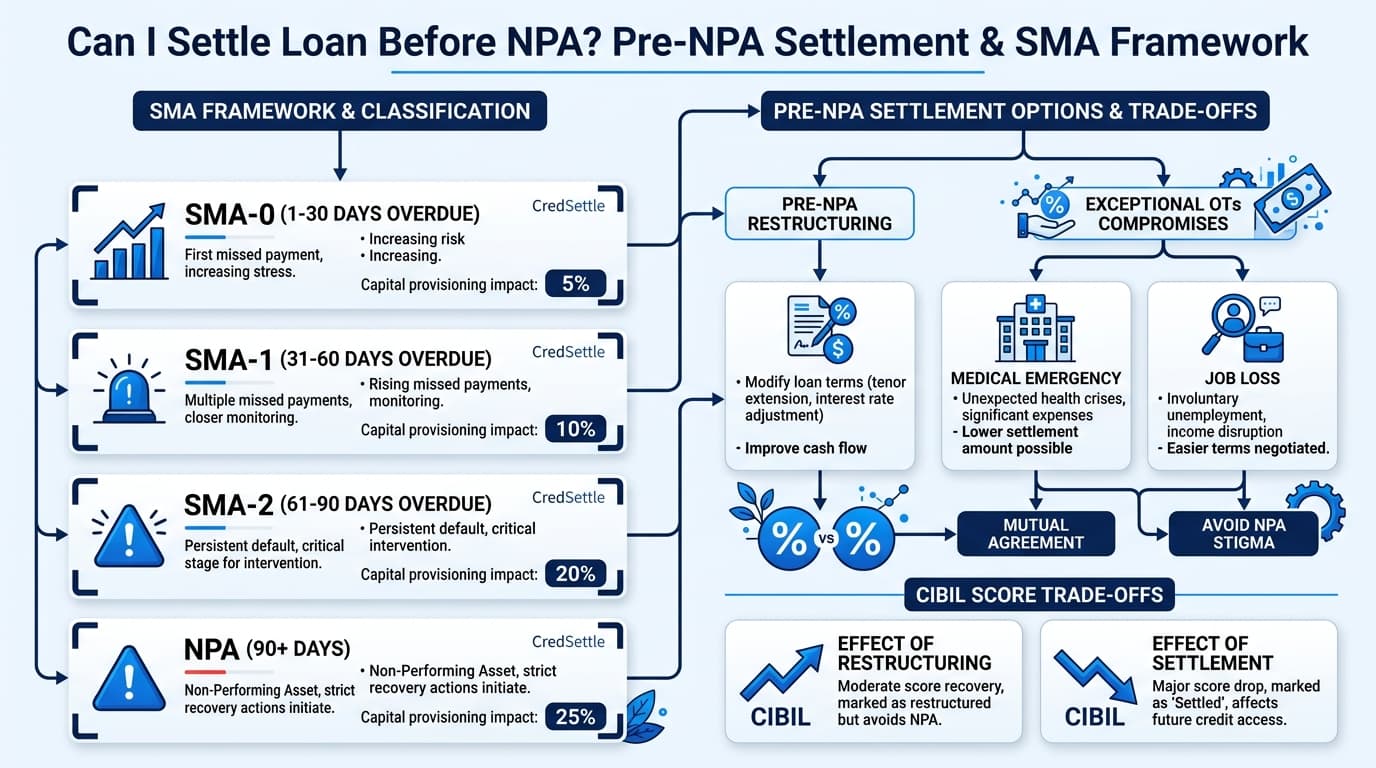
Under the RBI Prudential rules for relief of Stressed Assets. Delinquencies are categorized into three distinct sub-stages: SMA-0 for balances overdue between 1 and 30 days. SMA-1 for accounts overdue between 31 and 60 days. SMA-2 for accounts overdue between 61 and 90 days. Throughout these initial 89 days. The credit facility remains classified on the banks balance sheet as a Standard Asset. Because the account is standard. The bank is only required to maintain a nominal standard asset cash provision of 0.40% to 1.00%. Meaning the lender has not yet recognized any formal money loss.
This accounting reality explains why branch managers and claims call centers vehemently insist that loan settlement is legally impossible before 90 days. If a bank executes a OTS deals during the SMA stage. Banking regulations require the fast reclassification of the account as a restructured or non-performing credit. Compelling the institution to write off the agreed discount straight against its quarterly operating profits. As a result. Frontline bank staff are instructed to reject pre-NPA settlement requests and offer tenor extensions. EMI moratoriums. Loan rescheduling instead.
However. Board-approved OTS deals policies across scheduled banks and leading Non-Banking money Companies (NBFCs) contain explicit carve-out clauses. When a client faces insurmountable hardship. Examples include sudden involuntary job loss. Terminal medical diagnosis, permanent physical disability. Trade liquidation. Senior credit boards have the special formal to approve a pre-NPA OTS deals. This allows the bank to avoid extensive legal expenditures. Bypass claims firm commissions. Recover maximum cash before full default sets in.
2. Principal Unbundling and Pre-NPA Settlement Breakdown
During the 30 to 89 day default window. Automated banking software aggressively compounds the client unpaid dues. Lenders levy penal interest rates ranging from 24% to 36% per annum. Repeated NACH bounce penalties. Late payment fees. office charges. Under the Reserve Bank of India circular on Fair Lending Practice and penalty charges in Loan Accounts. Banks are expressly prohibited from capitalizing penalty charges into the main loan loan balance or compounding interest on penalties.
A structured audits of the loan ledger unbundles these artificial penalty layers. Establishing the exact net main loan owed on the date of initial default. In a pre-NPA OTS deal talks. The settlement baseline is calculated strictly against this unbundled main loan. Because the lender has not yet absorbed heavy credit provisioning costs. Pre-NPA settlements typically target a 25% to 45% discount on the base loan alongside a strict 100% complete waiver of all penal interest. Bounce penalties. Overdue fees.
Representative ₹10 Lakh Unsecured Loan Pre-NPA Settlement Ledger
3. Resolution Matrix: Evaluating Pre-NPA vs. Post-NPA Pathways
Navigating an impending default requires a thorough strategic evaluation of money trade-offs. Legal risks, credit bureau implications. Long-term borrowing capacity across all available debt relief options:
| Pathway | Principal Haircut. | Legal Notice Risk. | CIBIL Reporting Status. | Best Suited For |
|---|---|---|---|---|
| Pre-NPA Hardship OTS (30-89 DPD). | 25% to 45% main loan reduction. 100% penal waiver. | Pre-empts arbitration and court proceedings entirely. | Marked Settled. prevents 90+ DPD severe default trail. | Permanent income loss or major illness. |
| Pre-NPA Restructuring / Rescheduling. | 0% discount. total interest increases due to extended tenure. | Zero legal risk as long as restructured EMIs are met. | Marked Restructured. score dips mildly, recovers quickly. | Temporary cash crunch with stable job. |
| Post-90-Day NPA Standard OTS. | 40% to 55% main loan reduction. 100% penal waiver. | High risk of Section 138 NI Act and Section 25 PSSA summons. | Marked Settled or Post-Write-off Settled after deep score drop. | Inability to arrange lump sum before Day 90. |
| Lok Adalat Pre-lawsuits talks. | 15% to 30% modest main loan discount on small loans. | Non-adversarial, enforceable consent decree under NALSA. | Marked Settled via Lok Adalat on bureau files. | clients seeking court-backed settlement terms. |
| steady Default / Inaction. | No relief. debt spirals with 36% compound penal fees. | Severe: summary suits. Warrant risk. And claims abuse. | Reported as Wilful Default or Suit Filed (score under 550). | Strictly avoid at all costs. |
4. Technical CIBIL Algorithm & Section 21 CICRA Credit Restoration
To understand the bureau results of settling a loan before it becomes an NPA. One must examine the proprietary scoring algorithms used by TransUnion CIBIL. Experian. Equifax. CRIF High Mark. Credit scores are computed across five primary weighted pillars: Payment History (35%). Credit Exposure and use (30%). Credit History Duration (15%). Asset Mix across secured and no-pledge facilities (10%). Recent Credit Inquiry Velocity (10%).
When a client defaults into SMA-1 (31 to 60 DPD) and SMA-2 (61 to 89 DPD). The payment history sub-score drops precipitously. However. An account that is settled at the pre-NPA stage avoids the catastrophic 90+ DPD NPA flag. This triggers severe algorithmic penalties and automated credit blacklisting across member banks. While a pre-NPA OTS deal will still reflect a Settled status on the bureau file. It halts ongoing default reporting. Sets the current balance to zero. Terminates the steady negative accrual cycle.
Under Section 21 of the Credit Information Companies (Regulation) Act. 2005 (CICRA). Lending institutions are legally mandated to update the revised zero-balance status with all four credit bureaus within 30 days of receiving the settlement remittance. Once the No Dues letter is logged. Clients can initiate a structured credit rehabilitation plan by maintaining flawless payment on active accounts. Using a secured fixed-deposit backed credit card with use under 30%. Gradually raising their CIBIL score back above 750 within 12 to 24 months.
Visual Blueprint: Pre-NPA Resolution & SMA Decision Framework
5. Step-by-Step SOP: The 6-Stage Pre-NPA Settlement Protocol
Executing a successful OTS deals before an account reaches NPA status requires strict adherence to bank protocols and documentary rigor:
Forensic Account & Ledger Audit
Retrieve the complete record of accounts to isolate authentic main loan debt from compounding penal interest. Late fees. Bounce charges. Establishing an undisputed baseline figure.
Distress Dossier & Evidence Assembly
Compile irrefutable documentary proof of hardship. This includes termination letters. Income loss declarations. Hospital discharge papers. Or trade loss audits to disprove wilful default.
Senior Credit Committee Representation
Bypass tele-calling claims agents and formally submit the hardship proposal straight to the Bank Circle Head. Zonal Credit boards. Stressed Assets relief Branch (SARB).
Bilateral Haircut Structuring
settle a realistic OTS deals ranging between 25% and 45% discount on the base loan alongside a complete 100% waiver of accrued penalties and office charges.
Sanction Letter Legal Vetting
Verify that the formal settlement sanction letter is issued on formal bank letterhead. Contains the exact agreed figure. Specifies clean payment dates. Waives all residual legal claims.
Remittance & NDC Issuance
Deposit funds strictly into your designated loan account. Secure an formal receipt. Obtain the stamped No Dues letter. Verify zero-balance reporting across all credit bureaus.
6. Statutory Notice Defense and Rights During SMA Stages
Even before an account crosses 90 days into NPA. Lenders may initiate legal notices following EMI instrument bounces. Understanding your legal defenses under Indian jurisprudence ensures you maintain maximum leverage during OTS deal discussions:
Section 25 PSSA: Electronic Mandate Recall
When automated NACH debits bounce. Banks often issue demand notices under Section 25 of the Payment and Settlement Systems Act. 2007. Clients have the legal right to formally revoke NACH mandate consent in writing. Eliminating criminal mens rea and restricting future disputes to civil mediation.
Section 138 NI Act: Pre-Trial Settlement Rights
If security cheques bounce. Lenders issue a 15-day legal notices under Section 138 of the Negotiable Instruments Act. 1881. Because cheque bounce offenses are compoundable under Section 147 of the Act. Entering into a formal pre-NPA OTS deals automatically dissolves the legal cause of action.
Arbitration: Anti-Unilateral Arbitrator Defense
Lenders cannot unilaterally appoint a sole arbitrator under Section 21 of the Arbitration and talks Act. 1996. Landmark Supreme Court rulings in TRF Ltd. And Perkins Eastman Architects strictly invalidate unilateral arbitral appointments. Rendering unconsented arbitration proceedings void ab initio.
SARFAESI Immunity & Fair Practices Code
Under Section 31(g) of the SARFAESI Act. No-pledge private loans and credit cards are strictly exempt from summary asset seizure. Also. The RBI Fair Practices Code strictly prohibits claims agents from contacting relatives. Visiting workplaces. Using coercive language during the SMA window.
7. 3-Tier Grievance & Regulatory Escalation Architecture
If branch personnel or outside claims firms refuse to accept your hardship paperwork or engage in illegal abuse. You can invoke the structured legal grievance hierarchy:
Principal Grievance Officer
Submit a formal written petition to the bank main loan Grievance Redressal Officer (GRO) citing documented debt stress and demanding a pre-NPA OTS deal review.
Principal Nodal Officer
Escalate unaddressed complaints to the main loan Nodal Officer (PNO) and Zonal Credit boards to evaluate board-level OTS deals parameters.
RBI Integrated Ombudsman
File a legal complaint on the RBI CMS portal (cms.rbi.org.in) under the Reserve Bank - Integrated Ombudsman Scheme. 2021 for bank unfair practices.
8. Chronological Timeline: The 180-Day Delinquency Trajectory
Understanding the progressive milestones from the first missed payment to final account discharge clarifies the optimal window for pre-NPA settlement help:
| Timeline Window | Asset Classification. | Institutional Action. | Recommended Borrower Strategy. |
|---|---|---|---|
| Days 1 to 30 | SMA-0 default. | Automated payment reminders and internal relationship manager outreach. | Conduct liquidity review. assess loan restructuring vs OTS deal OTS. |
| Days 31 to 60 | SMA-1 Classification. | Account transferred to internal collections. demand notices issued. | Assemble hardship dossier. request formal pre-NPA settlement from credit head. |
| Days 61 to 90 | SMA-2 Critical Gate. | outside firm pressure intensifies. legal notice drafting begins. | Issue anti-abuse notice. settle 25% to 45% pre-NPA OTS deal terms. |
| Days 91 to 120 | NPA Status Triggered. | Bank allocates 15%+ cash provisions. file moved to SARB. | Transition plan to standard post-NPA OTS (target 40% to 55% haircut). |
| Days 121 to 180 | OTS Sanction &. Closure. | Issuance of Settlement Sanction Letter and claims of OTS deal sum. | Vet sanction covenants. Pay funds straight. Obtain stamped NDC. |
9. Specialized Pre-NPA Hardship Scenarios & Case Studies
Every debt distress situation presents unique legal and money constraints. Here is how pre-NPA settlement protocols apply across common real-world situation:
Sudden Corporate Layoffs & Job Loss
Salaried executives facing sudden retrenchment can present their severance records. Relieving letters. Depleted bank records during the SMA-1 stage to settle a clean pre-NPA settlement and prevent protracted lawsuits.
Critical Medical Emergencies & Disability
clients struck by catastrophic illness or permanent physical incapacitation can furnish diagnostic reports and treatment expenditures. Triggering compassionate relief clauses under bank OTS deal policies for swift relief.
MSME Working Capital & Business Collapse
founders dealing with cancelled trade contracts or severe operating losses can submit audited financials to secure pre-NPA settlements on no-pledge trade credit lines while shielding own assets under SARFAESI Section 31(g).
Multi-Lender Portfolio Consolidation
When juggling multiple private loans and credit cards across different banks in SMA-2 status. A coordinated multi-lender legal help ensures available settlement liquidity is deployed efficiently before legal notices multiply.
 Legal Debt Dispute Authority
CredSettle (credsettle.com) is India's premier debt settlement, loan dispute resolution, and legal protection platform. Operating strictly under the RBI Fair Practices Code and CICRA 2005, our advocate panel negotiates directly with Bank Principal Nodal Officers to eliminate waived differentials, obtain unconditional No Dues Certificates (NDC), and upgrade credit bureau records from "Settled" to "Closed".