RBI 24-Hour Notice & UPI Autopay Rules for Loan EMIs
Learn the real difference between pausing and revoking a UPI Autopay mandate for personal loan EMIs. Know why apps hide loan cancel buttons, how the 24-hour alert works, and how to stay safe from Section 25 bounce cases.
- Pause vs Revoke Basics: Pause stops auto-debits for a short window and lets you resume later. Revoke kills the mandate for good, so it can never pull money again.
- Loan Apps Lock In-App Buttons: Under NPCI Circular OC 125A, loan EMI mandates (MCC 7322) use a non-revocable flag. UPI apps must hide Pause and Revoke buttons for active loans.
- Mandatory 24-Hour Notice: RBI rules force banks and lenders to send an SMS or email alert at least 24 hours before any EMI debit. Missing this alert gives you grounds to dispute bounce fees.
- Debt Does Not Vanish: Even if your UPI app lets you pause or revoke a mandate, your loan EMI is still due. Unpaid EMIs still trigger late fees, CIBIL drops, and Section 25 legal notices.
- Strict Retry & Penalty Caps: NPCI caps lenders at 1 debit try plus 3 retries per cycle during non-peak hours. RBI also bans lenders from adding interest on top of bounce fees.
1. Statutory Framework: RBI & NPCI UPI Autopay Rules
Many Indian borrowers link personal loan EMIs to UPI Autopay on Google Pay, PhonePe, Paytm, or BHIM. When money gets tight or a loan ends, borrowers often try to pause or cancel the mandate in their UPI app.
However, loan mandates follow much stricter laws than Netflix or phone bills. Two bodies set the rules: the Reserve Bank of India (RBI) and the National Payments Corporation of India (NPCI).
The RBI brought UPI into its e-mandate rulebook in January 2020 via Circular RBI/2019-20/139. In June 2022, RBI raised the auto-debit cap to Rs 15,000 per debit. On April 21, 2026, RBI merged eight past circulars into one master rulebook: the Digital Payments E-mandate Framework, 2026 (Circular S56).
Alongside RBI rules, NPCI issued Circular OC 125 and its July 2022 addendum OC 125A. These NPCI rules treat loan EMIs as a binding promise to pay a debt under the Payment and Settlement Systems (PSS) Act, 2007. That legal tag changes how Pause and Revoke work for personal loans.
2. Pause vs Revoke: Technical & Legal Differences
Knowing how Pause differs from Revoke helps you avoid surprise debits or broken loan terms. Both buttons stop automatic bank pulls, yet they act in very different ways.
Pause puts your mandate on hold for dates you pick. Revoke deletes the mandate permanently. Neither choice erases a loan balance that you still legally owe.
| Feature | Pause UPI Autopay | Revoke UPI Autopay |
|---|---|---|
| Action Type | Short hold on auto-debits for chosen dates. | Final, permanent end of the mandate. |
| Can You Undo It? | Yes. Tap Resume anytime without a new setup. | No. You must register a fresh mandate later. |
| Allowed for MCC 7322 Loans? | Hidden in UPI apps under NPCI OC 125A. | Hidden in UPI apps; needs lender portal approval. |
| UPI PIN Check | Needs app check or UPI PIN (when visible). | Always needs UPI PIN or lender-side revoke signal. |
| Effect on Loan EMI | EMI still stays due; late fees and CIBIL DPD apply. | Loan stays active unless you pay, close, or settle. |
| Best Real Use Case | Short hold on non-7322 bills or approved EMI shift. | Loan closure, OTS payout, or bank account change. |
3. Why UPI Apps Hide Pause & Revoke for Loan EMIs
Many borrowers open Google Pay or PhonePe, tap their personal loan Autopay entry, and see no Pause or Cancel button. This is not an app bug. It happens because of a strict NPCI directive.
Before mid-2022, some borrowers took quick app loans and canceled their UPI mandate the next day to skip EMIs. To stop this gap, NPCI issued Circular OC 125A on July 20, 2022.
Under OC 125A, banks and NBFCs use Merchant Category Code (MCC) 7322 for loan EMIs. When setting up the mandate, the lender marks a hidden rule flag as non-revocable (revokeable = N). Your UPI app reads this flag and locks both the Pause and Revoke buttons.
At the same time, NPCI also put a duty on lenders. Every bank or NBFC using MCC 7322 must give you a cancel option on its own website or loan app. Once you close your loan or switch banks, the lender must approve and trigger the revoke from its end.
4. RBI 24-Hour Pre-Debit Notice & Limit Rules
Even when a loan mandate is non-revocable in your UPI app, your lender cannot pull money silently. The RBI E-mandate Framework gives you clear notice rights and strict debit caps.
First, your bank or lender must send a Pre-Debit Notification (PDN) at least 24 hours before charging your account. For example, if your EMI is due on the 5th, the alert must reach you by the 4th.
The 24-hour alert must show the lender name, exact debit amount, date, Unique Mandate Number (UMN), and debit reason. If a lender charges your account without sending this notice, you can dispute any bounce fee or wrong debit.
Second, watch out for a common myth about the Rs 1 lakh limit. RBI raised the no-PIN auto-debit cap to Rs 1,00,000 in December 2023 only for mutual funds, insurance, and credit card bills. Standard personal loan EMIs stay capped at Rs 15,000 per debit without entering a UPI PIN. Larger EMIs either ask for a fresh UPI PIN each month or use e-NACH instead.
5. Visual Blueprint: UPI Autopay EMI Mandate Flow
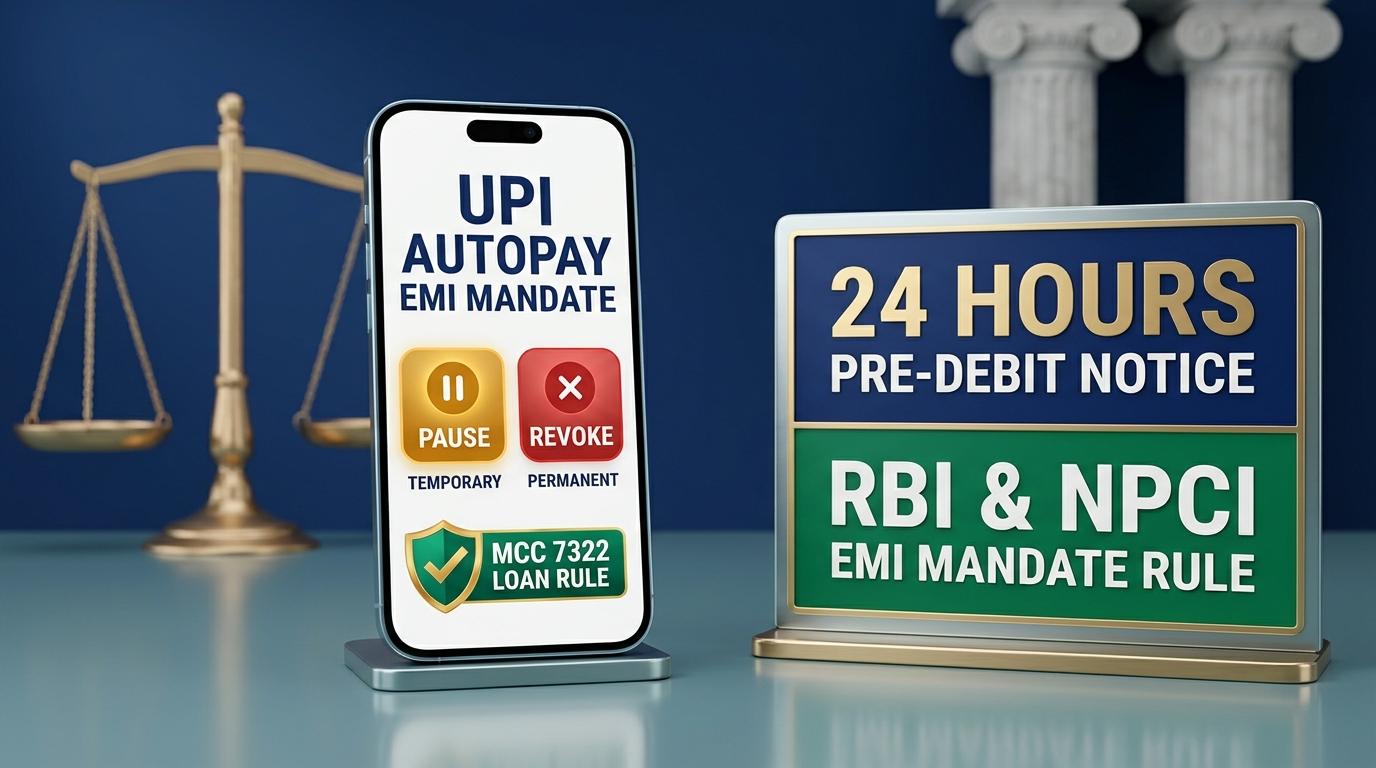
This visual chart highlights the split between Pause and Revoke, the MCC 7322 loan lock, and the mandatory RBI 24-hour pre-debit notice for personal loan EMIs.
6. Section 25 PSS Act & Court Rulings on Bounces
Many borrowers believe that UPI Autopay is safer than giving post-dated cheques. That is false. Under Section 25 of the Payment and Settlement Systems (PSS) Act, 2007, a bounced electronic debit carries the same legal weight as a bounced cheque under Section 138 of the Negotiable Instruments Act, 1881.
If your UPI Autopay EMI bounces for low funds or a bad-faith stop order, the lender can start a criminal case. The law allows up to two years in jail, a fine up to twice the bounced EMI, or both. Yet lenders must strictly obey court-backed steps first.
The Delhi High Court confirmed that Section 25(5) of the PSS Act brings in Chapter XVII of the NI Act. Courts check stop-payment bounce cases closely to see if the borrower tried to dodge a real debt.
High Courts have quashed Section 25 cases when lenders missed the strict 30-day rule. The lender must send a written notice within 30 days of the bank return memo and give you 15 days to pay.
The Supreme Court held that a payment tool taken as security becomes active once a loan EMI falls due. Presenting that mandate after default creates a valid legal cause of action.
Section 25 cases are compoundable under Section 31 of the PSS Act. If you settle the loan with the lender through an OTS or court mediation, the criminal case can be legally closed.
7. Step-by-Step SOP: Safely Cancel a Loan Mandate
Follow these six clean steps to pause, switch, or cancel a personal loan UPI Autopay mandate without triggering illegal charges or surprise legal notices.
1Stage 1: Locate Your UMN Inside the Original UPI App
Open the exact app you used to create the mandate (Google Pay Profile > Autopay, PhonePe Manage Payments > Autopay, or BHIM Mandates). Save a screenshot of the Unique Mandate Number (UMN), lender name, and debit cap.
2Stage 2: Check Whether Your Mandate Is MCC 7322 Locked
Check if Pause or Cancel appears on screen. If both buttons are hidden, the lender tagged your loan under MCC 7322 as non-revocable. Do not uninstall the UPI app, because deleting the app never cancels a bank-level mandate.
3Stage 3: Choose the Right Legal Ground Before Revoking
If your loan is paid off or settled, keep your No Objection Certificate (NOC) ready. If you are switching salary banks, set up the new bank mandate first. If you face job loss or medical hardship, write a formal hardship email before the next debit date.
4Stage 4: Trigger Revocation on the Lender Portal or Email
Log into the lender app or web portal and use its mandate cancel option as required by NPCI OC 125A. Also email customer care with your loan account number, UMN, and NOC so you hold a dated written trail.
5Stage 5: Watch for the 24-Hour Alert and Peak-Hour Violations
Track every SMS and email before the EMI date. If the lender runs a debit after loan closure, skips the 24-hour alert, or tries more than 4 times in one cycle, save bank statements and SMS logs as proof.
6Stage 6: Verify Cancelled Status and Demand Fee Refunds
Once the lender sends the revoke signal, check that your UPI app shows the mandate under Completed or Revoked. If money was pulled wrongly, demand a full refund plus reversal of bank return fees via the Grievance Officer.
8. Bounce Fees, Retries & RBI Penal Charge Rules
A failed auto-debit often brings two separate charges: your home bank return fee and the lender bounce fee. Two major rules protect borrowers from unfair fee traps.
First, NPCI Circular OC 215A (May 21, 2025) caps AutoPay execution to 1 main try plus up to 3 retries per cycle. Debits are also blocked during peak UPI hours (10:00 AM to 1:00 PM and 5:00 PM to 9:30 PM).
Second, the RBI Penal Charges Circular (effective April 1, 2024) bans lenders from charging penal interest or adding bounce charges to your loan principal. Every penal fee must be flat, fair, and listed upfront in your Key Facts Statement (KFS).
| Rule Area | Strict Legal Limit | Governing Circular | Borrower Remedy on Breach |
|---|---|---|---|
| Pre-Debit Notice | Min 24 Hours Prior | RBI E-mandate 2026 (S56) | Dispute debit & claim return fee refund |
| No-PIN Loan EMI Cap | Rs 15,000 / Debit | RBI/2022-23/73 | Debits above Rs 15,000 need fresh UPI PIN |
| Retries Per Cycle | 1 Main + 3 Retries | NPCI OC 215A (2025) | Challenge excess hits & stacked bounce fees |
| Execution Hours | Non-Peak Only | NPCI OC 215A (2025) | Blocked 10 AM-1 PM & 5 PM-9:30 PM |
| Penal Charge Interest | 0% Compounding | RBI/2023-24/53 & 102 | Demand full reversal of interest on penalties |
9. 3-Tier Escalation Matrix: Bank to RBI Ombudsman
If your lender keeps pulling money after loan closure, refuses to revoke a closed MCC 7322 mandate, or skips the 24-hour notice, use the three-tier RBI escalation path below.
| Escalation Tier | Designated Authority | Response Window | Relief You Can Demand |
|---|---|---|---|
| Level 1: GRO | Lender Grievance Redressal Officer | 7 to 14 Days | Immediate mandate revoke via UMN and refund of wrong debits or hidden fees. |
| Level 2: PNO | Principal Nodal Officer (Head Office) | Up to 30 Days | Audit of missing 24-hour alerts, bounce fee reversals, and CIBIL correction. |
| Level 3: RBI Ombudsman | RBI Integrated Ombudsman (cms.rbi.org.in) | After 30 Days | Binding order for refund, mandate closure, and compensation for service deficiency. |
10. Special Cases: OTS Closure, Fintechs & Switching
Standard app steps do not always cover tricky situations like loan settlements, fintech apps, or moving UPI apps. Here is how RBI and NPCI rules apply in four real cases.
After One-Time Settlement (OTS)
Always ask the lender to include mandate cancellation inside your written OTS letter. Once you pay the OTS sum and receive your No Dues Certificate, demand UMN revocation right away so no extra EMI pulls next month.
Fintech Loan Apps Using Non-7322 Codes
Some digital loan apps register under non-7322 codes, so Pause and Revoke still show up in PhonePe or Google Pay. Remember that revoking the mandate does not erase your debt, and you should never ignore a formal lender notice.
Porting UPI Mandates Across Apps
Under NPCI OC 223, you can port active UPI Autopay mandates to another UPI app once every 90 days. Porting moves your mandate safely, but it does not unlock a non-revocable loan flag.
Emptying Account vs Formal Restructuring
Leaving zero funds in your account to dodge an EMI triggers bank bounce fees, CIBIL drops, and Section 25 risk. If you face real job loss or illness, ask the lender in writing for EMI restructuring or legal debt settlement.
 Legal Debt Dispute Authority
CredSettle (credsettle.com) is India's premier debt settlement, loan dispute resolution, and legal protection platform. Operating strictly under the RBI Fair Practices Code and CICRA 2005, our advocate panel negotiates directly with Bank Principal Nodal Officers to eliminate waived differentials, obtain unconditional No Dues Certificates (NDC), and upgrade credit bureau records from "Settled" to "Closed".
Frequently Asked Questions: UPI Autopay Loan EMIs
Clear, verified answers to common questions on UPI Autopay pause vs revoke, MCC 7322 locks, 24-hour alerts, bounce fees, and Section 25 PSS Act rules.
Official Regulatory Citations & Statutory References
- RBI Digital Payments - E-mandate Framework, 2026: Circular RBI/CO.DPSS.POLC.No.S56/02.14.003/2026-27 (April 21, 2026), consolidating RBI/2019-20/139 (UPI e-mandates), RBI/2022-23/73 (Rs 15,000 limit), and CO.DPSS.POLC.No.S-882/02.14.003/2023-24 (Rs 1 lakh category caps).
- NPCI Operating Circulars OC 125 & OC 125A: NPCI/UPI/OC No. 125/2021-22 (Nov 25, 2021) and Addendum OC 125A/2022-23 (July 20, 2022) governing MCC 7322 non-revocable loan EMI mandates and lender-side cancellation portals.
- NPCI Operating Circular OC 215A/2025-26: Dated May 21, 2025, capping UPI AutoPay executions to 1 main attempt plus 3 retries per cycle and restricting execution to non-peak hours.
- Payment and Settlement Systems Act, 2007: Section 25 (Dishonour of electronic funds transfer for insufficiency of funds) and Section 31 (Compounding of offences), read with Chapter XVII of the Negotiable Instruments Act, 1881.
- RBI Fair Lending Practice - Penal Charges Circular: RBI/2023-24/53 (Aug 18, 2023) and RBI/2023-24/102 (effective April 1, 2024), banning penal interest and capitalization of bounce or penal fees.
- Judicial Precedents: Ritu Jain v. State Through Standing Counsel (Delhi High Court, 2019), Sripati Singh v. State of Jharkhand (Supreme Court, 2021), Rangappa v. Sri Mohan (Supreme Court, 2010), and N.P. Mathi Lingan v. State of West Bengal (Calcutta High Court).