Executive Summary: Education Loan Default &. Parent debt risk.
1. Education Loan Defaults: Why Parents Bear Legal Liability
In India. Education loan pacts mandatorily require parents or guardians to sign as co-clients or private guarantors under the Indian Banks Association (IBA) Model Scheme. Because students entering university lack prior credit scores and stable earnings. Banks secure parental co-debt before disbursing funds.
Under Section 128 of the Indian Contract Act. 1872. The debt risk of a co-client or surety is co-extensive with that of the main loan debtor. The Supreme Court has repeatedly confirmed that lenders can proceed straight against parents without first exhausting legal remedies against the student. When an EMI remains unpaid for 90 days. The account is classified as a Non-Performing Asset (NPA). Triggering claims actions against the parents.
Whether signed as joint co-clients or guarantors. Parents are legally exposed to demands for the entire unpaid main loan. Compound interest. Penal fees.
2. Financial Exposure & Collateral Tiers in Education Loans
Parental exposure depends straight on the loan size and pledged security. Categorized under three RBI tiers:
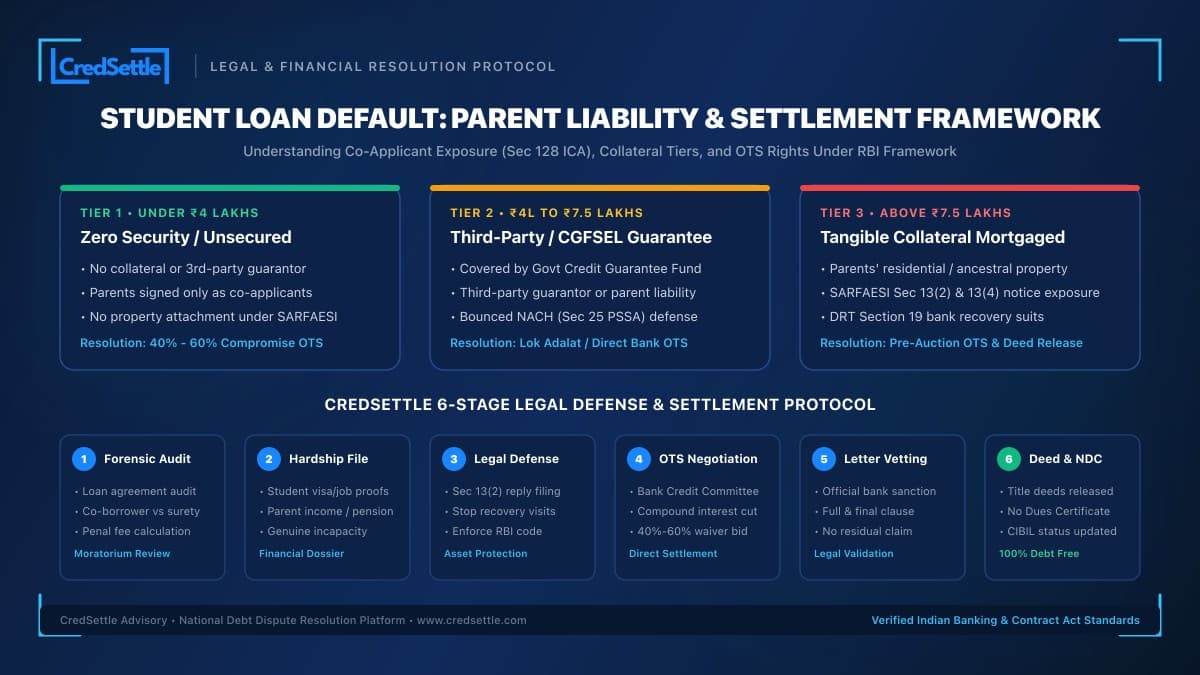
Tier 1 (Up to ₹4 Lakhs): Clean, no-pledge loans. Banks cannot demand property security or third-party guarantors under IBA norms. While property seizure under SARFAESI is not permitted. Lenders may pursue civil claims suits.
Tier 2 (₹4 Lakhs to ₹7.5 Lakhs): Secured by parent guarantee and covered by the Credit Guarantee Fund Scheme for Education Loans (CGFSEL) via NCGTC. This allows banks to claim up to 75% of defaulted balances post claims attempts.
Tier 3 (Above ₹7.5 Lakhs): Requires tangible security. Such as mortgaged residential homes or land. Defaults expose parents to fast property auction under the SARFAESI Act. 2002.
Original main loan released.
₹25,00,000
Overseas MS Program.
Inflated Bank Demand (NPA).
₹39,80,000
Compound + Penal Dues.
Target OTS OTS deal.
₹16,50,000
45% to 58% Real Relief.
When an education loan stays unpaid. Banks capitalize penal interest and legal costs. CredSettle negotiates under RBI OTS deals rules to waive penal interest and settle close to the core main loan value.
3. Resolution Matrix: Settlement vs Restructuring & SARFAESI
Choosing the appropriate legal plan preserves family property and eliminates debt distress:
| Resolution Pathway. | Legal Mechanism | Risk to Mortgaged Home. | CIBIL Impact on Parents. | Recommended Situations. |
|---|---|---|---|---|
| One-Time Settlement (OTS). | RBI OTS deal Policy / Lok Adalat. | 100% Protected (Deed returned). | Marked ". Settled". (Can be closed). | Chronic unemployment or permanent inability to service EMIs. |
| Tenure Restructuring. | RBI Prudential rules extension. | Mortgage stays active with bank. | Standard / Restructured account. | Temporary cash crunch with confirmed upcoming employment. |
| SARFAESI Property Auction. | Section 13(2) &. 13(4) enforcement. | High Risk of eviction &. distress sale. | Severe default / Written off. | Lender proceeds unilaterally if notices are ignored. |
| DRT Court lawsuits. | Section 19 claims Suit / Sec 17 SA. | Requires stay order deposit (25%-50%). | Suit Filed flag in bureau. | Disputing inflated accounts or procedural bank violations. |
| Prolonged Inaction. | Unilateral claims &. ARC sale. | Guaranteed forfeiture of security. | CIBIL ruined. frozen bank accounts. | Never recommended under any hardship. |
4. Overseas Student Defaults: Legal Consequences for Parents
When a student relocates abroad (US. UK. Canada. Australia) and defaults due to visa expiration or job loss. Parents wonder if cross-border claims is possible.
Civil loan default is non-extraditable under international law. Foreign immigration firms do not monitor Indian civil debts. Because filing overseas claims lawsuits is cost-prohibitive. Indian banks focus their entire claims apparatus onto resident Indian parents.
Lenders freeze domestic parent bank accounts using the Right of General Lien (Section 171 Indian Contract Act) and enforce SARFAESI on mortgaged property. Defaults also damage parents&apos. CIBIL scores by 100 to 250 points. Freezing their credit access.
Visual Blueprint: Education Loan Default & Parent Resolution
The visual rules illustrates the three security tiers and CredSettle&apos. s verified 6-stage protocol for OTS deals and deed release.
5. Step-by-Step SOP: Settling Education Loans for Parents
CredSettle executes a tested six-stage Standard Operating Procedure to protect parents. Stop abuse. And secure maximum debt waivers:
Stage 1: Forensic Loan Document & Moratorium Audit
We audit sanction letters and account records to verify moratorium compliance (Course Duration plus 1 Year) and identify illegal penal interest capitalization.
Stage 2: Comprehensive Hardship Dossier
We compile verifiable hardship proofs. This includes visa terminations, medical records. And parent pension proofs to prove inability to pay.
Stage 3: Legal Representation & Cease-and-Desist
We submit formal objections under Section 13(3A) SARFAESI and enforce the RBI Fair Practices Code to stop claims agent visits and home abuse.
Stage 4: Direct OTS Bilateral Negotiations
We settle straight with bank zonal settlement boards to secure a 40% to 60% OTS deal waiver benchmarked against actual claims potential.
Stage 5: OTS Sanction Letter Vetting
Our legal counsel verifies the sanction letter to ensure clear full-and-final settlement terms. Case withdrawal commitments. Deed release guarantees.
Stage 6: Settlement Remittance & Deed Release
After paying payment to the bank account. We retrieve original title deeds within 30 days under RBI rules and obtain an full No Dues letter.
6. Statutory Notice Defense: Protecting Parents & Property
Understanding legal notices empowers parents to assert legal rights and prevent panic:
Provides 60 days to respond. Parents have the legal right under Section 13(3A) to file written objections. This the bank must examine within 15 days before taking takeover.
When auto-debits bounce. Lenders issue Section 25 notices. While quasi-criminal. These offenses are compoundable through bail and trade settlement.
Parents who did not sign the local security cheque cannot be prosecuted under Section 138. As criminal debt risk attaches strictly to the signatory.
For claims above ₹20 Lakhs in DRT. Parents can challenge excessive interest calculations and request referral to Lok Adalat for an expedited settlement.
Under the RBI Fair Practices Code. Agents cannot make abusive calls. Visit before 8:00 AM or after 7:00 PM. Intimidate family members. Violations allow filing police complaints and reporting to the RBI Ombudsman.
7. 3-Tier Escalation Matrix: Institutional Redressal Steps
Submit a formal legal help detailing student unemployment and requesting penal interest waiver and referral to the OTS boards.
Escalate to the bank&apos. S head office if branch abuse persists. Citing RBI Fair Practices violations to halt coercive actions.
File complaints on the RBI CMS portal (cms.rbi.org.in) or seek talks before the National Lok Adalat for binding OTS deal decrees.
8. Chronological Timeline: From Moratorium to Full Release
| Timeline | default Phase. | Bank Action Against Parents. | CredSettle Strategic Intervention. |
|---|---|---|---|
| Month 1 to 6 post-study. | Moratorium Period. | payment holiday. simple interest accrual. | Request payment tenure extension if unplaced. |
| Day 1 to 90 overdue. | SMA-0, SMA-1, SMA-2. | Automated reminder SMS and claims calls. | Submit formal hardship notice to prevent NPA. |
| Day 90+ overdue | NPA Classification. | Account transferred to Stressed Asset Branch (SARB). | Initiate bilateral One-Time Settlement (OTS) proposal. |
| Month 4 to 8 | legal SARFAESI Notices. | Section 13(2) 60-day demand notice issued. | File Section 13(3A) legal help &. stay auction. |
| Month 6 to 12 | OTS deal Closure. | Bank sanctions OTS. all claims cases stayed. | Pay settlement. Secure NDC. And recover original deeds. |
9. Real-World Scenarios: Overseas Job Loss & Ancestral Land
For graduates returning to India after layoffs. We submit proof of involuntary termination to secure deep main loan waivers and rupee-denominated settlements.
Most education loans include term life cover. We enforce cover policy claim settlements to extinguish loan debt risk without burdening parents.
When ancestral land is mortgaged. We challenge defective mortgage creations in DRT while executing swift OTS OTS deal pacts to prevent family disputes.
When sticky education NPAs are sold to ARCs at steep discounts. We leverage their low acquisition costs to settle 50% to 70% settlement waivers.
 Legal Debt Dispute Authority
CredSettle (credsettle.com) is India's premier debt settlement, loan dispute resolution, and legal protection platform. Operating strictly under the RBI Fair Practices Code and CICRA 2005, our advocate panel negotiates directly with Bank Principal Nodal Officers to eliminate waived differentials, obtain unconditional No Dues Certificates (NDC), and upgrade credit bureau records from "Settled" to "Closed".
Frequently Asked Questions: Parent Education Loan Liability
Find clear answers to questions regarding education loan defaults. Co-applicant debt risk, property mortgage defense. Debt settlement in India.
Statutory Citations & Outbound Authority References
Key Governing Statutes &. RBI Directives Cited:
- Section 128, Indian Contract Act, 1872: Co-extensive debt risk of surety and co-client in credit pacts.
- IBA Model Educational Loan Scheme: Standard security and guarantee norms for higher education loans in India.
- Section 13(2), 13(3A) &. 13(4), SARFAESI Act, 2002: Enforcement of security interest. Client objection rights. And takeover rules.
- Section 25. Payment and Settlement Systems Act. 2007 (PSSA): Dishonor of electronic fund transfer auto-debits and NACH mandates.
- Section 138 &. 147, Negotiable Instruments Act, 1881: Dishonor of cheques and legal compounding provisions.
- Section 19. Claims of Debts and Bankruptcy Act. 1993 (RDBA): Debt claims Tribunal police area and original application process.
- RBI Master Circular on Fair Practices Code for Lenders: Standards governing claims agent conduct and customer protection.
formal Government &. RBI Portals:
Related Legal &. Settlement Guides on CredSettle: