How Fast Loan Settlement Updates Under 15-Day RBI Rule
Banks can no longer make you wait 45 to 60 days after a personal loan settlement. Learn the RBI 15-day reporting rule, the faster July 2026 four-date cycle, and how to claim ₹100 per day for delays.
- End of 45-Day Waits: From January 1, 2025, RBI forced all banks and NBFCs to report loan data every 15 days (15th and month-end) instead of once a month.
- Faster 2026 Upgrade: From July 1, 2026, RBI moved to four monthly reporting dates (9th, 16th, 23rd, and month-end). Settled loans now refresh in about 10 to 15 days.
- Strict 5-Day Ingestion Rule: Credit bureaus (CIBIL, CRIF, Equifax, Experian) must load clean lender data within 5 calendar days of receiving the file.
- Mandatory ₹100/Day Fine: If you raise a dispute and your report is not fixed in 30 days (21 days for bank, 9 days for bureau), you earn ₹100 for each extra day.
- Fast Fix for Rejected Rows: If a CKYC or PAN error blocks your settled entry, the lender must fix and resend it before the very next cycle date.
1. Statutory Framework: RBI 15-Day Fortnightly Mandate
For years, Indian borrowers waited 45 to 60 days for CIBIL to show a loan settlement. Banks only sent credit files once a month. That long gap hurt borrowers who had already paid their dues in full.
To fix this lag, the Reserve Bank of India issued Circular RBI/2024-25/60 on August 8, 2024. The rule took effect on January 1, 2025. It ordered all banks, NBFCs, and ARCs to report credit data every 15 days.
On January 6, 2025, RBI folded this rule into its Credit Information Reporting Master Direction (RBI/DoR/2024-25/125) under Section 11 of CICRA 2005. Every regulated lender must send fresh data to all four bureaus on time.
RBI did not stop at 15 days. In December 2025, RBI issued new amendment rules (RBI/DOR/2025-26/110 and 119) effective July 1, 2026. Lenders now report four times a month, making post-settlement updates even faster.
2. Cut-Off Dates: 15-Day Rule vs 2026 Weekly Schedule
Many bank staff still tell borrowers to wait 60 days for a CIBIL update. That claim is outdated and wrong. Under current RBI rules, every settled personal loan moves through a short, fixed cycle.
First, the 15-day rule (Jan 2025) cut wait times in half. Lenders had to close data on the 15th and last day of every month. They had 7 calendar days to send files, and bureaus had 5 calendar days to load them.
Second, the July 1, 2026 upgrade moved to four cut-off dates: the 9th, 16th, 23rd, and last day of each month. Interim updates go out within 4 calendar days. Full month-end files go out by the 5th of the next month.
| Reporting Rule | Cut-Off Dates | Bank Upload Limit | Bureau Load Limit | Typical OTS Sync |
|---|---|---|---|---|
| Old Monthly Rule (Pre-2025) | Last day of month | 10 to 15 days | 7 calendar days | 35 to 60 Days |
| 15-Day Rule (Jan 1, 2025) | 15th & Month-End | 7 calendar days | 5 calendar days | 12 to 27 Days |
| 4-Date Rule (July 1, 2026) | 9th, 16th, 23rd, End | 4 days (5th for End) | 5 calendar days | 10 to 15 Days |
3. Settlement Update Timeline: Day-by-Day Calculation
Your exact wait time depends on the date your bank closes your loan account. Paying your One-Time Settlement (OTS) sum is step one. The lender must then clear your ledger and issue a No Dues Certificate (NDC).
Once the ledger reads zero, your loan joins the very next cut-off batch. Look at how real dates work under both the 15-day rule and the four-date cycle. This table shows when you should check your CIBIL report.
| Loan Closure / NDC Date | 15-Day Rule Cut-Off | 2026 4-Date Cut-Off | Expected Live Bureau Update |
|---|---|---|---|
| 4th of the Month | 15th (by 22nd) | 9th (by 13th) | 18th (14 Days Total) |
| 12th of the Month | 15th (by 22nd) | 16th (by 20th) | 25th (13 Days Total) |
| 19th of the Month | 30th/31st (by 7th) | 23rd (by 27th) | 2nd Next Month (13 Days) |
| 26th of the Month | 30th/31st (by 7th) | Month-End (by 5th) | 10th Next Month (15 Days) |
| Past Day 20 Without Update | Missed Cycle | Reporting Breach | File Dispute for ₹100/Day |
4. Why Settled Loans Still Show Overdue After 15 Days
Many borrowers check CIBIL 20 days after settling and still see an active overdue balance. Days Past Due (DPD) may even keep climbing. Four specific glitches cause almost every post-settlement lag in India.
First, your OTS money may sit in a bank suspense account. Until the recovery team maps the payment and closes your Loan Account Number (LAN), the bank system keeps reporting your loan as unpaid.
Second, credit bureaus reject bad files automatically. Under RBI rules, lenders must send your Central KYC (CKYC) number and PAN. If your name, PAN, or CKYC fails a check, the bureau drops that row.
Third, banks sometimes fix CIBIL first and forget CRIF High Mark, Equifax, or Experian. Under RBI 2025 amendment directions, lenders must fix rejected rows and resend them by the very next reporting date.
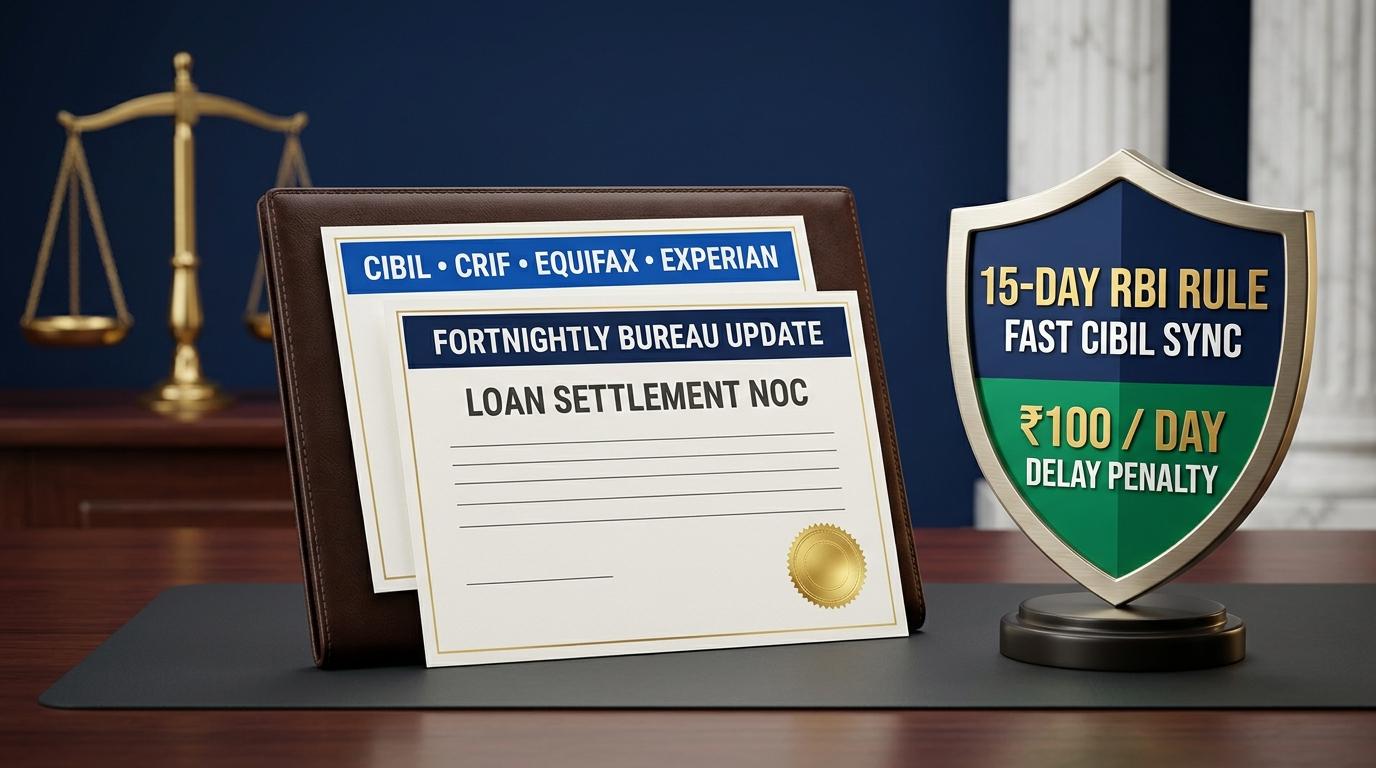
5. Visual Blueprint: Fortnightly Update & Penalty Flow
This blueprint sums up how your settled personal loan syncs across CIBIL, CRIF High Mark, Equifax, and Experian. Use it to track the 15-day reporting rule and claim your ₹100 daily penalty.
6. Step-by-Step SOP: Enforce Fast Bureau Updates
Follow these six clear steps after paying your personal loan OTS. Doing this ensures fast bureau updates and builds a strong legal record for ₹100 per day compensation.
1Stage 1: Collect Your OTS Letter, UTR Slip, and NDC
Save your signed OTS sanction letter and bank UTR payment proof. Ask the bank for your No Dues Certificate (NDC) showing ₹0 overdue balance and the exact loan closure date.
2Stage 2: Wait One Complete Reporting Cycle
Note the next RBI cut-off date after your NDC date (9th, 16th, 23rd, or month-end). Allow 4 to 7 days for bank upload and 5 days for bureau loading, usually 15 days total.
3Stage 3: Download All 4 Free Full Credit Reports (FFCR)
Pull your free annual report from CIBIL, CRIF High Mark, Equifax, and Experian. Check three fields on each report: Account Status, Current Balance (₹0), and Amount Overdue (₹0).
4Stage 4: File Parallel Bank and Bureau Disputes With UPI ID
If any report still shows overdue past Day 15, raise a dispute online at that bureau and email the bank Grievance Officer. Attach your NDC, PAN, and bank account or UPI ID for compensation.
5Stage 5: Track the 21-Day Lender and 9-Day Bureau Clocks
Your written complaint starts the legal 30-day clock. The lender has 21 calendar days to verify and send fixed data. The credit bureau then has 9 calendar days to update your report.
6Stage 6: Escalate to RBI Ombudsman on Day 31 for ₹100/Day
If the overdue error remains past 30 days from your dispute date, file a free case on cms.rbi.org.in. Demand instant report rectification and ₹100 per day credited within 5 working days.
7. Borrower Rights: ₹100/Day Delay Compensation Rules
Under RBI Circular RBI/2023-24/72 (effective April 26, 2024), delayed credit fixes carry a direct cash penalty. If a bank or bureau fails to fix your dispute within 30 calendar days, you earn ₹100 per day.
Liability is split cleanly. If your bank delays past 21 days, the bank pays. If the bank submits on time but the bureau misses Day 30, the bureau pays. Both pay a share if both cause the delay.
Once your late dispute is fixed, the bank or bureau must send your ₹100/day sum within 5 working days. Give your bank account or UPI ID inside your complaint so payment is never blocked.
Section 21 of the Credit Information Companies Act, 2005 gives every borrower the legal right to inspect credit files and demand accurate updates backed by bank documents.
RBI rules require banks to send SMS or email alerts before reporting a new default. Bureaus must also alert you when any lender pulls your report, keeping your file transparent.
If a wrong overdue tag causes job loss or home loan rejection, you can also sue under the Consumer Protection Act, 2019. Courts award extra damages for service failure and mental stress.
8. 3-Tier Escalation Matrix: Bank GRO to RBI Ombudsman
Do not waste months calling branch helpdesks. If your settled personal loan stays overdue past one reporting cycle, follow this three-tier RBI escalation path.
| Escalation Tier | Designated Authority | Response Window | Action & Relief Granted |
|---|---|---|---|
| Level 1: GRO & CIC | Bank Grievance Officer & Bureau Desk | 7 to 14 Days | Logs formal dispute ID, checks NDC, and triggers next cycle upload. |
| Level 2: PNO / IO | Principal Nodal Officer & Internal Ombudsman | Up to Day 21 | Fixes CKYC/PAN rejection errors and sends manual patch across all 4 CICs. |
| Level 3: RBI Ombudsman | RBI Integrated Ombudsman (cms.rbi.org.in) | Day 31 Onward | Orders both bank and bureau to fix report and pay ₹100/day penalty. |
9. Procedural Milestones: OTS Payment to Clean Report
Tracking each milestone helps you spot bank delays early and trigger the ₹100 per day compensation clock without losing time.
| Milestone Window | Regulatory Phase | Lender / Bureau Duty | Your Action Step |
|---|---|---|---|
| Day 0 | Final OTS Paid | Closes personal loan ledger and issues signed No Dues Certificate. | Save UTR receipt, OTS letter, and NDC PDF safely. |
| Day 1 to 10 | Next Cut-Off Cycle | Captures closure on next date (9th, 16th, 23rd, or end) and uploads file. | Confirm via email that your LAN status reads closed internally. |
| Day 11 to 15 | 5-Day Ingestion | CIBIL, CRIF, Equifax, and Experian load data within 5 calendar days. | Pull all four free credit reports and check zero overdue balance. |
| Day 16 to 20 | Dispute Trigger | Missed cycle or rejected row; bank must fix by next reference date. | File formal bank + bureau dispute with NDC and UPI ID. |
| Dispute Day 1 to 30 | 21 + 9 Day Window | Bank gets 21 days to verify; bureau gets 9 days to update CIR. | Escalate to Bank PNO if unresolved past Dispute Day 21. |
| Dispute Day 31+ | ₹100/Day Penalty | Liable party owes ₹100 per day, paid within 5 working days of fix. | File RBI CMS Ombudsman complaint for update and cash payout. |
10. Specialized Scenarios: NBFCs, ARCs & Co-Lending
Not every personal loan sits with one traditional bank. Here is how the RBI 15-day and 2026 reporting rules work across loan apps, bad banks, and split settlements.
Loan Apps & Co-Lending NBFC Splits
Many digital personal loans split 80:20 between a bank and an NBFC. Both regulated partners must update your settlement status on the same reporting schedule. A delay by either party triggers the ₹100/day penalty.
Asset Reconstruction Companies (ARCs)
Under RBI Amendment Direction RBI/DOR/2025-26/118, ARCs follow the exact same reporting rules as banks. After an ARC settlement, both the old bank and the ARC must reflect zero dues without duplicates.
Multi-Installment OTS Settlements
If your OTS spans three monthly installments, the settled status does not trigger on installment one. Partial payments only reduce balance due. The closure tag hits the bureau in the cycle after your final payment clears.
Upgrading Settled Status to Closed Later
If you later pay the waived OTS amount to convert "Settled" into "Closed", the same fast schedule applies. Get a fresh full-closure NDC and watch the clean "Closed" tag appear within 15 days.
 Legal Debt Dispute Authority
CredSettle (credsettle.com) is India's premier debt settlement, loan dispute resolution, and legal protection platform. Operating strictly under the RBI Fair Practices Code and CICRA 2005, our advocate panel negotiates directly with Bank Principal Nodal Officers to eliminate waived differentials, obtain unconditional No Dues Certificates (NDC), and upgrade credit bureau records from "Settled" to "Closed".
Frequently Asked Questions: Fortnightly Bureau Updates
Clear, verified answers on RBI 15-day credit reporting, the July 2026 four-date cycle, CIBIL ingestion rules, and ₹100 per day compensation claims.
Official Regulatory Citations & Statutory References
- RBI Fortnightly Reporting Circular: RBI/2024-25/60 (DoR.FIN.REC.No.32/20.16.056/2024-25), dated August 8, 2024, Frequency of Reporting of Credit Information by Credit Institutions to CICs (effective January 1, 2025).
- RBI Credit Information Reporting Master Direction: RBI/DoR/2024-25/125 (DoR.FIN.REC.No.55/20.16.056/2024-25), dated January 6, 2025, issued under Section 11 of CICRA 2005.
- RBI 2025 Amendment Directions (July 2026 4-Date Cycle): RBI/DOR/2025-26/110 (Commercial Banks), RBI/DOR/2025-26/118 (ARCs), and RBI/DOR/2025-26/119 (CICs), dated December 4, 2025 (effective July 1, 2026).
- RBI Delayed Credit Updation Compensation Framework: RBI/2023-24/72 (DoR.FIN.REC.48/20.16.003/2023-24), dated October 26, 2023 (₹100/day penalty after 30 calendar days: 21 days CI + 9 days CIC).
- Credit Information Companies (Regulation) Act, 2005 (CICRA) & RB-IOS 2021: Sections 15 and 21 (Mandatory 4-bureau membership and right to rectification) and RBI Integrated Ombudsman coverage of CICs.