How to Settle Base & Top-Up Personal Loans Together
Defaulting on a top-up personal loan often triggers NPA status on your main loan too. Learn the RBI borrower-wise rules, stop payment misallocation under Section 59, and close both accounts with two clean NOCs.
- Two Separate Loan Accounts: Most banks book a top-up loan under a new Loan Account Number (LAN) with its own EMI, auto-debit mandate, and CIBIL line.
- One Default Flags Both Loans: Under RBI IRACP Section 4.2.7, NPA status applies borrower-wise. If one LAN crosses 90 days overdue, both LANs turn NPA.
- Combined OTS Prevents Traps: Always settle both LANs under one written One-Time Settlement (OTS) letter that lists each LAN and its exact payoff amount.
- Section 59 Payment Shield: Always write the exact LAN on every transfer memo. Without clear direction, Section 60 lets the bank move your funds to old fees.
- Two NOCs and 15-Day Bureau Sync: Collect separate NOCs for both LANs and check all four credit bureaus after 15 days under RBI fortnightly reporting rules.
1. How Top-Up Personal Loans Create Dual LAN Traps
Many borrowers think a top-up personal loan simply adds extra money to their old loan. In real life, most banks and NBFCs create a brand new loan account behind the scenes.
You end up holding two active Loan Account Numbers (LANs) under one Unique Customer Identification Code (UCIC). LAN 1 is your original base personal loan. LAN 2 is your new top-up personal loan.
Both accounts pull separate EMIs from your bank account every month. When income drops due to a job loss or medical crisis, paying two EMIs becomes hard. Missing payments on either loan starts a chain reaction across both accounts.
Each LAN also builds its own bounce fees, late charges, and legal notices. If you settle only one account by mistake, the bank can still chase you for the second LAN for years.
2. RBI Borrower-Wise NPA & Cross-Default Legal Rules
The Reserve Bank of India (RBI) sets strict rules on how banks mark bad loans. Under Section 4.2.7 of the RBI IRACP Master Circular (RBI/2024-25/12), NPA tagging is strictly borrower-wise and not loan-wise.
This rule has a huge impact on top-up borrowers. Suppose you pay every EMI on your base personal loan (LAN 1) on time, but you stop paying your top-up loan (LAN 2) with the same bank. Once LAN 2 crosses 90 days overdue, the bank must tag both LAN 1 and LAN 2 as Non-Performing Assets (NPAs).
Even worse, you cannot pull LAN 1 back to Standard status by paying only LAN 1. RBI rules require you to clear all unpaid arrears across every loan with that lender before either account upgrades back to Standard.
Three other RBI circulars also shape dual account settlements:
- RBI Compromise Settlement Framework (RBI/2023-24/40, June 8, 2023): Banks and NBFCs must follow a clear Board-approved OTS policy. A compromise settlement ends the debt after cash payment, but carries at least a 12-month cooling-off period for fresh loans from the same lender.
- RBI Key Facts Statement Circular (RBI/2024-25/18, April 15, 2024): Lenders must give you a separate Key Facts Statement (KFS) showing the true Annual Percentage Rate (APR) and fees before signing a top-up loan. Hidden fees missing from the KFS cannot be charged.
- RBI Penal Charges Circular (RBI/2023-24/53, August 18, 2023): Lenders cannot add penal interest onto your loan principal or charge interest on penalties. Every late fee must stay as a flat, transparent penal charge.
3. Parallel Dual LAN vs Consolidated Top-Up Structure
Before you talk to recovery officers, check how your bank booked your top-up loan. Indian lenders use two models. Your KFS and credit bureau report will quickly show which one you hold.
| Feature | Parallel Dual LAN Top-Up | Consolidated Single LAN Top-Up |
|---|---|---|
| Loan Account Numbers | Two active LANs (LAN 1 Base + LAN 2 Top-Up) | Old LAN is foreclosed; one merged LAN stays active |
| Monthly EMI & NACH | Two separate EMI debits and two bounce charges | One single EMI debit and one mandate |
| CIBIL / Bureau Lines | Two active personal loan entries on your report | Old line shows Closed; one new line shows Active |
| Settlement Letter Rule | Must cite BOTH LANs and exact split | Standard single-LAN OTS letter applies |
| NOC Requirement | Two separate NOCs required after payoff | One NOC for the merged account (plus old closure proof) |
If your bank closed LAN 1 using your top-up money, check your CIBIL report right away. Sometimes banks forget to mark the old LAN as Closed, leaving a ghost account that hurts your credit score.
4. Dual Account Financial Audit & OTS Math Breakdown
When two loans default at the same time, bank software inflates both balances with late fees, double NACH bounce fees, legal fees, and unapplied interest. Always strip out these add-ons to find the real principal balance first.
The example below shows how a borrower with a ₹5,00,000 base loan and a ₹3,00,000 top-up loan can audit total dues after 180 days of default. Note that actual OTS waivers depend on your hardship proof and the lender's Board-approved policy.
| Ledger Component | Base Loan (LAN 1) | Top-Up Loan (LAN 2) | Combined Total |
|---|---|---|---|
| Unpaid Principal Outstanding | ₹3,20,000 | ₹2,80,000 | ₹6,00,000 |
| Normal Interest Accrued | ₹48,000 | ₹54,000 | ₹1,02,000 |
| Penal Charges & Double Bounce Fees | ₹34,000 | ₹38,000 | ₹72,000 |
| Inflated Bank Demand Total | ₹4,02,000 | ₹3,72,000 | ₹7,74,000 |
| Illustrative Unified OTS Target (45% to 55% of Demand) | ₹1,90,000 | ₹1,80,000 | ₹3,70,000 (Both Closed) |
Notice why negotiating both accounts as one bundle works better. When a lender sees a serious cash offer that clears your entire UCIC exposure at once, credit committees often approve deeper waivers on penal charges and post-NPA interest.
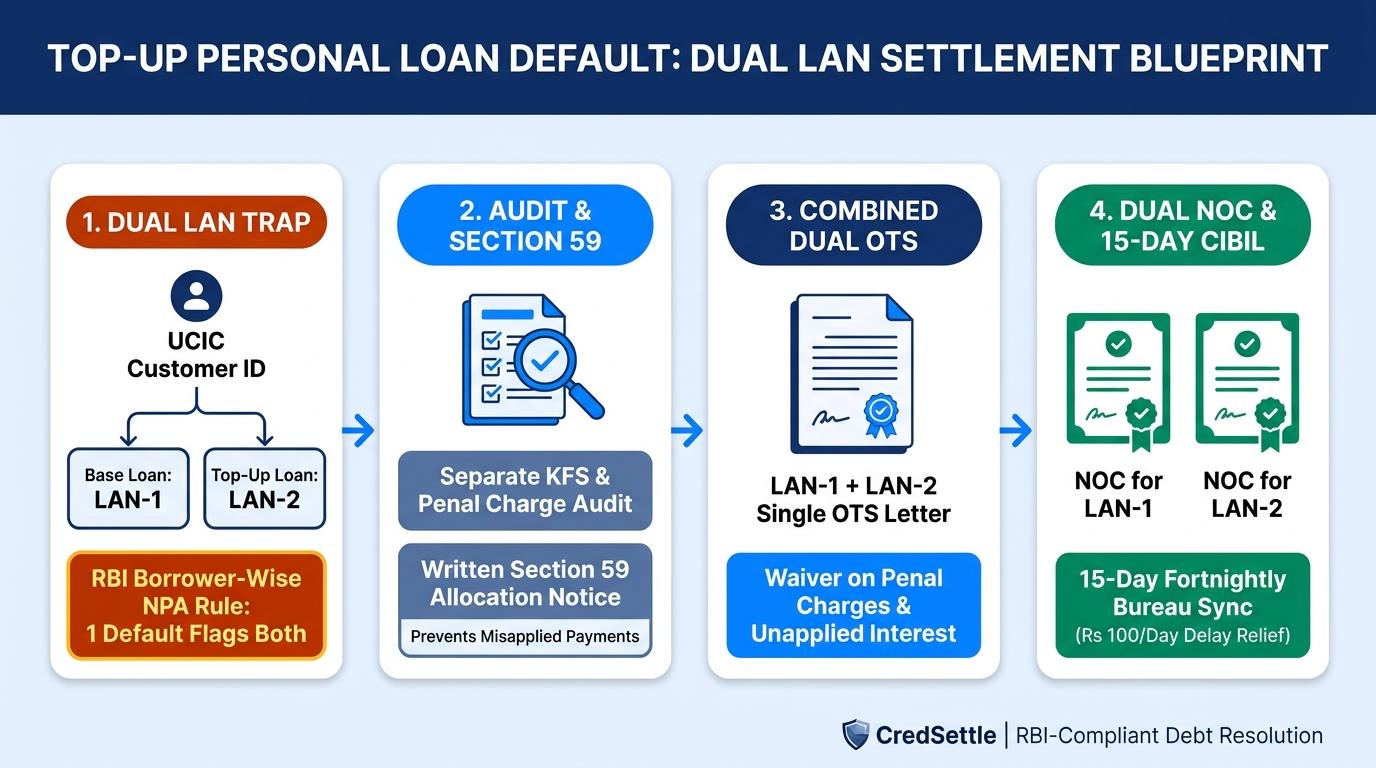
5. Visual Blueprint: Dual LAN Settlement & NOC Flow
This chart maps out the four steps to exit a dual personal loan default safely. Follow this flow to link both LANs, protect your money under Section 59, and close both CIBIL tradelines.
6. Step-by-Step SOP: Settling Both LANs Together
Follow these six steps to settle a base personal loan and its top-up loan without falling into a single-account closure trap.
1Stage 1: Pull Full Ledgers and KFS for Both LANs
Download your CIBIL report and ask the bank for the Key Facts Statement (KFS) and Statement of Account for both LANs. Confirm the exact unpaid principal and spot any illegal compound penal interest.
2Stage 2: Send One Combined Hardship Proposal
Email the bank's central recovery cell with proof of financial distress, such as a layoff letter or medical bills. Clearly list your UCIC, Base LAN, and Top-Up LAN, and ask for a single combined OTS.
3Stage 3: Verify Every Word of the Dual OTS Letter
Never pay based on a phone promise or WhatsApp chat. Demand an official settlement letter on bank letterhead sent from an official bank email ID. Confirm both LANs, exact Rupee figures, due dates, and full legal withdrawal terms.
4Stage 4: Pay With a Written Section 59 Direction
Make separate NEFT or RTGS transfers into each LAN if the OTS letter splits the amounts. Email the UTR receipts right away with a Section 59 note stating that the transfer is strictly for OTS full closure of each named LAN.
5Stage 5: Collect Two Separate NOCs and Close Mandates
Demand two separate No Dues Certificates, one for LAN 1 and one for LAN 2, within 15 to 30 days. Also ensure both e-NACH and UPI Autopay mandates are cancelled so no random debit triggers later.
6Stage 6: Audit All Four Credit Bureaus After 15 Days
Check CIBIL, Experian, Equifax, and CRIF High Mark after the next fortnightly cycle. Both LANs must show zero balance and Settled status. If one LAN stays Active, file a dispute immediately.
7. Borrower Protections: Sections 59 & 171 Explained
When you owe two loans to one lender, two rules of the Indian Contract Act, 1872 decide how your money and bank balances are treated. Knowing these laws stops banks from misusing your settlement funds.
Under Section 59, when you tell the bank in writing which LAN your payment covers, the bank must obey. If you stay silent, Section 60 lets the lender put that money into any other due or fee it picks.
In Industrial Credit v. Smithaben H. Patel (1999) and Gurpreet Singh v. Union of India (2006), the Supreme Court held that Sections 59 to 61 apply before a court decree. Once a court passes a decree, payments follow the court order first.
The Supreme Court confirmed a bank's general lien over securities and FDRs for general balances unless excluded by contract. For sole savings accounts in the same bank, lenders may also assert set-off, but not over trust or third-party funds.
Under RBI circular RBI/2023-24/72, if a bank or bureau fails to fix an open top-up LAN error within 30 calendar days of your complaint, they must pay you ₹100 for each day of delay.
8. 3-Tier Escalation Matrix: GRO to RBI Ombudsman
If your lender diverts your OTS payment to the wrong LAN, refuses a second NOC, or leaves your top-up loan overdue in CIBIL, use this official three-tier escalation path.
| Escalation Tier | Designated Authority | Turnaround Time | Scope of Relief & Action |
|---|---|---|---|
| Level 1: GRO | Bank or NBFC Grievance Redressal Officer | 7 to 10 Working Days | Logs your dual-LAN dispute, audits misapplied UTR receipts, and issues missing NOCs. |
| Level 2: PNO | Principal Nodal Officer (Head Office) | 14 to 21 Working Days | Reverses unlawful penal interest, aligns both LAN closures, and pushes 15-day bureau fixes. |
| Level 3: RBI Ombudsman | Reserve Bank Integrated Ombudsman | 30 Days Post-Complaint | Orders binding NOC release, CIBIL correction, and ₹100/day delay payout on cms.rbi.org.in. |
9. Procedural Timeline: Dual Default to Clean Bureau
Timing matters in dual account settlements. Banks rarely grant deep waivers in Month 1, yet waiting too long invites arbitration or Section 25 PASA bounce notices on both mandates.
| Timeline Stage | Account Status | Bank System Action | Smart Borrower Move |
|---|---|---|---|
| Day 1 to 89 | SMA-0 to SMA-2 | Double EMI bounces hit both LANs; reminder calls rise sharply. | Save hardship proof and keep salary safe from auto-set-off risk. |
| Day 90 | Dual NPA Tag | RBI borrower-wise rule flips BOTH LANs to NPA under your UCIC. | Stop paying piecemeal EMIs; request both KFS and full ledgers. |
| Day 120 to 180 | OTS Negotiation Window | Account shifts to central recovery or NPA settlement desk. | Pitch one unified OTS covering both LANs after stripping penal fees. |
| OTS Payoff Day | Settlement Execution | Receives OTS funds against signed sanction letter terms. | Send UTR proof with written Section 59 LAN allocation letter. |
| Payoff + 15 to 30 Days | Dual NOC & Bureau Sync | Issues two NOCs and reports both LANs in next 15-day bureau cycle. | Verify zero balance on all four credit bureaus; escalate any mismatch. |
10. Common Mistakes & Special Dual-Account Cases
Small paperwork slips ruin many dual loan settlements. Watch out for these four common traps before signing or transferring any money.
Mistake 1: Accepting a Single-LAN OTS Letter
Some agents promise that paying one OTS letter closes both loans automatically. Never believe verbal claims. If the second LAN is not written on the letter, that debt stays legally alive.
Case 2: One LAN Sold to an ARC
Sometimes a lender sells one bad loan to an Asset Reconstruction Company (ARC) while keeping the other in-house. Check assignment notices and settle with each legal owner separately to get both NOCs.
Case 3: Technical Write-Off Confusion
If your top-up loan shows Written-Off while you settle your base loan, do not ignore it. Under RBI circular RBI/2023-24/40, a technical write-off does not wipe out your duty to pay.
Case 4: Dual Loans Across Two Different Banks
If you took a top-up or second loan from a different bank or NBFC, RBI borrower-wise NPA rules do not auto-link them. Each lender tracks its own recovery, though your CIBIL score reflects both.
 Legal Debt Dispute Authority
CredSettle (credsettle.com) is India's premier debt settlement, loan dispute resolution, and legal protection platform. Operating strictly under the RBI Fair Practices Code and CICRA 2005, our advocate panel negotiates directly with Bank Principal Nodal Officers to eliminate waived differentials, obtain unconditional No Dues Certificates (NDC), and upgrade credit bureau records from "Settled" to "Closed".
Frequently Asked Questions: Dual Loan Settlement
Clear, plain-English answers on top-up personal loan defaults, RBI borrower-wise NPA rules, Section 59 payment letters, and dual NOC recovery.
Official Regulatory Citations & Statutory References
- RBI Master Circular on IRACP Norms: RBI/2024-25/12, DOR.STR.REC.8/21.04.048/2024-25 (Section 4.2.7: Borrower-wise Asset Classification across Multiple Facilities).
- RBI Framework for Compromise Settlements and Technical Write-offs: RBI/2023-24/40, DOR.STR.REC.20/21.04.048/2023-24 (Dated June 8, 2023).
- RBI Key Facts Statement (KFS) for Loans & Advances: RBI/2024-25/18, DOR.STR.REC.13/13.03.00/2024-25 (Dated April 15, 2024).
- RBI Fair Lending Practice on Penal Charges: RBI/2023-24/53, DoR.MCS.REC.28/01.01.001/2023-24 (Dated August 18, 2023).
- RBI Credit Bureau Reporting & Compensation Circulars: RBI/2024-25/60 (15-Day Fortnightly Reporting) and RBI/2023-24/72 (₹100/Day Rectification Delay Compensation).
- Indian Contract Act, 1872 & Supreme Court Precedents: Sections 59, 60, 61, and 171; Syndicate Bank v. Vijay Kumar (1992); Industrial Credit v. Smithaben H. Patel (1999); Gurpreet Singh v. Union of India (2006).