Audit & Lock CKYC Alerts From Unfamiliar Lending Apps
Got an SMS saying an unknown NBFC downloaded your CKYC record? Check your credit report fast, demand consent logs under RBI rules, lock Aadhaar biometrics, and stop fake personal loans before they hurt your CIBIL score.
- Explicit Consent Is Mandatory: Under RBI KYC rules and the DPDP Act 2023, no NBFC may pull your CKYC file without clear, logged consent.
- First Check Partner Apps: Many unknown NBFC alerts come from backend lenders inside UPI, Pay Later, wallet, or shopping EMI apps.
- No Direct CKYC Freeze Button: CERSAI blocks silent pulls using OTP consent gates, while UIDAI lets you lock Aadhaar biometrics and your Aadhaar number.
- Act Fast Within 72 Hours: Pull your CIBIL report, email the NBFC Nodal Officer for consent logs, and report fraud at 1930 or cybercrime.gov.in.
- Rs 100/Day Delay Penalty: If a fake loan appears on CIBIL and is not fixed within 30 days, RBI rules mandate Rs 100 per day compensation.
1. Why Did an Unknown NBFC Download Your CKYC Record?
CKYC stands for Central Know Your Customer. CERSAI runs this central record store for banks, NBFCs, insurers, and mutual funds across India. Once you finish KYC at one bank, you get a 14-digit CKYC Identifier (KIN).
Whenever any bank or NBFC fetches your CKYC file, CERSAI sends an SMS alert to your phone. Seeing a strange company name in that alert feels scary. Yet not every unknown alert means a scammer stole your identity.
Often, a consumer app hides its real lending partner in fine print. For example, a shopping app, Buy Now Pay Later wallet, or quick credit check may link to a backend NBFC you never heard of. Checking a "pre-approved" loan banner or EMI offer can also trigger a KYC pull.
At other times, the alert points to real danger. A scammer may have your leaked PAN and date of birth from a fake job site or rogue app. A shady loan agent may also reuse your old forms to apply for loans without asking you.
2. Legal Framework: RBI KYC, PMLA & DPDP Rules
Indian law places strict walls around your KYC data. Lenders cannot browse or store your CKYC profile just to market loans. Five core laws protect you when an unknown NBFC touches your record.
Circular RBI/DBR/2015-16/18 sets the core rule for banks and NBFCs. A lender can fetch your CKYC file only when you share your KIN with explicit consent. Pulling data with zero consent breaches RBI rules.
Rule 9A creates the Central KYC Records Registry under CERSAI. Rule 9(1F) bars lenders from using fetched KYC files for any goal outside identity checks. Section 12 of PMLA also demands strict secrecy.
Issued on May 8, 2025 (RBI/DOR/2025-26/136), these rules cover all NBFC loan apps. Apps must log clear user consent with an audit trail. Borrowers also hold the right to cancel consent and delete app data.
Section 6 of the DPDP Act demands clear consent, and Section 12 gives you data erasure rights. If someone steals your ID for a fake loan, IT Act Sections 66C and 66D and BNS Sections 318 and 319 apply.
3. Can You Lock CKYC? OTP Consent vs Aadhaar Lock
Many online posts tell users to click a "Lock CKYC" button on the CERSAI site. In reality, CERSAI does not offer a manual freeze switch for citizens on ckycindia.in. Only regulated entities can upload or update records.
So how do you stop silent downloads? CERSAI enforces an OTP-based consent gate for individual CKYC fetches. When a lender tries to pull your record, CKYCRR sends an OTP to your phone. Without that OTP, a fresh download should fail.
You should pair this with real locks that you control directly. Lock your Aadhaar biometrics and Aadhaar number via UIDAI, and cancel old data consents on your Account Aggregator app. The table below compares each defense tool.
| Protection Layer | Direct User Lock? | How It Stops Misuse | Where to Control It |
|---|---|---|---|
| CERSAI CKYCRR Record | No Manual Switch | Uses OTP consent gate and SMS alerts on every fetch. | ckycindia.in / Missed call 7799022129 |
| UIDAI Aadhaar Biometrics | Yes (Instant Lock) | Blocks fingerprint and iris e-KYC checks by fraudsters. | myaadhaar.uidai.gov.in / mAadhaar |
| UIDAI Aadhaar Number | Yes (Use VID) | Stops Aadhaar OTP and demographic e-KYC using your 12-digit ID. | mAadhaar App (16-digit Virtual ID) |
| Account Aggregator (AA) | Yes (Revoke Any Time) | Cuts off live bank statement sharing with loan apps. | OneMoney, Finvu, Anumati, Setu apps |
| Credit Bureau Alerts | Monitoring & Dispute | Flags new hard inquiries and fake personal loans fast. | CIBIL, Experian, Equifax, CRIF |
4. Spot Loan Fraud: CKYC vs CIBIL Hard Inquiries
A CKYC download SMS does not automatically mean someone took a loan in your name. Still, you must never ignore it. Fraudsters often test your KYC details first, then push a personal loan application through a fast digital app.
You cannot see a full backend CKYC download log on the public CERSAI site. Those server logs stay restricted to reporting entities and regulators. Your best forensic tool is your credit report across all four Indian credit bureaus: CIBIL, Experian, Equifax, and CRIF High Mark.
Under RBI rules, each credit bureau must give you one free full credit report every calendar year. Pull your reports and check two tabs right away: the "Enquiry Information" list and the "Account Information" list.
| Signal Type | Risk Level | Impact on CIBIL Score | Immediate Action Needed |
|---|---|---|---|
| CKYC SMS Only (No Bureau Pull) | Low to Medium | Zero direct score drop | Email NBFC Nodal Officer to ask why they pulled CKYC. |
| CKYC SMS + Hard Credit Inquiry | High Warning | Minor drop (5 to 15 points) | Demand inquiry removal and block pending loan processing. |
| CKYC SMS + Unknown Loan Account | Active Fraud | Severe drop if EMI defaults | File Cyber Crime report (1930), send legal notice, dispute bureaus. |
5. Visual Blueprint: CKYC Audit & Fraud Defense
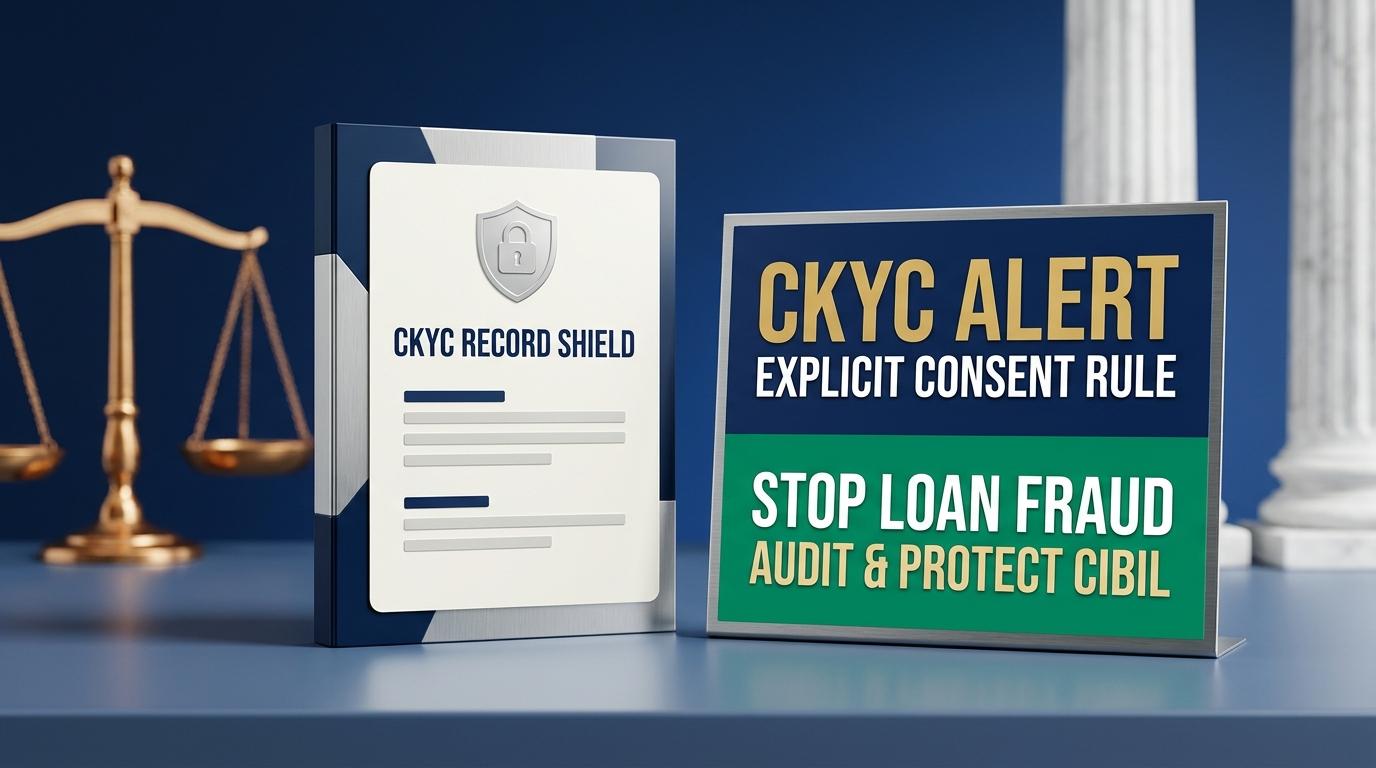
This visual overview captures the core defense pillars when an unfamiliar lender accesses your Central KYC file. Keep your SMS proof, check CIBIL early, enforce consent rules, and protect your credit profile.
6. Step-by-Step SOP: Stop Misuse Within 72 Hours
Fast action keeps your liability at zero if a fraudster is misusing your KYC profile. Follow these six steps within 72 hours of receiving an unknown CKYC download alert.
1Stage 1: Save the SMS Alert and Fetch Your CKYC Card
Take a clear screenshot of the CKYCRR SMS showing the NBFC name, date, and sender ID. Give a missed call to 7799022129 from your linked phone or visit ckycindia.in to check your 14-digit CKYC number and registered phone details.
2Stage 2: Audit All 4 Credit Reports and RBI DLA Directory
Download your credit reports from CIBIL, Experian, Equifax, and CRIF High Mark to spot new inquiries or fake loans. Also check the RBI public Digital Lending Apps (DLA) Directory on rbi.org.in to see if the NBFC is legally registered.
3Stage 3: Email the NBFC Nodal Officer for Consent Proof
Look up the NBFC Nodal Officer email in the Reporting Entities list on ckycindia.in. State clearly that you never applied for credit and never gave consent. Demand their timestamped consent log, IP address, app name, and written confirmation that your profile is deleted.
4Stage 4: Lock Aadhaar Biometrics and Revoke App Consents
Open the mAadhaar app or myaadhaar.uidai.gov.in and lock your Aadhaar biometrics right away. Next, exercise your DPDP Act 2023 data erasure rights on unused loan apps so they cannot reuse your PAN or phone profile.
5Stage 5: File a Cyber Crime Report If Fraud Appears
If you find an unknown loan, unknown disbursal, or forged application, file a complaint on cybercrime.gov.in or dial 1930 at once. Save the NCRP complaint number. Ask the police to invoke IT Act Sections 66C and 66D and BNS Sections 318 and 319.
6Stage 6: Dispute Credit Bureaus and Escalate to CERSAI & RBI
Log a fraud dispute on CIBIL and the other bureaus, attaching your cybercrime receipt and NBFC email. If the NBFC fails to answer within 3 to 5 working days, report the CKYC breach to helpdesk@ckycindia.in and escalate to cms.rbi.org.in.
7. Court Judgments & Zero-Liability Borrower Rights
Indian courts strongly protect citizens when lenders mishandle KYC data or approve loans without careful checks. Crucially, the legal burden of proving customer negligence rests on the lender, not on you.
A 9-judge Supreme Court bench held that informational privacy is a core right under Article 21. KYC data shared with a bank carries strict purpose limits and cannot be scraped or leaked freely.
The Supreme Court upheld Gauhati High Court orders granting zero liability to a fraud victim who reported fast. The court ruled that banks carry the burden of proving customer fault.
The Kerala High Court made clear that banks cannot blame customers for complex cyber fraud or system gaps without solid technical proof of customer fault.
The Kerala High Court ruled that merely sending SMS alerts does not clear a lender from its duty of care. Consumer Commissions also award CIBIL cleanup and damages under the Consumer Protection Act, 2019.
Keep one vital caution in mind. In State Bank of India v. Hare Ram Singh, the Delhi High Court noted that sharing OTPs or clicking unsafe links can complicate a zero-liability claim. Report alerts fast and never hand over any OTP to callers.
8. 4-Tier Escalation: NBFC, CERSAI, RBI & Cyber Cell
Per CERSAI grievance procedures and RBI norms, start with the NBFC that pulled your CKYC record. Move up to the next tier below if the lender stalls or denies responsibility.
| Escalation Tier | Authority & Contact | Expected Timeline | Action & Legal Relief |
|---|---|---|---|
| Tier 1: NBFC GRO / PNO | Nodal Officer via ckycindia.in directory | 3 to 15 Working Days | Shares consent audit trail, cancels fake loan, deletes profile. |
| Tier 2: CERSAI CKYCRR | helpdesk@ckycindia.in (022-61102592) | 7 to 14 Working Days | Flags unauthorized download by the Reporting Entity with SMS proof. |
| Tier 3: RBI Ombudsman | cms.rbi.org.in (or sachet.rbi.org.in) | 30 Days Post-NBFC | Orders NBFC to drop fake dues, fix CIBIL, and pay delay penalty. |
| Tier 4: Cyber Cell & Court | cybercrime.gov.in (1930) & Consumer Forum | Immediate FIR Filing | Traces fraud mule bank account and awards damages for harassment. |
9. Legal Timelines, Penalties & Rs 100/Day Rule
Knowing exact legal deadlines helps you press lenders hard. Under RBI Circular RBI/2023-24/72 (October 26, 2023), banks, NBFCs, and credit bureaus face automatic daily fines if they drag out credit disputes past 30 days. Learn more in our RBI Rs 100/day CIBIL compensation guide.
| Statutory Rule / Law | Strict Deadline | Penalty or Legal Impact |
|---|---|---|
| RBI Fraud Reporting Window | Within 3 Working Days | Protects zero customer liability for third-party electronic fraud. |
| PML Rule 9(1A) CKYC Upload | Within 10 Days | Reporting entities must upload verified KYC records after onboarding. |
| RBI CIC Dispute Rule (RBI/2023-24/72) | 30 Days (21 NBFC + 9 CIC) | Rs 100 per calendar day paid to you within 5 working days of fix. |
| RBI Integrated Ombudsman | After 30 Days No Reply | Binding RBI order against regulated NBFCs and credit bureaus. |
| IT Act Sec 66C & 66D / BNS 318 & 319 | Criminal Prosecution | Up to 3 years + Rs 1 lakh fine (IT Act); up to 5 to 7 years jail (BNS). |
10. Common Mistakes & Fintech Partner NBFC Cases
Many borrowers make panic mistakes right after seeing an unfamiliar NBFC alert. Avoid these four costly errors so you stay safe and keep your legal claim airtight.
Hidden BNPL & Pay Later Partner NBFCs
Activating Amazon Pay Later, Flipkart Pay Later, or instant checkout EMI often pulls CKYC under a partner NBFC name. Read our BNPL shadow NBFC closure guide to close unused credit lines cleanly.
Sharing "Cancellation" OTPs With Callers
Scammers sometimes call right after a CKYC alert, claiming they can cancel the loan if you read back an OTP. Never share any OTP. That OTP often approves the fake loan disbursal itself.
Multi-Lender Aggregators & DSA Forms
Entering your PAN on a loan comparison portal or handing copies to a broker can trigger CKYC pulls from five or more NBFCs at once. Always check who receives your data before ticking consent boxes.
Paying EMIs on a Fake Loan Out of Fear
Some victims pay one EMI just to stop recovery calls and save their CIBIL score. Do not pay even Rs 1 on a fraudulent loan. Paying can be twisted by lenders as proof that you accepted the loan.
 Legal Debt Dispute Authority
CredSettle (credsettle.com) is India's premier debt settlement, loan dispute resolution, and legal protection platform. Operating strictly under the RBI Fair Practices Code and CICRA 2005, our advocate panel negotiates directly with Bank Principal Nodal Officers to eliminate waived differentials, obtain unconditional No Dues Certificates (NDC), and upgrade credit bureau records from "Settled" to "Closed".
Frequently Asked Questions: Unknown NBFC CKYC Alerts
Plain-English answers to common questions on CERSAI CKYC SMS alerts, explicit consent rules, Aadhaar locks, fake loans on CIBIL, and RBI Ombudsman filings.
Official Regulatory Citations & Legal Authorities
- RBI Master Direction on KYC (2016, updated): Reference RBI/DBR/2015-16/18 mandating explicit customer consent before downloading CKYCR records using a KYC Identifier.
- Prevention of Money-Laundering (Maintenance of Records) Rules, 2005: Rule 9(1A) to 9(1F) and Rule 9A governing CERSAI CKYCRR operations, purpose limits, and client confidentiality.
- Reserve Bank of India (Digital Lending) Directions, 2025: Master Direction RBI/DOR/2025-26/136 (May 8, 2025) requiring explicit data consent audit trails and the public DLA Directory.
- RBI CIC Compensation Circular (2023): RBI/2023-24/72 (DoR.FIN.REC.48/20.16.003/2023-24, Oct 26, 2023) establishing the 30-day credit dispute deadline and Rs 100/day delay compensation.
- Digital Personal Data Protection Act, 2023 & Criminal Statutes: DPDP Act Sections 6, 8, and 12; IT Act, 2000 Sections 66C and 66D; Bharatiya Nyaya Sanhita, 2023 Sections 318 and 319.
- Judicial Precedents: Justice K.S. Puttaswamy v. Union of India (2017) 10 SCC 1; State Bank of India v. Pallabh Bhowmick (SC, 2025); Tony Enterprises v. RBI (Kerala HC, 2019); State Bank of India v. P.V. George (Kerala HC).