Fix CIBIL Drop From Unauthorized Aggregator Loan Pulls
Did a loan app, broker, or unknown NBFC flood your CIBIL report with hard pulls? Learn how to remove fake personal loan inquiries in 30 days and claim ₹100 per day for RBI delays.
- You Can Delete Illegal Pulls: Hard checks run without your consent, by rogue DSAs, or via PAN misuse can be wiped from your report.
- Use a Dual-Track Dispute: CIBIL cannot erase an entry alone under CICRA 2005. Raise a bureau ticket and demand proof of consent from the lender.
- Strict 30-Day RBI Clock: Lenders get 21 days to verify disputes and bureaus get 9 days to update your file. Delays past day 30 earn ₹100 per day.
- Mandatory SMS Alerts: Credit bureaus must alert you by SMS or email whenever a bank or NBFC pulls your report under RBI rules.
- Free Ombudsman Remedy: Both banks and all four credit bureaus come under the RBI Ombudsman. File free cases online at cms.rbi.org.in.
1. Hard vs Soft CIBIL Inquiries: Score Drop Explained
Many borrowers face a sudden CIBIL score drop right after checking personal loan rates online. You fill out one short form on a loan portal or talk to a phone agent. Hours later, you get six to ten SMS alerts from banks and NBFCs you never picked.
Each formal loan check logs a hard inquiry on your credit file. A single hard pull may trim your score by only a few points. However, five to ten personal loan pulls in one week look like a sign of cash stress to bank risk systems.
Banks call this pattern credit-hungry behavior. As a result, good borrowers with clean EMI records get rejected or offered higher interest rates. Even worse, hard inquiries remain visible on your report for 24 to 36 months unless removed.
| Inquiry Feature | Soft Inquiry (Safe) | Genuine Hard Inquiry | Unauthorized Hard Pull |
|---|---|---|---|
| How It Happens | You check your own score or view pre-approved offers. | You apply directly for a personal loan or card. | DSA, loan app, or scammer pulls your PAN without consent. |
| Impact on Score | Zero impact on score. | Small short-term dip. | Sharp drop when clustered. |
| Who Can See It | Visible only to you. | Visible to all lenders. | Visible to all lenders for 2 to 3 years. |
| Can Be Removed? | Not needed (zero harm). | No, even if loan is rejected. | Yes, via RBI dispute rules. |
2. Legal Framework: CICRA 2005 & RBI Circulars
Credit bureaus and lenders in India do not operate in a legal gray zone. Strict Parliament laws and Reserve Bank of India rules control who can read your credit file and how errors must be fixed.
The core statute is the Credit Information Companies (Regulation) Act, 2005, known as CICRA. Under Section 17, only licensed member banks, NBFCs, and specified users can pull credit reports for valid lending needs.
Section 20 of CICRA and Regulation 10 of the CIC Regulations, 2006 enforce strict privacy rules. Lenders must guard your data from misuse and never pull reports without a lawful credit request. Under Section 23(2), a willful breach of privacy rules carries a fine up to ₹1 crore.
Section 21 gives every borrower two direct tools. First, you can ask any lender for a copy of the credit report they pulled. Second, Section 21(3) lets you demand correction of wrong data within 30 days.
To strengthen these rights, RBI issued Circular RBI/2023-24/73 on October 26, 2023. It directs bureaus to send instant SMS or email alerts whenever a lender accesses your report. Later, RBI merged all these rules into the Master Direction on Credit Information Reporting, 2025 (RBI/DoR/2024-25/125, dated January 6, 2025).
RBI also cut bureau update lag through Circular RBI/2024-25/60, effective January 1, 2025. Lenders must now report credit updates every 15 days instead of once a month. This helps clean up approved corrections much faster.
3. Loan Aggregator & DSA Consent Rules Under RBI Law
Most multiple inquiry blasts happen on loan comparison apps, fintech marketplaces, or through Direct Selling Agents (DSAs). Borrowers often click one "Check Eligibility" button, and ten NBFCs pull their CIBIL report behind the scenes.
The Reserve Bank of India (Digital Lending) Directions, 2025 (Circular RBI/2025-26/36, dated May 8, 2025) target this exact problem. Paragraph 6, effective November 1, 2025, sets strict rules for Lending Service Providers (LSPs) that display offers from multiple lenders.
Loan apps must show a clear, neutral view of matching loan offers before sending your file to lenders. Consent for bureau pulls must be specific and need-based. More importantly, the partner bank or NBFC bears full legal blame if its agent breaks RBI consent rules.
Section 6 of the Digital Personal Data Protection (DPDP) Act, 2023 backs this up. Valid consent must be free, specific, clear, and given by an active choice. Pre-ticked boxes or buried fine print allowing "all partner banks" to pull your CIBIL file do not meet this test.
You pick one named bank or NBFC after viewing terms. You give an active OTP or click for that specific lender. The lender keeps a dated audit log of your exact consent.
A broker shares your PAN across 10 lenders without naming them first. Or an app uses a pre-ticked box to trigger hard pulls across NBFCs you never chose.
4. RBI 30-Day Rule & ₹100 Daily Delay Compensation
Earlier, banks and bureaus dragged CIBIL disputes for months without penalty. To end this delay, RBI issued Circular RBI/2023-24/72 (DoR.FIN.REC.48/20.16.003/2023-24) on October 26, 2023. The rule took effect on April 26, 2024.
Under this rule, your dispute must be solved within 30 calendar days from the date you file it. The Credit Institution (bank or NBFC) gets 21 days to verify your claim and send the correction. The bureau gets 9 days to update your report.
If your verified dispute stays open past 30 days, you earn ₹100 for every extra calendar day. The party that caused the delay must credit this money to your bank account within 5 working days of closing the dispute. Always enter your bank details or UPI ID when filing your dispute.
| Time Since Dispute Filed | Delay Past Day 30 | RBI Regulatory Status | Statutory Payout Owed |
|---|---|---|---|
| Day 1 to Day 21 | 0 Days | Bank / NBFC Verification Window | ₹0 (Allowed Window) |
| Day 22 to Day 30 | 0 Days | Bureau Report Update Window | ₹0 (Allowed Window) |
| Day 45 (15 Days Late) | 15 Days Delay | RBI Breach: Daily Penalty Active | ₹1,500 |
| Day 60 (30 Days Late) | 30 Days Delay | RBI Ombudsman Escalation Stage | ₹3,000 |
| Day 90 (60 Days Late) | 60 Days Delay | Ombudsman + Consumer Damages | ₹6,000 + Extra Relief |
5. Visual Blueprint: Hard Inquiry Removal Workflow
This visual chart maps the full legal path to erase fake loan pulls. It shows how the 30-day RBI dispute clock, lender consent audit, and ₹100 daily penalty protect your credit score.
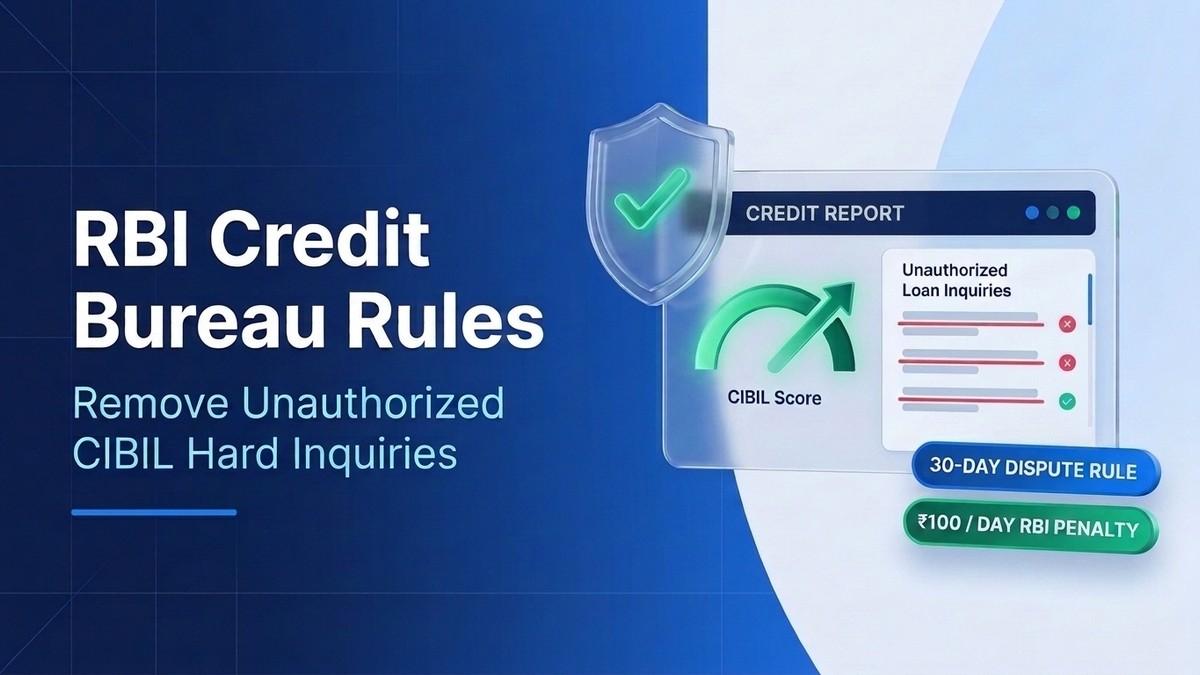
6. Step-by-Step Guide to Remove Hard CIBIL Inquiries
Follow these six clear steps to wipe fake personal loan pulls from your credit report and restore your score fast.
1Stage 1: Download Reports From All 4 Credit Bureaus
Get your free full report from TransUnion CIBIL, Experian, Equifax, and CRIF High Mark. Open the Enquiry tab and list every bank name, exact date, and loan amount shown.
2Stage 2: Separate Valid Pulls From Unauthorized Entries
Mark only inquiries you never approved, duplicate pulls by one bank, or unknown NBFCs. Save screenshots of SMS alerts, loan app screens, and emails as proof.
3Stage 3: Raise Online Bureau Disputes With Payout Info
Log into the myCIBIL Dispute Center and select each fake entry under Enquiry Information. Add your bank account or UPI ID so the 30-day RBI penalty clock starts right away.
4Stage 4: Email Each Lender Demanding Consent Proof
Write to each bank or NBFC Grievance Redressal Officer directly. Cite CICRA Section 21 and RBI Digital Lending Directions. Demand your signed form or OTP log, or ask them to suppress the pull.
5Stage 5: File a Cyber Crime Report for PAN Fraud
If strange loans or pulls show PAN identity theft, file an online complaint at cybercrime.gov.in. Attach the complaint number to your emails to the lender and CIBIL.
6Stage 6: Audit Updated Report & Escalate on Day 31
Check your updated free credit report once the dispute closes. If any bank rejects without valid proof or crosses 30 days, file a free case with the RBI Ombudsman on day 31.
7. Court Judgments & Borrower Legal Remedies
Indian High Courts and Consumer Commissions hold banks and credit bureaus liable when wrong credit records hurt a borrower. Note that standalone court orders solely on hard inquiries are rare. Instead, courts apply broader rules on privacy, negligence, and wrong CIBIL reporting.
Under the Consumer Protection Act, 2019, wrongful credit reporting and refusal to fix errors amount to a deficiency in service. You can claim damages for loan rejection losses and mental stress in addition to the RBI ₹100 daily penalty.
A 9-judge bench held that data privacy is a basic right under Article 21. Lenders cannot read your credit history without lawful grounds or clear consent.
In WP(C) No. 5339 of 2024, the bank cleared the loan status online. The Kerala High Court ordered TransUnion CIBIL to restore the borrower credit score right away.
Wrong CIBIL data led to loan rejections for the borrower. The Consumer Commission ordered both the NBFC and CIBIL to pay ₹5 lakh each for loss and mental stress.
The State Commission found the lender guilty of a service lapse for wrong CIBIL reporting. It awarded damages for mental stress and harm to the borrower good name.
8. 3-Tier Escalation: Lender GRO to RBI Ombudsman
Since September 1, 2022, RBI brought all four credit bureaus under the Integrated Ombudsman Scheme (Notification CEPD.PRD.No.S544). Under Clause 15(2), the Ombudsman can award up to ₹20 lakh for actual loss plus up to ₹1 lakh for mental agony.
| Escalation Tier | Authority to Contact | Turnaround Time | What Relief You Get |
|---|---|---|---|
| Level 1: GRO & CIC | Lender Grievance Officer + CIBIL Dispute Desk | Up to 21 + 9 Days | Audits consent log, marks entry under dispute, and issues suppression note. |
| Level 2: PNO | Principal Nodal Officer (Bank / NBFC Head Office) | 7 to 14 Days | Reviews rogue DSA or app pulls and orders fast bureau purge. |
| Level 3: RBI Ombudsman | RBI CMS Portal (cms.rbi.org.in) | After 30 Days | Orders deletion, enforces ₹100/day penalty, and awards Clause 15(2) damages. |
9. Dispute Milestones: Alert to Score Restoration
Tracking each deadline stops banks from stalling your ticket. Keep all email dates and dispute IDs saved in one folder.
| Milestone Window | Regulatory Phase | Lender / Bureau Duty | Your Action Step |
|---|---|---|---|
| Day 0 | SMS Alert & Filing | CIC sends mandatory SMS alert under RBI/2023-24/73. | Pull all 4 bureau reports, file disputes, and email each lender GRO. |
| Day 1 to 21 | Lender Consent Audit | Bank or NBFC must verify OTP consent or send deletion order. | Follow up in writing if the lender asks for extra time or gives vague replies. |
| Day 22 to 30 | Bureau Suppression | Bureau removes verified fake pulls and emails updated report. | Check that every disputed bank name is gone from the Enquiry tab. |
| Day 31 | ₹100/Day Starts | Statutory breach begins; daily ₹100 delay compensation accrues. | Escalate to Bank PNO and file RBI Ombudsman complaint online. |
| Within 5 Days Post-Fix | Payout & Sync | Credits delay payout and syncs records in next 15-day cycle. | Confirm bank credit and check restored score across all 4 bureaus. |
10. Common Mistakes & Special Dispute Scenarios
Borrowers often lose valid disputes because of small mistakes. Avoid these traps to get unauthorized inquiries removed on the first try.
Disputing Genuine Rejected Applications
If you applied for a loan yourself and got rejected, the bank holds your OTP consent. Disputing valid pulls wastes time and gets rejected under CICRA rules.
Duplicate Pulls From One Application
Sometimes an app glitch triggers 2 or 3 hard pulls from the same NBFC on the same day. You have the right to demand removal of all extra duplicate entries.
BNPL & Unknown Shadow NBFC Pulls
Checking a Buy Now Pay Later limit often triggers pulls from partner NBFCs you never recognize. Audit the app privacy terms and demand removal if consent was unclear.
Ignoring Experian, Equifax & CRIF
Cleaning only CIBIL leaves fake inquiries active on Experian, Equifax, and CRIF High Mark. Many top NBFCs reject loans based on CRIF or Experian inquiry counts.
 Legal Debt Dispute Authority
CredSettle (credsettle.com) is India's premier debt settlement, loan dispute resolution, and legal protection platform. Operating strictly under the RBI Fair Practices Code and CICRA 2005, our advocate panel negotiates directly with Bank Principal Nodal Officers to eliminate waived differentials, obtain unconditional No Dues Certificates (NDC), and upgrade credit bureau records from "Settled" to "Closed".
Frequently Asked Questions: CIBIL Hard Inquiries
Clear answers to the most common questions on deleting fake CIBIL loan pulls, RBI delay penalties, and loan aggregator rules.
Official Regulatory Citations & Legal References
- Credit Information Companies (Regulation) Act, 2005 (CICRA): Sections 17, 18, 20, 21, and 23(2), read with Regulation 10 of the CIC Regulations, 2006.
- RBI Circular RBI/2023-24/72 (DoR.FIN.REC.48/20.16.003/2023-24): Framework for Compensation to Customers for Delayed Updation or Rectification of Credit Information (₹100 per calendar day).
- RBI Circular RBI/2023-24/73 (DoR.FIN.REC.49/20.16.003/2023-24): Strengthening of Customer Service by CICs and CIs (mandatory SMS and email alerts on report access).
- RBI Master Direction RBI/DoR/2024-25/125 (January 6, 2025): Credit Information Reporting Directions, 2025, consolidating fortnightly updates (RBI/2024-25/60) and dispute rules.
- RBI (Digital Lending) Directions, 2025 (RBI/2025-26/36, May 8, 2025): Explicit borrower consent and Paragraph 6 multi-lender aggregation rules (effective November 1, 2025).
- Reserve Bank Integrated Ombudsman Scheme, 2021 & DPDP Act, 2023: Notification CEPD.PRD.No.S544 (CIC inclusion from September 1, 2022), Clause 15(2) compensation, and DPDP Act Section 6 consent rules.