Reclaim New Loan Funds Trapped in Dormant KYC Accounts
Did your personal loan land in a frozen, dormant, or KYC-blocked bank account? Learn how to unlock your funds for free under RBI rules, stop unfair EMI interest, and shield your CIBIL score.
- Why the Money Got Stuck: A partial KYC freeze or dormant status lets credits enter while blocking all withdrawals. Even a ₹1 penny-drop test passes before disbursal.
- Zero-Fee Account Activation: Under RBI Circular RBI/2023-24/105, banks cannot charge any fee to revive a dormant account. You can update KYC at any branch or via Video KYC (V-CIP).
- 2-Hour NEFT Return Rule: If a closed or fully frozen account rejects the loan transfer, the bank must return it within 2 hours or pay Repo Rate plus 2% penal interest automatically.
- Cooling-Off Exit & Interest Shield: You can exit a digital loan inside the cooling-off period with zero fine. Under RBI Circular RBI/2024-25/30, lenders cannot charge interest if funds never reached you.
- Cyber Freeze & NACH Defense: High Courts bar full account freezes for small cyber liens. Shift your EMI auto-debit to an active account right away to avoid NACH bounce fees.
1. Why Loans Credit Into Frozen & Dormant Accounts
Many borrowers feel shocked when a new personal loan hits a blocked bank account. They assume a frozen account will reject incoming money. In Indian banking, that is often not true.
Under the RBI Master Direction on KYC, banks use a phased freeze system when periodic KYC is overdue. First, the bank must send a three-month notice and a second three-month reminder. After six months, the bank puts a partial freeze on the account.
A partial freeze allows all incoming credits, such as NEFT, RTGS, or IMPS transfers. At the same time, it blocks every outgoing debit, UPI payment, and ATM cash withdrawal. Dormant accounts with no customer activity for 24 months behave the same way for incoming credits.
Before releasing a loan, banks and NBFCs run a ₹1 penny-drop check to verify your name. Since a ₹1 test is an incoming credit, it passes even on a debit-frozen account. The lender then wires the full loan, and your money gets trapped while EMI interest starts ticking.
2. RBI Rules: Zero-Fee Dormant & KYC Reactivation
The Reserve Bank of India issued strict rules to help customers unlock frozen and dormant accounts fast. On January 1, 2024, RBI issued Circular RBI/2023-24/105 (effective April 1, 2024). It sets clear duties for every bank in India.
First, banks cannot charge any fee to activate a dormant or inoperative account. They also cannot deduct minimum balance penalties for the months the account stayed inoperative. If a clerk demands a reactivation fee, show them this RBI rule.
Second, RBI updated these rules on June 12, 2025 via Circular RBI/2025-26/52. You no longer need to travel to your home branch to unfreeze your account. Any branch of your bank must accept your KYC update and unblock request.
Third, banks can verify your KYC remotely using Video KYC (V-CIP) or through Business Correspondents. If none of your KYC details changed, a simple self-declaration via mobile banking, email, or ATM is enough. Also, banks must keep low-risk accounts open for up to one year after re-KYC falls due, or until June 30, 2026, whichever is later.
3. Freeze Diagnostic Matrix: Remedies & Timelines
Every bank freeze has a specific reason code inside the core banking system. Your exact fix depends on why the account was locked. Use this table to match your freeze type with the fastest legal fix.
| Account Block Type | Can Loan Credit Land? | Primary Unblock Fix | Typical Timeline |
|---|---|---|---|
| Partial KYC Freeze (Debit Block) | Yes (Credits Allowed) | Submit re-KYC at any branch, app, or V-CIP. | 24 to 72 Hours |
| Dormant / Inoperative (24+ Months) | Yes (Most Credits Pass) | Free KYC update plus one customer transaction. | 1 to 3 Working Days |
| Total Freeze / Closed Account | No (NEFT Must Bounce) | Get UTR return proof; claim zero interest & re-disbursal. | 2 Hours (NEFT Rule) |
| Cyber Crime Police Freeze | Yes (Funds Get Trapped) | Request lien cap on disputed sum via IO or High Court. | 15 to 45 Days |
| Bank Set-Off / Tax Attachment | Yes (Risk of Sweep) | Dispute illegal set-off or seek lender cooling-off exit. | 7 to 30 Days |
4. Cooling-Off Exit, NEFT Return & Interest Rules
Three binding RBI protections stop lenders from profiting when a loan disbursal goes wrong. Know these rules before you pay a single rupee of unfair interest.
First, under the RBI Digital Lending Directions, 2025 (Circular RBI/2025-26/36 dated May 8, 2025), every digital personal loan carries a mandatory cooling-off period. The lender board sets this window, and it cannot be less than one day. Check your Key Facts Statement (KFS) for the exact number of days. During this window, you can cancel the loan by returning the principal plus daily APR with zero foreclosure fine.
Second, if your account had a total freeze or was closed, the NEFT transfer cannot credit. Under RBI NEFT guidelines, the receiving bank must return uncredited funds within two hours of batch settlement. If the bank delays, it must pay penal interest at the RBI Repo Rate plus 2% automatically without you filing a claim.
Third, RBI issued Circular RBI/2024-25/30 on April 29, 2024 on Fair Practices for Charging Interest. Lenders can charge interest only from the actual date funds are disbursed and made available to you. If a failed NEFT sits in a suspense account or returns to the lender, charging EMI or broken-period interest violates RBI rules.
5. Visual Blueprint: Frozen Account Loan Recovery
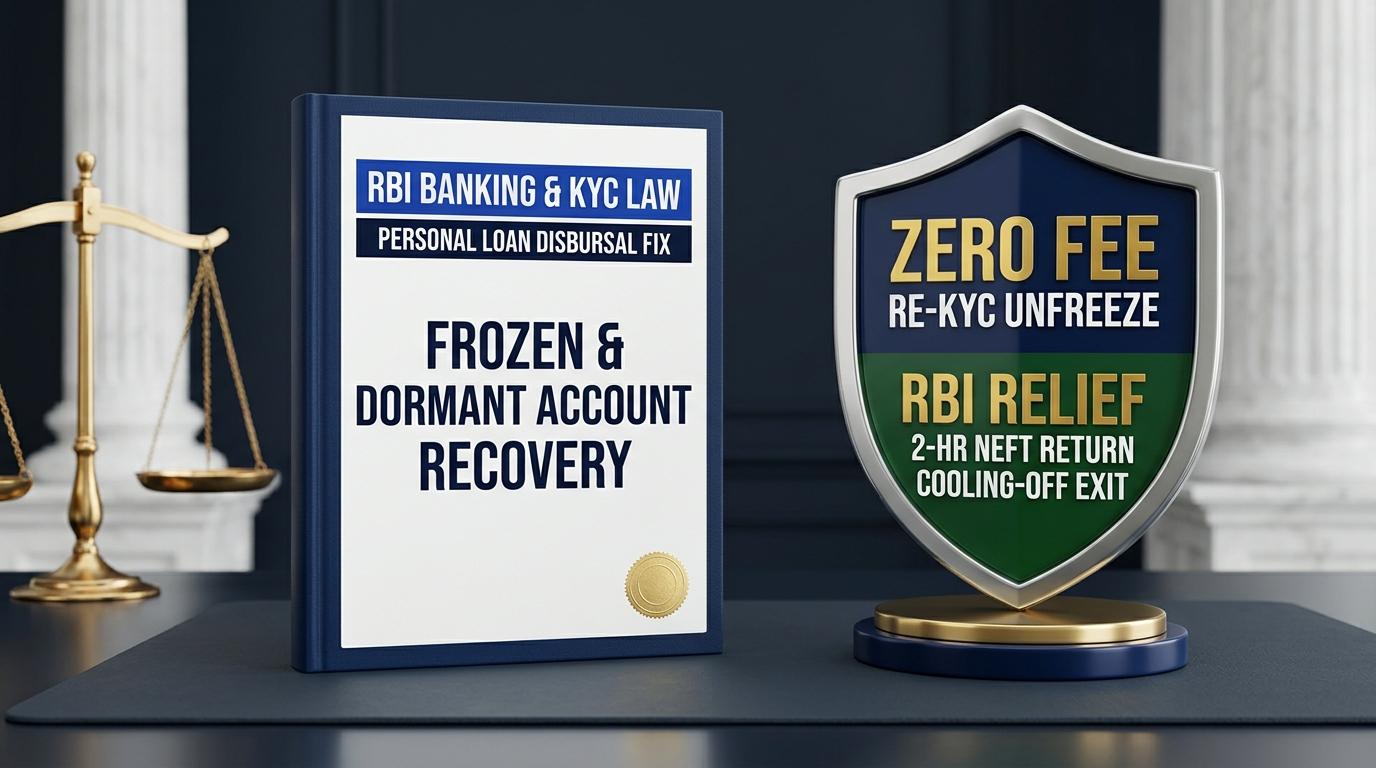
This visual guide highlights your core banking shields when a personal loan gets stuck in a dormant or frozen account. It summarizes zero-fee re-KYC activation, the 2-hour NEFT return rule, and your cooling-off exit right.
6. Step-by-Step SOP: Unfreeze & Protect Your Loan
Act within the first 24 to 48 hours of disbursement. Follow these six steps to free your loan money and prevent bounce fees or CIBIL drops.
1Stage 1: Get the Exact Freeze Code and UTR Proof
Download the loan disbursal UTR number from your lender app. Call or visit any branch of your receiving bank and ask for the written freeze reason code. Confirm if it is a KYC block, dormancy lock, cyber lien, or total freeze.
2Stage 2: Complete Zero-Fee Re-KYC at Any Branch or V-CIP
For a dormant or KYC freeze, submit your Aadhaar, PAN, and a reactivation form at the nearest branch or via Video KYC. Cite RBI Circular RBI/2025-26/52 if staff tell you to visit your home city. Take a stamped receipt with the date.
3Stage 3: Email the Lender Before Cooling-Off Ends
If the freeze will take weeks (like a cyber freeze), email your lender right away with your KFS and bank freeze letter. Ask to trigger the cooling-off exit or pause EMI billing if the NEFT returned to them.
4Stage 4: Shift NACH and UPI Autopay to an Active Bank
Do not let your first EMI hit a debit-frozen account. Submit a bank swap request to move your e-NACH mandate to a live savings account at least 10 days before the EMI date. This stops ₹500+ bounce fees and Section 25 PSS Act notices.
5Stage 5: Audit Failed NEFT Return and Reverse Wrong Interest
If the bank rejected the credit, verify the return UTR timestamp. Demand Repo Rate plus 2% penal interest for any return delayed past 2 hours. Also demand full interest waiver from the lender under RBI Circular RBI/2024-25/30.
6Stage 6: Escalate Unfair Delays to PNO and RBI Ombudsman
If the receiving bank drags re-KYC beyond 72 hours or the lender reports a fake late mark to CIBIL, file a formal complaint with the Principal Nodal Officer. After 30 days without relief, file on cms.rbi.org.in for free.
7. Legal Remedies: Cyber Liens, Set-Off & Courts
When a routine KYC fix does not apply, Indian courts and banking statutes still protect your trapped loan money. Here are four key legal shields you can invoke.
The Court held that freezing an entire bank account over a small cyber complaint violates Article 19(1)(g). It ordered the bank to mark a lien only on the disputed sum and free the rest of the balance.
The Kerala High Court ruled that police using Section 102 CrPC (now Section 106 BNSS, 2023) cannot lock innocent funds indefinitely. Fresh personal loan credits above a cyber lien must remain free to use.
Under Section 171 of the Indian Contract Act, 1872, a bank cannot silently seize funds meant for a specific purpose or ignore prior notice rules. Unfair sweeps without clear default notice can be challenged.
Freezing an account without the mandatory 6-month KYC notice or refusing free dormant activation is a deficiency in service. You can claim interest loss and mental agony damages in Consumer Court.
8. 3-Tier Escalation Matrix: GRO to RBI Ombudsman
If your receiving bank refuses to unfreeze your account or your lender refuses to reverse wrong EMI interest, escalate through this official three-tier channel.
| Escalation Tier | Designated Banking Authority | Turnaround Time | Scope of Intervention & Relief |
|---|---|---|---|
| Level 1: GRO / CFC | Bank Grievance Officer or NEFT CFC | 3 to 7 Working Days | Clears pending re-KYC, traces failed NEFT UTR, and logs your ticket ID. |
| Level 2: PNO | Principal Nodal Officer (Head Office) | 10 to 15 Working Days | Lifts wrong branch blocks, waives unfair interest, and updates NACH or CIBIL. |
| Level 3: RBI Ombudsman | Reserve Bank Integrated Ombudsman | 30 Days Post-PNO | Issues binding orders on cms.rbi.org.in for unfreeze, refund, and CIBIL repair. |
9. Recovery Milestones: Day 0 Disbursal to Unfreeze
Timing matters most in the first month. Missing a cooling-off window or a first EMI date can turn a simple KYC delay into a credit report disaster.
| Milestone Window | Case Stage | Bank / Lender Action | Borrower Action Protocol |
|---|---|---|---|
| Day 0 (Disbursal) | Trap Detected | Loan NEFT credits frozen account or bounces back in 2 hours. | Save UTR number, KFS copy, and SMS alerts showing credit or block. |
| Day 1 to 3 | Re-KYC / Cooling-Off | Processes free KYC update at any branch or V-CIP channel. | File re-KYC or send cooling-off cancellation email to the lender. |
| Day 4 to 7 | Mandate Protection | Activates KYC/dormant account or shares cyber complaint details. | Move e-NACH EMI mandate to an active bank account to block bounces. |
| Day 8 to 15 | Formal Escalation | Bank GRO/PNO reviews branch delay or failed NEFT penal interest. | Send written notice citing RBI Circulars 2024/105, 2025/52, and 2024/30. |
| Day 16 to 30 | Pre-EMI Safeguard | First EMI cycle approaches; bureau reporting prepares to sync. | Pay EMI from an alternate active account if loan stays open; check CIBIL. |
| Day 31 and Beyond | Ombudsman / Writ | Faces binding RBI Ombudsman award or High Court writ order. | File on cms.rbi.org.in or move High Court to cap a blanket cyber freeze. |
10. Special Cases: Cyber Freeze, Set-Off & NACH
Some account blocks go beyond simple KYC paperwork. Here is how to handle four tricky real-world traps without losing your money or credit score.
Cyber Crime Layer Freeze on New Loan
If a small P2P or UPI trade triggered a cyber freeze, your entire account may lock. Show your loan sanction letter and UTR to the bank and IO to prove the new funds are clean. Request a lien cap limited only to the disputed sum.
Old Overdue Loan Set-Off in Same Bank
Never disburse a new loan from Lender B into a bank account at Bank A where you already have an overdue card or loan. Bank A may sweep the cash using set-off. If it swept funds without notice, file a formal grievance at once.
NACH Bounce & Section 25 PSS Act Risk
A frozen account blocks auto-debit mandates even when the loan cash is sitting inside it. Multiple NACH bounces trigger fees and Section 25 Payment and Settlement Systems Act notices. Swap your EMI bank mandate early to stay safe.
Failed NEFT Trapped in Bank Suspense Pool
Sometimes a totally frozen account rejects the loan, yet the money sits in a bank suspense ledger for days. Pull the NEFT UTR trace through the bank Customer Facilitation Centre (CFC) and claim automatic Repo Rate plus 2% penal interest.
 Legal Debt Dispute Authority
CredSettle (credsettle.com) is India's premier debt settlement, loan dispute resolution, and legal protection platform. Operating strictly under the RBI Fair Practices Code and CICRA 2005, our advocate panel negotiates directly with Bank Principal Nodal Officers to eliminate waived differentials, obtain unconditional No Dues Certificates (NDC), and upgrade credit bureau records from "Settled" to "Closed".
Frequently Asked Questions: Loan in Frozen Account
Straightforward answers on unfreezing dormant KYC accounts, cancelling trapped personal loans, handling cyber liens, and stopping unfair EMI charges under RBI rules.
Official Regulatory Citations & Statutory Sources
- RBI Inoperative Accounts Circulars: RBI/2023-24/105 (DOR.SOG(LEG).REC/64/09.08.024/2023-24) and June 12, 2025 Amendment RBI/2025-26/52 (zero activation fees, non-home branch, and V-CIP reactivation).
- RBI Master Direction on KYC (2016, Updated 2025): Periodic Updation of KYC, mandatory 3+3 months prior notice before partial freeze, and simplified self-declaration norms.
- RBI Digital Lending Directions, 2025: RBI/2025-26/36 (DOR.STR.REC.19/21.07.001/2025-26), mandatory cooling-off exit window and upfront KFS disclosures.
- RBI Fair Practices Code on Charging Interest: RBI/2024-25/30 (DoS.CO.PPG.SEC.1/11.01.005/2024-25), charging interest strictly from actual disbursement date, plus RBI NEFT 2-Hour Return & Repo Rate + 2% Penal Interest Guidelines.
- High Court Cyber Freeze Precedents & Statutes: Mohammed Saifullah v. RBI (Madras HC, 2024), Dr. Sajir v. RBI (Kerala HC, 2023), Section 106 BNSS 2023 (Section 102 CrPC), Section 171 Indian Contract Act 1872, and Consumer Protection Act 2019.