Stop Repeated Same-Month NACH Presentations & Fees
Is your NBFC hitting your bank mandate 5 times in one month and draining your account with bounce fees? Learn NPCI retry limits, RBI penal charge rules, and the exact steps to claim a full refund.
- Strict NPCI Retry Cap: NPCI rules limit retries on a failed NACH debit to 2 tries (1 initial hit plus 2 retries). Hitting your bank 5 times in a month breaks these rules.
- 3-Day Cooling Period: Lenders must wait at least 3 days after a bounce before trying again. Only your clear consent allows an earlier hit. They must also send SMS or email alerts first.
- No Profit From Penalties: RBI Circular RBI/2023-24/53 bans using penalty fees for profit. NBFCs cannot add bounce fees to your loan principal or charge interest on them.
- Key Facts Statement Rule: RBI Circular RBI/2024-25/18 protects you from hidden fees. If a bounce fee is missing from your Key Facts Statement (KFS), the NBFC cannot charge it.
- Right to Cancel Mandate: You can stop a NACH mandate directly at your own bank without an NBFC NOC. Then you can pay manually or settle the loan without daily bounce hits.
1. Why NBFCs Hit NACH Mandates 5 Times a Month
Quick Answer: No, an NBFC should not hit your bank account 5 times in one month for the same missed EMI. NPCI rules limit retries on a returned NACH debit to two attempts after the first bounce, with a three-day gap in between.
Many personal loan NBFCs and digital lending apps run auto-retry scripts when an EMI fails. They hope your salary or a friend's transfer hits your savings account so they can sweep the cash first.
Even worse, each failed hit triggers two separate fees. Your own bank cuts an inward NACH return fee from your savings account. At the same time, the NBFC adds a bounce fee to your loan balance.
When a lender hits your bank 5 times in a month, costs explode fast. A single ₹4,000 EMI delay can pile up ₹5,000 to ₹8,000 in bounce fees. Indian banking rules protect you and help you claim a refund.
2. NPCI NACH Retry Limits & 3-Day Cooling Period
NACH stands for National Automated Clearing House. The National Payments Corporation of India (NPCI) runs this system for recurring EMI debits across India. Every bank and NBFC using NACH must follow NPCI circulars.
In 2023, NPCI issued strict circulars to stop lenders from spamming empty bank accounts with endless debit files. The key circulars are NPCI/2023-24/NACH/007 (August 18, 2023), addendum NPCI/NACH/OC No.010/2023-24 (October 31, 2023), and Master Circular NPCI/NACH/OC No.012/2023-24 (December 29, 2023).
NPCI limits a lender to 1 initial presentation plus at most 2 retries for a returned debit. Hitting your mandate 4, 5, or 8 times in one month breaks this cap directly.
Lenders must wait at least 3 days after a bounce date before retrying. They can retry sooner only if you clearly confirm that funds are now in your bank account.
NBFCs must send an SMS or email alert before a debit retry. NPCI directs lenders to confirm fund readiness with the borrower rather than blindly hitting the account.
If an NBFC's NACH return rate crosses 50%, NPCI charges extra return fees and can block it from registering new mandates. Closed or stopped accounts cannot be retried at all.
3. RBI Penal Charges & Key Facts Statement Rules
Alongside NPCI rules, two major RBI circulars give you strong legal power to challenge stacked NBFC bounce fees and demand a refund.
First, RBI issued Circular RBI/2023-24/53 (DoR.MCS.REC.28/01.01.001/2023-24) on August 18, 2023, on Fair Lending Practice: Penal Charges in Loan Accounts. A follow-up circular (RBI/2023-24/102) made these rules binding from April 1, 2024 for new loans and June 30, 2024 for older loans.
- Not a Profit Tool: RBI clearly states that penal charges exist only to promote credit discipline. NBFCs cannot use repeat bounce fees as a source of extra revenue.
- No Interest on Bounce Fees: Lenders cannot add unpaid bounce charges to your loan principal (no capitalization). They cannot charge compound interest on bounce fees.
- Reasonable & Fair Policy: Bounce charges must follow a Board-approved policy and match the actual default. Personal loan borrowers cannot be charged more than business borrowers for the same breach.
Second, RBI issued the Key Facts Statement (KFS) Circular RBI/2024-25/18 (DoR.STR.REC.13/13.03.00/2024-25) on April 15, 2024. Every NBFC must give you a plain one-page KFS before you sign your loan.
Under this circular, an NBFC cannot collect any bounce charge or penal fee that was left out of your KFS without your clear consent. If your KFS lists one bounce fee or omits retry charges, extra same-month fees are unlawful.
4. Double-Hit Cost Math: Bank vs NBFC Bounce Fees
Many borrowers notice only the fee inside their loan app. Yet your own savings bank also cuts a return fee on each failed hit. Most banks charge ₹250 to ₹590 (with GST) per bounce.
Look at how 5 hits in one month turn a ₹6,000 EMI into a costly fee trap. The table below uses a common ₹590 bank return fee and a ₹590 NBFC bounce fee per hit.
| Debit Attempt & Day | NPCI Rule Status | Bank Return Fee | NBFC Bounce Fee | Refund Claim Status |
|---|---|---|---|---|
| Hit 1 (EMI Due Date: Day 5) | Permitted (Initial Hit) | ₹590 | ₹590 | Dispute only if KFS silent |
| Hit 2 (Day 7: 2-Day Gap) | Breach (Under 3-Day Gap) | ₹590 | ₹590 | Challenge Cooling Breach |
| Hit 3 (Day 11: Retry 2) | Max Limit (Needs Notice) | ₹590 | ₹590 | Challenge If No Alert |
| Hit 4 (Day 16: Retry 3) | Violates NPCI 2-Retry Cap | ₹590 | ₹590 | Full Refund Demand |
| Hit 5 (Day 22: Retry 4) | Violates NPCI & RBI Rules | ₹590 | ₹590 | Full Refund + Compensation |
| Total Single-Month Impact | 10 Separate Fee Entries | ₹2,950 | ₹2,950 | ₹5,900 Total Drain |
Notice the result: on a single missed EMI, excess retries can drain nearly ₹5,900 before you even pay a rupee toward your real loan principal. You have a clear basis to demand reversal of every excess NBFC charge and reimbursement of matching bank return fees.
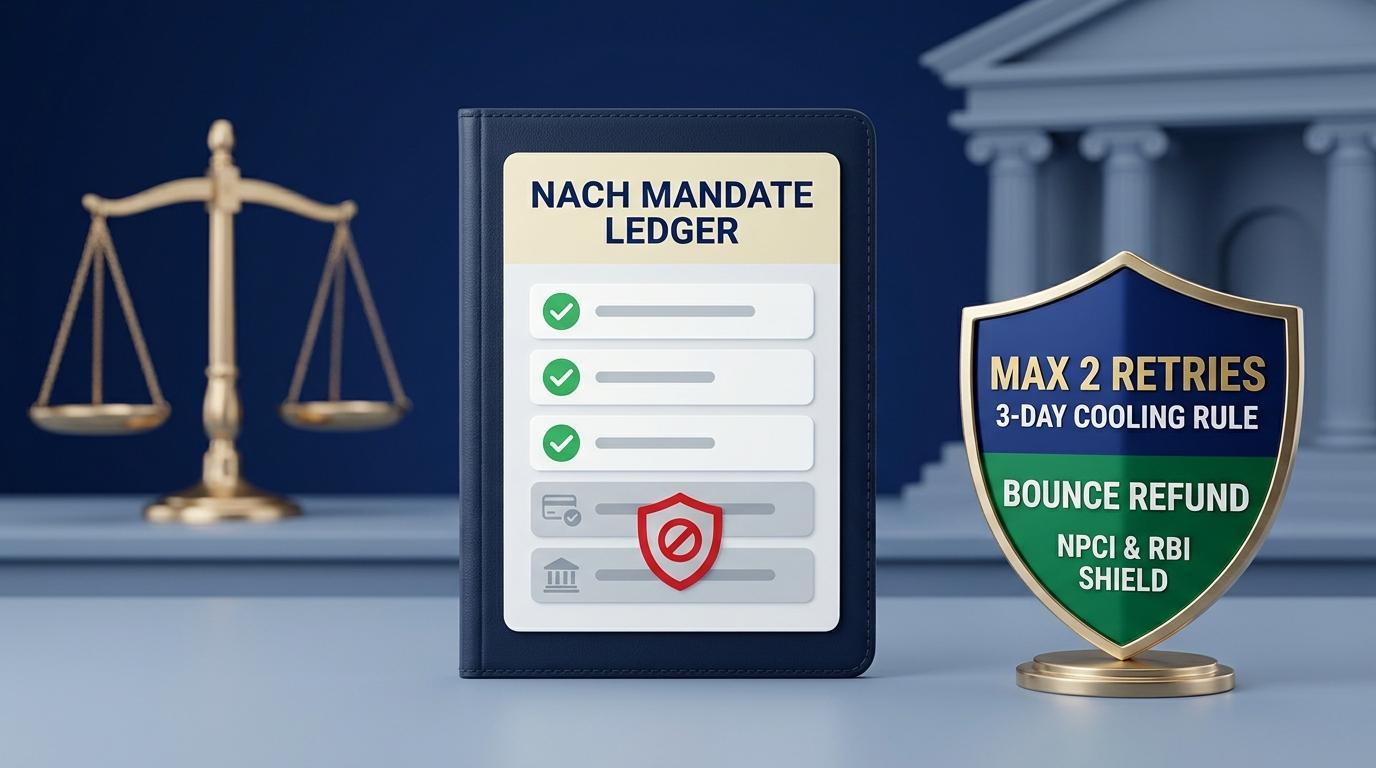
5. Visual Blueprint: NACH Retry Cap & Refund Flow
This visual chart sums up your core rights under NPCI and RBI rules. It shows the 2-retry limit, the 3-day cooling gap, and why excess hits trigger bounce fee refunds.
6. UPI AutoPay vs e-NACH Pre-Debit Notice Rules
Many borrowers mix up UPI AutoPay rules with e-NACH rules when drafting complaints. Knowing the exact legal difference makes your RBI Ombudsman claim much stronger and harder for an NBFC to reject.
| Protection Feature | e-NACH / Physical NACH | UPI AutoPay Mandate |
|---|---|---|
| Governing Rules | NPCI NACH Circulars (007, 010, 012) & RBI Fair Lending Rules. | RBI Digital Payments E-Mandate Framework & NPCI UPI Rules. |
| Pre-Debit Alert | Lender must send SMS or email notice before presentation and retry. | Strict mandatory 24-hour pre-debit alert with instant opt-out link. |
| Retry & Gap Rules | Max 2 retries after initial hit; at least 3-day cooling period. | You can pause or revoke in-app before debit to avoid repeat failures. |
| Bank Bounce Charges | Heavy inward return fee (₹250 to ₹590+) cut by your bank each time. | Usually zero bank return fee, though NBFCs may still add loan late fees. |
| How to Stop Debits | Cancel via destination bank NetBanking, app, or branch request. | Instant pause or revoke inside PhonePe, GPay, Paytm, or BHIM. |
If your personal loan uses UPI AutoPay and the NBFC failed to trigger a 24-hour pre-debit alert, cite the RBI E-Mandate Framework directly. For e-NACH personal loans, cite NPCI's 2-retry cap, 3-day cooling rule, and RBI's Penal Charges circular.
7. Section 25 PSS Act & Landmark Court Judgments
When you protest 5 bounces, NBFC agents often threaten arrest under Section 25 of the Payment and Settlement Systems (PSS) Act, 2007. You must know the real law so recovery calls cannot scare you.
Under Section 25, a bounced NACH or ECS debit for low funds is a criminal offence. It carries up to two years in jail or a fine up to twice the amount. Under Section 25(5), the notice rules of Chapter XVII of the Negotiable Instruments Act also apply.
Still, an NBFC cannot send you to jail over auto-retry bounces. First, the lender must send a written notice within 30 days of the bounce. Next, it must give you 15 days to pay. Only after those 15 days can it file a court case within 1 month.
In (2002) 1 SCC 367, a Supreme Court Constitution Bench banned adding penal charges to loan principal. Lenders cannot charge interest on penalties. The Court also held that RBI circulars bind all lenders over loan contracts.
In (2013) 1 SCC 177, the Supreme Court allowed lawful re-presentation of a valid payment instrument. Yet this rule does not let NBFCs break NPCI's 2-retry cap just to collect extra bounce fees.
Cases like Vipul Kant Upadhyay v. Standard Chartered Bank (2023:DHC:3757) and Sohail Anwar Lone v. Tata Capital (SC, 2025) confirm strict court checks. Lenders must follow every notice and jurisdiction rule in Section 25 cases.
Section 2(11) covers Deficiency in Service, and Section 2(47) covers Unfair Trade Practice. Under both sections, consumer courts order banks and NBFCs to refund wrong NACH fees and pay mental stress damages.
8. Step-by-Step SOP: Stop Repeats & Claim Refunds
Follow these six clear steps to stop repeat debits, build rock-solid proof, and force the NBFC to reverse unlawful bounce fees.
1Stage 1: Build Your Bounce Evidence Timeline
Download your bank statement, NBFC loan statement, and Key Facts Statement (KFS). Highlight every NACH debit date, UMRN mandate number, bank return charge, and NBFC bounce fee in one simple table.
2Stage 2: Audit Cooling Gaps & Missing Alerts
Count how many times the mandate ran in one month. Mark every retry beyond attempt 3, every retry made within 3 days of a bounce, and every debit sent without prior SMS or email notice.
3Stage 3: Email the NBFC Grievance Redressal Officer (GRO)
Send a clear written email to the NBFC GRO, not just chat support. Cite NPCI Circulars 007 and 012, RBI Circular RBI/2023-24/53, and RBI KFS rules. Demand reversal of all excess NBFC fees plus reimbursement of your bank return charges.
4Stage 4: File a Parallel Dispute With Your Own Bank
Write to your savings bank customer care and ask them to log an NPCI NACH dispute (DMS) against the lender's utility code for repeated same-month debits. Ask your bank for a goodwill or policy waiver on duplicate return fees.
5Stage 5: Escalate to Principal Nodal Officer (PNO)
If the GRO replies with a standard template or ignores your proof for 7 to 14 days, escalate to the NBFC Principal Nodal Officer. Attach your ticket number and warn that you will file an RBI Ombudsman complaint on Day 31.
6Stage 6: File on RBI CMS Portal (cms.rbi.org.in)
If the NBFC refuses relief or takes over 30 days, file a free complaint under the RBI Integrated Ombudsman Scheme, 2021. Upload your highlighted PDF timeline, KFS copy, and unanswered GRO emails for a binding refund order.
9. Can You Cancel a NACH Mandate Without NBFC NOC?
Yes. Under NPCI NACH Mandate Cancellation rules (including NPCI/2022-23/NACH/004 and Master Circular NPCI/2024-25/NACH/001), stopping or cancelling a NACH mandate is strictly the account holder's right.
Your own bank (the destination bank) cannot reject your cancellation request just because you lack an NOC from the NBFC. You can cancel the mandate through NetBanking, your mobile banking app, or a signed branch letter citing the UMRN number.
Once cancelled in NPCI's Mandate Management System (MMS), your bank must block future debits under that UMRN. If your bank still processes a debit or charges a bounce fee after valid cancellation, your bank is directly liable to refund you.
Cancelling NACH stops the automated debit loop and saves you from bank bounce fees. It does not cancel your loan debt. Always inform the NBFC in writing that you are shifting to manual UPI or NEFT payments, or seeking hardship restructuring or settlement.
10. 3-Tier Escalation Matrix: GRO to RBI Ombudsman
If customer care refuses to refund excess same-month bounce charges, follow this official three-tier escalation route with exact statutory deadlines.
| Escalation Level | Authority to Contact | Wait Window | Expected Relief & Action |
|---|---|---|---|
| Tier 1: Internal GRO | NBFC Grievance Redressal Officer & Bank Desk | 7 to 14 Days | Logs formal complaint ID, audits retry count, and reverses excess NBFC fees. |
| Tier 2: Head Office PNO | Principal Nodal Officer (NBFC & Destination Bank) | Up to Day 30 | Overrides branch denials, halts auto-retry scripts, and reimburses bank return charges. |
| Tier 3: RBI Ombudsman | Reserve Bank Integrated Ombudsman (cms.rbi.org.in) | Day 31 Onwards | Orders full fee refund, stops unfair penal practices, and can award compensation. |
| Parallel: Consumer Court | District Consumer Commission (e-Daakhil) | Within 2 Years | Awards refund, mental agony damages, and legal costs for unfair trade practices. |
11. Common Mistakes & Safe Personal Loan Remedies
Borrowers facing repeated NACH hits often make small mistakes that weaken their refund claim or trigger deeper debt trouble. Avoid these four common traps.
Leaving Small Cash in the Linked Bank Account
Keeping ₹2,000 in an account facing a ₹10,000 NACH debit causes repeated bounces, letting your bank drain that ₹2,000 through return fees. Keep funds separate until you pay directly or cancel the mandate.
Ignoring EMI Due Date Mismatch With Salary
If your salary arrives on the 7th and your NACH hits on the 2nd, every month starts with a bounce. Request an official EMI date shift in writing to stop permanent bounce cycles.
Relying Only on Phone Calls With Agents
Recovery agents often promise fee waivers verbally so you pay quickly, then never reverse the ledger. Never trust verbal claims. Always send written emails and save ticket numbers.
Waiting Too Long During Genuine Financial Hardship
If job loss or medical costs prevent you from paying EMIs, do not let bounce fees snowball. Request loan restructuring or a formal One-Time Settlement (OTS) to waive penal fees and close the loan cleanly.
 Legal Debt Dispute Authority
CredSettle (credsettle.com) is India's premier debt settlement, loan dispute resolution, and legal protection platform. Operating strictly under the RBI Fair Practices Code and CICRA 2005, our advocate panel negotiates directly with Bank Principal Nodal Officers to eliminate waived differentials, obtain unconditional No Dues Certificates (NDC), and upgrade credit bureau records from "Settled" to "Closed".
Frequently Asked Questions: NACH Bounce Refunds
Clear, verified answers to common borrower questions on repeated same-month NACH presentations, NPCI retry caps, RBI bounce fee refunds, and Section 25 notices.
Official Regulatory Citations & Statutory References
- NPCI NACH Debit Return Circulars: NPCI/2023-24/NACH/007 (August 18, 2023), NPCI/NACH/OC No.010/2023-24 (October 31, 2023), and Master Circular NPCI/NACH/OC No.012/2023-24 (December 29, 2023) on ACH Debit Return Penalties, 2-Retry Limits, and 3-Day Cooling Period.
- NPCI NACH Mandate Cancellation Guidelines: Circulars including NPCI/2022-23/NACH/004 and Master Circular NPCI/2024-25/NACH/001 affirming customer-initiated mandate cancellation via destination banks.
- Reserve Bank of India Penal Charges Circular: RBI/2023-24/53 (DoR.MCS.REC.28/01.01.001/2023-24, August 18, 2023) and Extension Circular RBI/2023-24/102 (December 29, 2023), Fair Lending Practice: Penal Charges in Loan Accounts.
- Reserve Bank of India Key Facts Statement Circular: RBI/2024-25/18 (DoR.STR.REC.13/13.03.00/2024-25, April 15, 2024), Mandatory Disclosure of All Fees and Penal Charges in KFS.
- Payment and Settlement Systems Act, 2007: Section 25 (Dishonour of Electronic Funds Transfer for Insufficiency of Funds), read with Chapter XVII of the Negotiable Instruments Act, 1881.
- Supreme Court & High Court Precedents: Central Bank of India v. Ravindra (2002) 1 SCC 367; M.S.R. Leathers v. S. Palaniappan (2013) 1 SCC 177; Vipul Kant Upadhyay v. Standard Chartered Bank (2023:DHC:3757); Sohail Anwar Lone v. Tata Capital Housing Finance (SC, 2025).