Prevent Policy Foreclosure on LIC Personal Loan Default
Learn what happens when you miss payments on a loan against your LIC policy. Protect your family life cover from forced bank surrender, stop CIBIL damage, and avoid surprise Section 80C and 194DA tax bills.
- Direct LIC Loan vs Bank Loan: Direct LIC loans rarely hit CIBIL, but bank loans against assigned LIC policies report every default to CIBIL.
- Foreclosure Trigger Point: On a direct LIC loan, unpaid interest compounds half-yearly. LIC sends a 30-day foreclosure notice once total debt passes your surrender value.
- Section 38 Bank Surrender Power: When you assign an LIC policy to a bank, the bank can surrender it on default. Still, the bank must refund any extra money above your valid loan dues.
- 2% TDS & 80C Clawback Trap: Early surrender before 2 years reverses past Section 80C tax breaks. Non-exempt payouts of ₹1 lakh or more face 2% TDS under Section 194DA.
- Unassigned Policy Shield: Under Section 60(1)(kb) of the CPC, banks cannot attach your unassigned LIC policy to recover a normal personal loan.
1. Direct LIC Loan vs Bank Loan Against Assigned Policy
Many Indian families borrow against their LIC plans during a cash crunch. It feels safer than a high-cost personal loan. Yet the rules change a lot based on who gave you the loan.
You can take a loan straight from LIC of India. Or you can borrow from a bank or NBFC using your plan as collateral. In both cases, you assign the plan under Section 38 of the Insurance Act, 1938. This step gives rights in the plan to the lender until you pay off the debt.
A direct LIC loan has no monthly EMI. You only pay interest every six months, often near 9.5% a year. LIC treats this as a cash advance from your own plan value. So LIC does not report missed interest to CIBIL.
A bank or NBFC loan against your LIC plan works very differently. Banks ask for monthly EMIs or overdraft interest. They send your account data every 15 days to all credit bureaus. If you miss dues for 90 days, the bank tags your loan as NPA and hits your CIBIL score.
| Key Feature | Direct Loan from LIC | Bank or NBFC Loan Against LIC |
|---|---|---|
| Loan Limit | Up to 80% to 90% of Surrender Value (85% for paid-up plans). | Usually 75% to 90% of Surrender Value as term loan or OD. |
| Repayment Mode | No EMI. Pay half-yearly interest; principal paid anytime. | Strict monthly EMI or monthly overdraft interest billing. |
| CIBIL Score Impact | Not reported to CIBIL or other credit bureaus. | Reported to CIBIL, CRIF, Equifax, and Experian. |
| Default Trigger | Foreclosure only when debt crosses policy Surrender Value. | NPA at 90 days overdue; bank can surrender policy right away. |
| Shortfall Liability | Debt ends once policy is foreclosed against surrender value. | Bank can still sue or recover unpaid shortfall from you. |
2. How LIC Policy Foreclosure Works After Loan Default
Many people think an LIC loan never brings trouble until the plan matures. That is true only while your total debt stays below your surrender value. Each time you skip a six-month interest date, LIC adds that unpaid interest to your loan balance.
In the next six months, LIC charges interest on both the loan and the past unpaid interest. Over time, this debt grows faster than your plan bonuses. The risk gets much worse if you stop paying yearly LIC premiums and the plan turns paid-up.
Once your loan plus unpaid interest meets or beats your surrender value, LIC starts foreclosure. LIC mails a written notice to your address. You get at least 30 days to pay the interest dues. If you fail to pay in time, LIC closes your plan for good.
For a bank loan against an assigned LIC plan, closure happens much faster. Under Section 38(8) of the Insurance Act, LIC must obey valid surrender orders from the bank. Once your bank loan crosses 90 days past due, the bank sends a recall notice. It can then file a surrender form straight with LIC to get its cash back.
3. Foreclosure Trigger & Interest Compounding Ledger
To see how quickly unpaid interest eats up a paid-up LIC policy, look at this simple example. Suppose your paid-up policy has a fixed Surrender Value of ₹5,00,000. You take an 85% policy loan of ₹4,25,000 at 9.5% annual interest, compounded half-yearly (4.75% every 6 months).
Also note LIC's minimum 6-month interest rule. Even if you close a direct LIC loan within one month, you must pay a full 6 months of interest. If you skip every interest due date instead, your loan breaches the ₹5,00,000 surrender cap in just 24 months.
| Time Elapsed | Unpaid Interest Added | Total Loan Debt | Policy Equity Left & Status |
|---|---|---|---|
| Month 0 (Disbursal) | ₹0 | ₹4,25,000 | ₹75,000 Safe Cushion |
| Month 6 (Cycle 1) | ₹20,188 | ₹4,45,188 | ₹54,812 Cushion Left |
| Month 12 (Cycle 2) | ₹41,334 (Cumulative) | ₹4,66,334 | ₹33,666 Warning Zone |
| Month 18 (Cycle 3) | ₹63,485 (Cumulative) | ₹4,88,485 | ₹11,515 High Risk |
| Month 24 (Cycle 4) | ₹86,688 (Cumulative) | ₹5,11,688 | Breaches SV: 30-Day Foreclosure |
4. Income Tax on Surrender: 10(10D), 80C & 194DA TDS
Taking a loan from your LIC plan is not taxable income. A loan is debt you must pay back. Still, if default causes a forced surrender, four tax rules can hit you with a big tax bill.
First, the Section 80C(5) Clawback Rule: If a standard LIC plan ends before you pay two full years of premiums, past Section 80C tax breaks are taken back. For ULIPs, this lock-in is five years. The tax office adds those old tax breaks back to your income in the year the plan ends.
Second, Section 10(10D) and Section 56(2)(xiii): Payouts stay tax-free only if your plan meets Section 10(10D) rules. For plans issued on or after April 1, 2012, yearly premiums must not cross 10% of the sum assured. Also, for non-ULIP plans bought on or after April 1, 2023, total yearly premiums must stay within ₹5,00,000. If your plan breaks either limit, the net gain is taxed at your slab rate under Section 56(2)(xiii) and Rule 11UACA.
Third, the 2% TDS Rule under Section 194DA: From October 1, 2024, Finance Act 2024 cut Section 194DA TDS from 5% to 2%. When a taxable payout is ₹1,00,000 or more in a year, LIC cuts 2% TDS on the net gain. That gain is your Gross Surrender Value minus Total Premiums Paid. With no valid PAN, TDS jumps to 20% under Section 206AA.
Fourth, the Zero-Cash Tax Trap: Your bank or LIC may use the whole surrender sum to clear your debt. You might get ₹0 in hand. Even then, LIC reports the full Gross Surrender Value and TDS in your Form 26AS and AIS. You must match those gross numbers in your ITR. If your plan met Section 10(10D), you can claim the cut TDS back as a refund.
| Income Tax Rule | When It Triggers | Tax Rate & Impact on Borrower |
|---|---|---|
| Section 80C(5) Clawback | Surrender before 2 full policy years (5 years for ULIPs). | All old Section 80C deductions added back to taxable income. |
| Section 10(10D) Breach | Annual premium > 10% of Sum Assured (or > ₹5 lakh post-April 2023). | Surrender payout loses tax-free status completely. |
| Section 56(2)(xiii) & Rule 11UACA | Any non-exempt surrender payout with positive gain. | Gross payout minus unclaimed premiums taxed at slab rate. |
| Section 194DA TDS | Non-exempt gross payout of ₹1,00,000 or more in a year. | 2% TDS on income portion (20% under Section 206AA if no PAN). |
5. Visual Blueprint: Foreclosure & Surrender Tax Flow
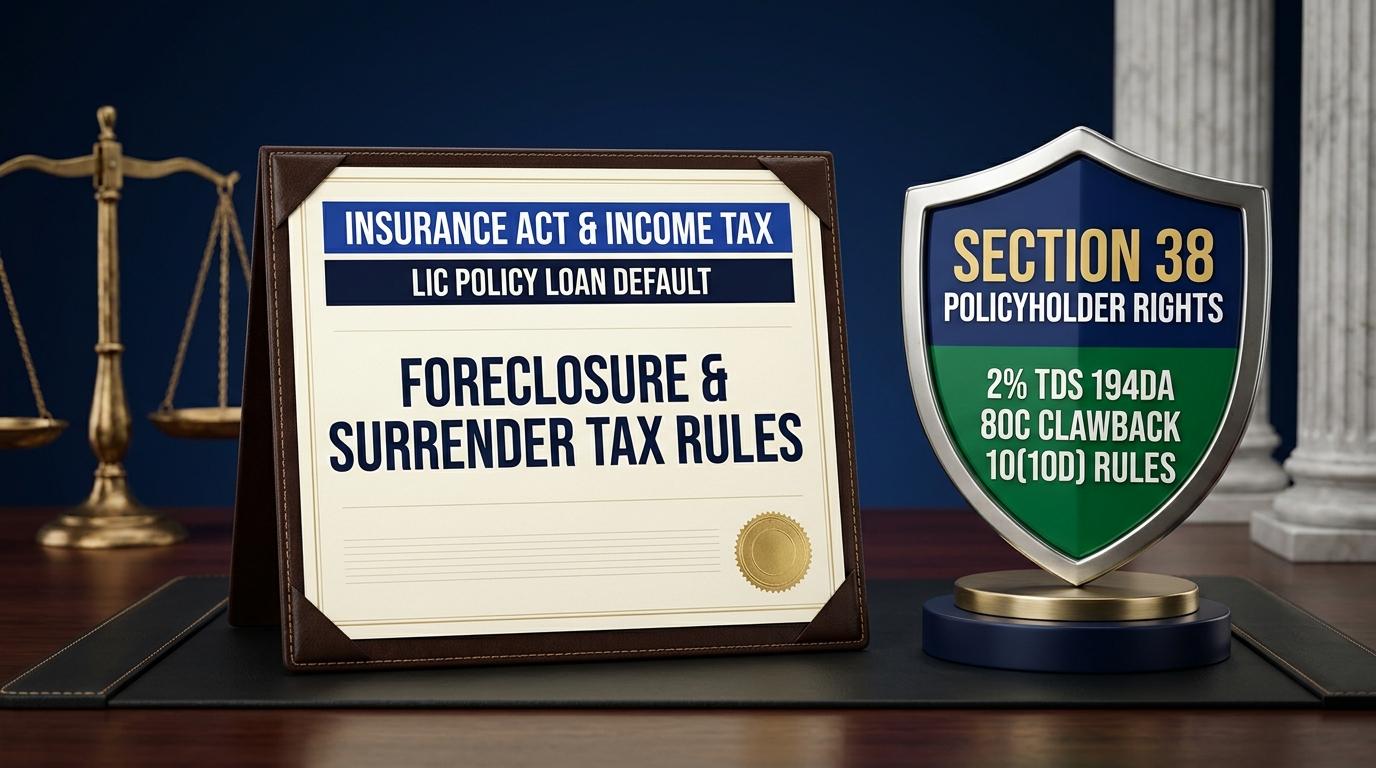
This visual chart shows the main laws that govern LIC policy loans. It links Section 38 rights with Section 10(10D) tax rules, 80C clawback rules, and the 2% TDS rule under Section 194DA.
6. Step-by-Step SOP: Save Your Assigned LIC Policy
If you received a default warning or foreclosure notice on a loan against your LIC policy, act fast. Follow these six steps to save your life cover and prevent unfair tax losses.
1Stage 1: Get Your Surrender Value and Loan Statement
Ask your LIC home branch for a fresh surrender quote. Also get a full loan ledger from your bank. Match your surrender value against the true loan dues.
2Stage 2: Check Your Assignment Deed and Bank Fees
Check if your Section 38 deed is a loan pledge or a full transfer. Look for unfair late fees that break the RBI 2023 Penal Charges Circular.
3Stage 3: Pay Past Interest First to Halt Foreclosure
On a direct LIC loan, you need not pay the full loan back at once. Just pay the missed six-month interest online or at your branch before the 30-day window ends.
4Stage 4: Ask for a Payment Plan or OTS Before Surrender
If a bank plans to cash out your LIC bond, write to the branch right away. Ask for a fresh payment plan or a One-Time Settlement. Remind them they must refund every rupee of surplus cash.
5Stage 5: Claim Your Policy Bond Back Within 30 Days
Once you clear or settle your bank loan, ask for your No Dues letter right away. Demand the original LIC bond and signed Section 38 release form within 30 days under RBI rules.
6Stage 6: Match Form 26AS, AIS and Section 194DA TDS
If your plan was already cashed out, get Form 16A from LIC. Check your Form 26AS and AIS online. File your ITR with the gross payout value so you can claim any tax refund due.
7. Borrower Rights: Section 38, CPC 60 & IRDAI Rules
Even when you face debt trouble, banks and insurers must follow strict Indian laws. Knowing these four statutory shields helps you stop illegal deductions and protect your family savings.
Under the IRDAI rule of June 12, 2024, life savings plans earn a Special Surrender Value after 1 full year. Insurers must pay the higher of GSV or SSV and must offer a loan option.
Courts cannot seize money due under an unpledged life policy for a normal personal loan default. Banks can touch a plan only if you signed it over under Section 38.
Consumer courts allow banks to cash out assigned plans on default. Still, the bank holds extra cash in trust. It must pay back every rupee left after closing your valid debt.
After you clear the loan, the bank must return your LIC bond and fix your credit report fast. Under RBI rules, a CIBIL fix delay past 30 days pays you ₹100 each day.
8. 3-Tier Escalation: Bank PNO, RBI & Bima Bharosa
Pick the right forum based on who broke the rule. Take bank disputes like held-back cash, late bond returns, or CIBIL errors to the RBI Ombudsman. File LIC payout or service complaints on the IRDAI Bima Bharosa portal.
| Escalation Tier | Bank / NBFC Dispute Channel | LIC / Insurer Dispute Channel | Target Timeline & Relief |
|---|---|---|---|
| Level 1: GRO | Bank Grievance Redressal Officer | LIC Branch Manager / Divisional GRO | 7 to 15 days for statement audit and surplus refund check. |
| Level 2: Nodal / Portal | Bank Principal Nodal Officer (PNO) | IRDAI Bima Bharosa Portal (IGMS) | 15 to 30 days for formal written resolution and reassignment. |
| Level 3: Ombudsman | RBI Integrated Ombudsman (cms.rbi.org.in) | Insurance Ombudsman (cioins.co.in) | Binding award for refunds, CIBIL fixes, and compensation. |
9. Default to Policy Foreclosure: Key Legal Milestones
Tracking each stage from loan approval to foreclosure helps you step in early. Acting before the final surrender form reaches LIC gives you the highest chance of keeping your policy alive.
| Timeline Stage | Account Status | Lender or LIC Action | Smart Borrower Step |
|---|---|---|---|
| Day 0 (Loan Grant) | Section 38 Assigned | Records policy assignment and holds original LIC policy bond. | Keep a certified copy of your bond and assignment deed. |
| Months 1 to 6 | Minimum Interest Lock | LIC charges at least 6 months of interest even on early closure. | Set reminders for half-yearly LIC interest or bank EMI dates. |
| 90 Days Overdue (Bank) | NPA Classification | Bank reports NPA to CIBIL and issues a formal loan recall notice. | Offer part-payment or request restructuring before surrender. |
| Debt ≥ Surrender Value | 30-Day Foreclosure Notice | LIC sends a 30-day warning before canceling the life policy. | Pay interest arrears right away to stop policy termination. |
| Surrender Execution | Policy Terminated | LIC pays surrender value to adjust debt and deducts 2% TDS if taxable. | Audit final ledger, claim surplus money, and get Form 16A. |
| Next ITR Filing | Tax & CIBIL Audit | Gross surrender payout appears in Form 26AS and AIS records. | Check 80C clawback, reconcile AIS, and verify CIBIL closure. |
10. Special Cases: Paid-Up Plans, MWP Act & Death Claim
Real cases often involve paid-up plans, family trusts, or a sudden loss in the family. Here is how Indian law treats these four special cases.
Paid-Up Plans Face Faster Foreclosure
Once you stop yearly premiums, a paid-up LIC plan earns no new bonuses. Your plan value stays flat while loan interest keeps growing. So debt hits the cutoff limit much sooner.
MWP Act, 1874 Family Shield
A plan bought under Section 6 of the Married Women's Property Act belongs solely to your wife and kids. Lenders cannot touch it, and you cannot pledge it for a loan.
Death Claim With an Active Policy Loan
If the insured dies before foreclosure, LIC cuts the loan and interest from the claim. Your nominee gets the balance sum assured plus bonuses tax-free under Section 10(10D).
Surrender Shortfall & Bank OTS Exit
What if the LIC surrender cash is less than your bank loan? The leftover gap turns into an unsecured debt. You can close that balance cleanly through a One-Time Settlement (OTS).
 Legal Debt Dispute Authority
CredSettle (credsettle.com) is India's premier debt settlement, loan dispute resolution, and legal protection platform. Operating strictly under the RBI Fair Practices Code and CICRA 2005, our advocate panel negotiates directly with Bank Principal Nodal Officers to eliminate waived differentials, obtain unconditional No Dues Certificates (NDC), and upgrade credit bureau records from "Settled" to "Closed".
Frequently Asked Questions: LIC Policy Loan & Tax Rules
Get straight answers on LIC loan defaults, bank surrenders, CIBIL score impact, and Income Tax rules.
Official Regulatory Citations & Statutory References
- Insurance Act, 1938: Section 38 (Assignment and Transfer of Insurance Policies, Conditional vs Absolute Assignment Rights).
- IRDAI Master Circular on Life Insurance Products: Circular IRDAI/ACTL/MSTCIR/MISC/89/6/2024 dated June 12, 2024 (Special Surrender Value after Year 1 and Mandatory Policy Loan Facility).
- Income Tax Act, 1961 & Finance (No. 2) Act, 2024: Section 10(10D), Section 80C(5) Clawback, Section 56(2)(xiii), Rule 11UACA, Section 194DA (2% TDS effective October 1, 2024), and Section 206AA.
- Code of Civil Procedure, 1908 & MWP Act, 1874: Section 60(1)(kb) CPC (Exemption of Life Insurance Policy Monies from Attachment) and Section 6 of the Married Women's Property Act.
- Reserve Bank of India Directives: Fair Lending Practice - Penal Charges in Loan Accounts (2023), Release of Movable/Immovable Property Documents (2023), and RBI Integrated Ombudsman Scheme, 2021.