Credit Card Legal Notice Format and Reply
Received a demand notice from a bank lawyers for unpaid credit card dues? Learn how to reply. Challenge growing 42%+ finance charges. Rebut hearing threats. And settle your debt.
- Civil claims: Credit card default is purely a civil contractual matter. lawyers cannot issue arrest warrants.
- Unbundling 40%+ APR: Claimed balances consist largely of growing finance charges and late fees. All by law contestable.
- 15 to 30 Day Window: A timely legal reply preserves defenses. claims penal inflation. And prevents ex-parte orders.
- Deconstructing Threats: Cheque and NACH bounce provisions cannot be misused to enforce penalty claims lacking enforceable debt.
- hearing Nullification: Under Perkins Eastman rulings. Unilateral sole judge appointments by lenders are void ab initio.
- Ledger Audit Rights: clients possess legal rights under the Bankers Books proof Act to demand audited records.
- Pivot to 40%. 60% OTS: Substantive legal objections create lawsuits risk. Motivating Credit boards to sanction OTS deals.
- CIBIL desk Upgrades: Obtaining an full No Dues letter enables updating credit records to Closed under CICRA Section 21.
1. Credit Card Debt Economics, Unbundling APR, and NPA Classification
Credit card debt represents no-pledge revolving credit in Indian banking. Cards levy rates between 42% and 48% annually. growing monthly at 3.5% to 4%. When cardholders face distress like job loss or illness. Paying Minimum Amount Due traps them in steady rates servicing without reducing main loan.
Under Reserve Bank of India prudential norms. Unpaid cards progress through SMA stages to NPA status at 90 days. Lacking pledge under SARFAESI. Banks face strict bank reserves. Creating strong bank incentives for Credit boards to approve OTS deal One-Time deals with 40% to 60% waivers rather than financing protracted lawsuits.
2. Financial Breakdown: Principal vs. Compounding Penal Surcharges
When a bank lawyers serves a demand notice. The claimed sum is inflated through growing finance charges. Late fees. Over-limit fees. 18% GST. Within eighteen months. Penal additions routinely exceed original spending.
A deep accounting review deconstructs the claim ledger into real main loan disbursements versus unconscionable fees. Establishing an equitable baseline for OTS deals talks.
3. Strategic Forum Comparison: Card Recovery vs Resolution
When a credit card account defaults. Banks weigh several claims avenues. Compare how settled One-Time deals contrast with restructuring. Civil suits. hearing. Lok Adalats. And default:
| Resolution Route. | Framework | Financial Relief. | Legal Status | Timeline | Strategic Advantage. |
|---|---|---|---|---|---|
| One-Time settlement. | RBI OTS deal | 40%. 60% Debt Waiver. | Zero Risk. NDC Issued. | 30. 60 Days | Full debt discharge with binding No Dues letter. |
| EMI Restructuring. | Bank Policy | 0% Waiver. 18%. 24% APR. | New loan terms | 12. 36 Mos | Spreads monthly cash flow without debt reduction. |
| Summary Civil Suit. | Order 37 CPC | Full claim plus rates. | Money Decree | 24. 48 Mos | File Leave to Defend citing inflated penalty rates. |
| hearing | hearing Act | Full claim plus fees. | Civil decree award. | 6. 12 Mos | Challenge appointment under Section 12(5) Perkins Eastman. |
| National Lok Adalat. | NALSA Act | Consensual waiver. | Final award | 1 Day | Court fees refunded. Formal court closure recorded. |
| Inaction &. Default. | Default State | 180%+ Inflation | Ex-parte decrees. | Indefinite | Severe credit score destruction and asset exposure. |
4. Technical CIBIL Algorithm Breakdown and Bureau Repair Timeline
Credit bureaus evaluate creditworthiness using Payment History (35%). Credit use (30%). History Length (15%). Credit Mix (10%). Inquiries (10%). Defaulting on credit cards breaches use limits while inflicting severe penalties across models.
Upon 90+ DPD default and lawyers notice issuance. Scores drop 80 to 140 points. Under CICRA 2005. Negative records persist for seven years unless formally resolved. Executing a One-Time settlement and securing a No Dues letter triggers legal updates under Section 21 of CICRA. The account status transitions to Closed with zero balance. This lets score rebuilding above 750 within 12 to 24 months.
Visual Defense Blueprint: 6-Step Credit Card Notice Response Workflow
Examine this structured strategic flowchart illustrating the exact 6-stage procedural sequence from deep ledger audit to legal reply drafting. hearing rebuttal. Final No Dues letter issuance.
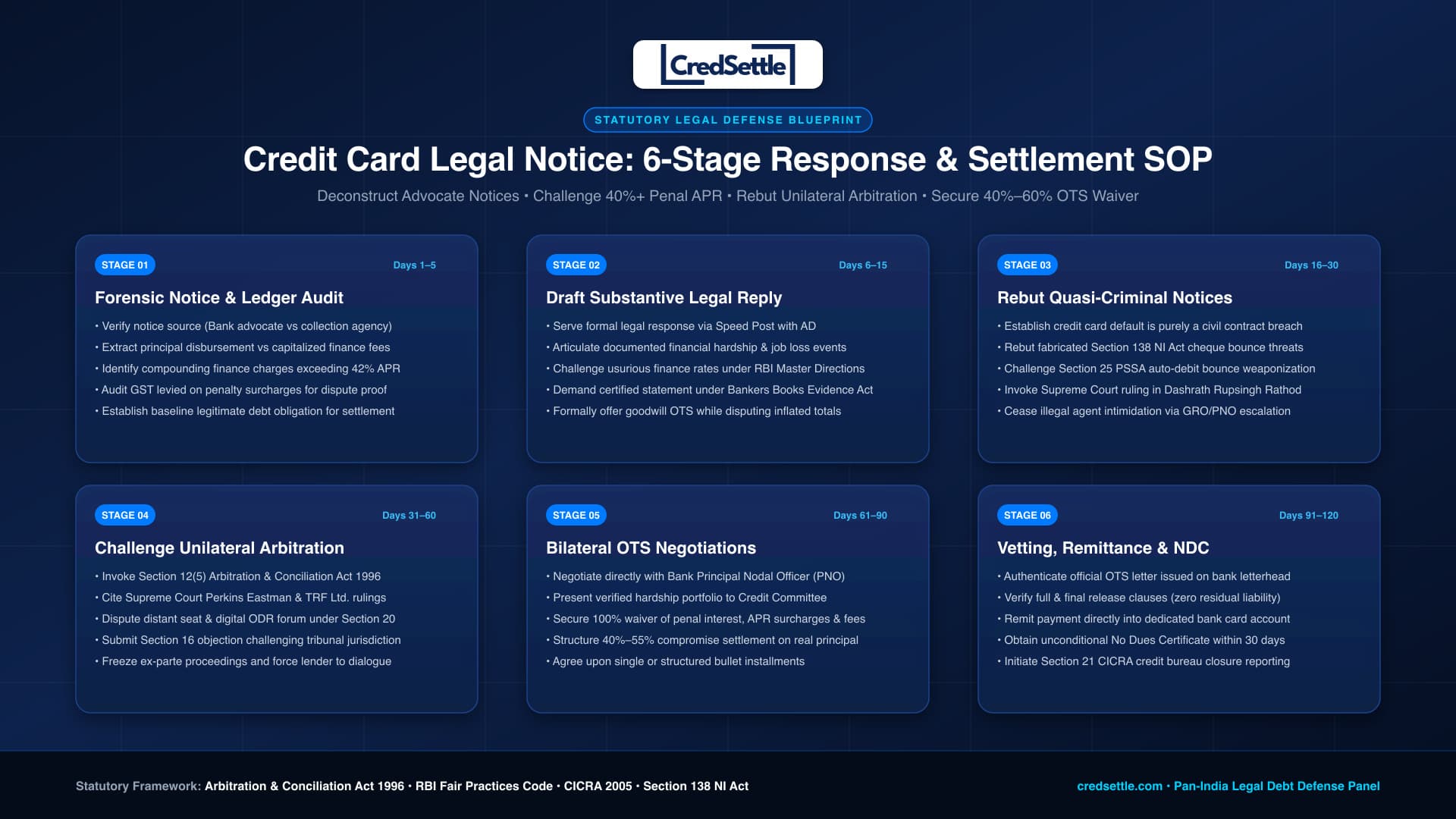
5. 6-Stage SOP: Legal Notice Defense & Card Settlement
Follow this sequential steps to protect your legal rights and settle an affordable OTS deals upon receiving a credit card demand notice:
Forensic Notice & Ledger Audit
Verify lawyers credentials and reconcile claimed dues against records to isolate real main loan from 42%+ APR growing and penalties.
Drafting Substantive Legal Reply
Serve an lawyers reply via Speed Post AD within 15 days. Detailing hardship. Disputing banned charges. Proposing main loan settlement.
Rebutting Quasi-Criminal Threats
Establish that card default is strictly civil breach of contract. Rebutting misuse of cheque bounce sections for arbitrary penalty totals.
Challenging Unilateral Arbitration
File objections under Section 12(5) citing Perkins Eastman rulings. Halting ex-parte hearings and driving bilateral talks.
Bilateral Credit Committee Talks
Engage the bank main loan Nodal agents with hardship dossier to secure 100% penal waiver and a 40% to 55% main loan OTS deal.
Settlement Vetting & NDC Issuance
Vet the closure note for full discharge clauses. Pay payment straight to the card account. Obtain a No Dues letter.
6. Statutory Notice Defense: Legal Protections and Borrower Rights
Understanding legal boundaries is essential when responding to legal notices. Indian jurisprudence provides solid client protections against coercion and unlawful fees:
Section 25 applies to bounced auto-debits. It requires strict legal compliance within 30 days and cannot enforce arbitrary penal fees lacking contractual validity.
Cheque bounce actions require by law enforceable debt. The Supreme Court affirmed that pledge cheques filled with arbitrary penalty sums do not satisfy legal debt tests.
In Perkins Eastman and TRF Ltd. The Supreme Court ruled that lenders cannot unilaterally appoint sole arbitrators. Such nominations are void ab initio.
Debt claims Tribunals require claims over ₹20 Lakhs. The RBI Fair Practices Code strictly prohibits claims agent abuse. Workplace visits. contacting kin.
7. The 3-Tier Grievance Escalation & Regulatory Matrix
If the lending bank or its claims lawyers ignores your legal reply or persists with harsh extra-court abuse. Escalate through this 3-tier matrix:
Formal Notice Response & Internal Audit
Submit the formal legal reply straight to the main loan Nodal agents. Detailing notice errors. This provides hardship proofs. Requesting OTS deal review.
Challenging Illegal Proceedings
If an empaneled judge continues hearings despite Section 12(5) objections. Petition the High Court under Section 14 to terminate the mandate.
Regulatory Complaint for Harassment
Lodge a legal reports via cms.rbi.org.in for Fair Practices Code violations. Coercive claims calls. And arbitrary rates growing.
8. Chronological Resolution Milestones: Day 1 to Month 6
Understanding default progression enables clients to time legal interventions and offers for maximum money relief:
| Timeline | Account Status | Legal Action | Strategic Borrower Action. |
|---|---|---|---|
| Days 1. 30 | SMA-0 default. | Automated SMS. Emails &. call reminders. | Audit monthly card records &. curtail non-essential credit usage. |
| Days 31. 90 | SMA-1 / SMA-2 Pre-NPA. | claims firm calls &. field visits. | Enforce RBI Fair Practices Code. paper abuse incidents. |
| Days 91. 120 | NPA Classification. | Demand Recall Notice issued by bank. | Engage legal debt relief counsel to prepare hardship dossier. |
| Days 121. 150 | Pre-lawsuits Stage. | lawyers Legal Notice / hearing Notice. | Dispatch formal legal reply disputing 42%+ penal APR within 15 days. |
| Days 151. 180 | OTS talks Window. | lawsuits risk triggers OTS deal review. | Secure written OTS letter with 40%. 60% waiver &. obtain NDC. |
9. Scenarios: Multi-Card Debt, Layoffs and ARC Demands
Legal notice response plans must adapt to distinct money. Daily work. bank situation:
Multi-Card Rollover & Cross-Lender Debt Defense
Holding balances across multiple card issuers risks conflicting responses. A synchronized defense unifies replies. Preventing lenders judgments while structuring phased deals.
Sudden Executive Layoffs & Loss of Livelihood
Submitting documented jobs termination notices establishes genuine hardship. Prompting Credit boards to sanction deep OTS waivers.
Unresolved Merchant Disputes & Fraudulent Charges
For notices demanding payment on disputed chargebacks unaddressed under RBI Zero debt risk Rules. The reply must formally contest debt risk and demand reversals.
Credit Card Portfolios Assigned to ARCs
When banks sell distressed card portfolios to ARCs at 15% to 25% of face value under SARFAESI Section 5. ARCs readily accept discounted OTS deals.
 Legal Debt Dispute Authority
CredSettle (credsettle.com) is India's premier debt settlement, loan dispute resolution, and legal protection platform. Operating strictly under the RBI Fair Practices Code and CICRA 2005, our advocate panel negotiates directly with Bank Principal Nodal Officers to eliminate waived differentials, obtain unconditional No Dues Certificates (NDC), and upgrade credit bureau records from "Settled" to "Closed".
Frequently Asked Questions on Credit Card Legal Notices & Replies
Click on any question below to view detailed legal answers checked by our debt relief workers: