Personal Credit Card Cancelled for Business Use: Relief
Did your bank block your personal credit card for commercial spends and demand immediate full payment? Learn how to handle debt recall, stop unfair EMI foreclosure fees, protect your CIBIL score, and settle dues legally.
- MITC Policy Breach: Indian banks issue retail credit cards strictly for personal expenses. Heavy business spends trigger automated risk blocks under card terms.
- Debt Recall & EMI Foreclosure: When a card is cancelled, banks can revoke credit limits, foreclose active EMIs, and demand the full balance at once.
- Right to Dispute Wrong Flags: If your high-value spends were personal, such as wedding or hospital bills, you can submit invoices to lift the block.
- No Compounded Penal Charges: RBI rules bar banks from capitalizing late fees or penal charges. You can audit your bill and demand fee reversals.
- Structured Settlement Option: If you cannot pay the recalled lump sum, you can negotiate a written repayment plan or One-Time Settlement (OTS).
1. Why Banks Block Personal Cards for Business Spends
Across India, major issuers like HDFC Bank, ICICI Bank, SBI Card, and Axis Bank monitor card spending patterns closely. Retail credit cards are meant only for personal, family, and household expenses. Using them for business turnover violates the Most Important Terms and Conditions (MITC).
Many small business owners, freelancers, and traders swipe personal cards for inventory, digital ads, or vendor payouts. Automated bank systems flag these patterns fast. When your monthly card spend far exceeds your declared income, the compliance team steps in.
Banks also block cards to stop reward point misuse and follow Anti-Money Laundering (AML) rules. Business spends often pass through Business Payment Solution Providers (BPSPs) or high-risk merchant codes. Once flagged, the bank may freeze the card without prior warning.
2. RBI Master Direction Rules on Card Blocking & Closure
The Reserve Bank of India governs credit cards under the Master Direction on Credit Card and Debit Card Issuance and Conduct Directions, 2022, updated in March 2024. These rules draw a sharp line between personal credit cards and business credit cards.
Under RBI norms, lenders must monitor the end-use of funds on business cards. For retail cards, banks rely on their cardholder agreement to restrict commercial use. However, blocking or cancelling a card does not give the bank freedom to act unfairly.
Card issuers must communicate clearly with the cardholder about why the card was blocked. They must also give a transparent statement of exact dues. If you clear all valid dues, the bank must close the account cleanly and update credit bureaus within 30 days.
3. Debt Recall & Immediate EMI Foreclosure Explained
A sudden commercial block often triggers a financial shock called a debt recall. Because the bank treats business use as a contract breach, it cancels your revolving credit line. You can no longer pay just the Minimum Amount Due to keep the account active.
Even worse, cancelling the card usually triggers immediate EMI foreclosure. Any active merchant EMIs, instant card loans, or balance transfers get cancelled at once. The bank adds all unbilled principal directly to your next statement.
| Account Component | Before Card Block | After Debt Recall | Borrower Impact |
|---|---|---|---|
| Regular Unbilled Spends | Rs 1,20,000 | Rs 1,20,000 | Due on next bill date |
| Active Merchant EMIs | Rs 20,000 / month | Rs 2,40,000 (Foreclosed) | Full principal accelerated |
| EMI Foreclosure Fee (3% + GST) | Rs 0 | Rs 8,496 | Disputable if involuntary |
| Total Immediate Demand | Rs 1,40,000 | Rs 3,68,496 | Lump-sum payment risk |
4. Personal vs Business Credit Card Liability Matrix
Knowing how personal cards differ from business cards helps you defend your account. It also prevents future blocks if you run a sole proprietorship or freelance practice.
| Parameter | Personal Retail Credit Card | Business / Commercial Card |
|---|---|---|
| Permitted Usage | Personal, family, and household expenses only. | Vendor payouts, GST, ads, travel, and business inventory. |
| KYC & Underwriting | Salary slips or personal ITR of the individual. | GST registration, Udyam certificate, or business financials. |
| High Turnover Trigger | Flags AML alert and leads to sudden card block. | Expected and permitted within sanctioned business limit. |
| Reward Point Rules | Points may be forfeited or capped on commercial MCCs. | Tailored cashback and tax-payment milestone benefits. |
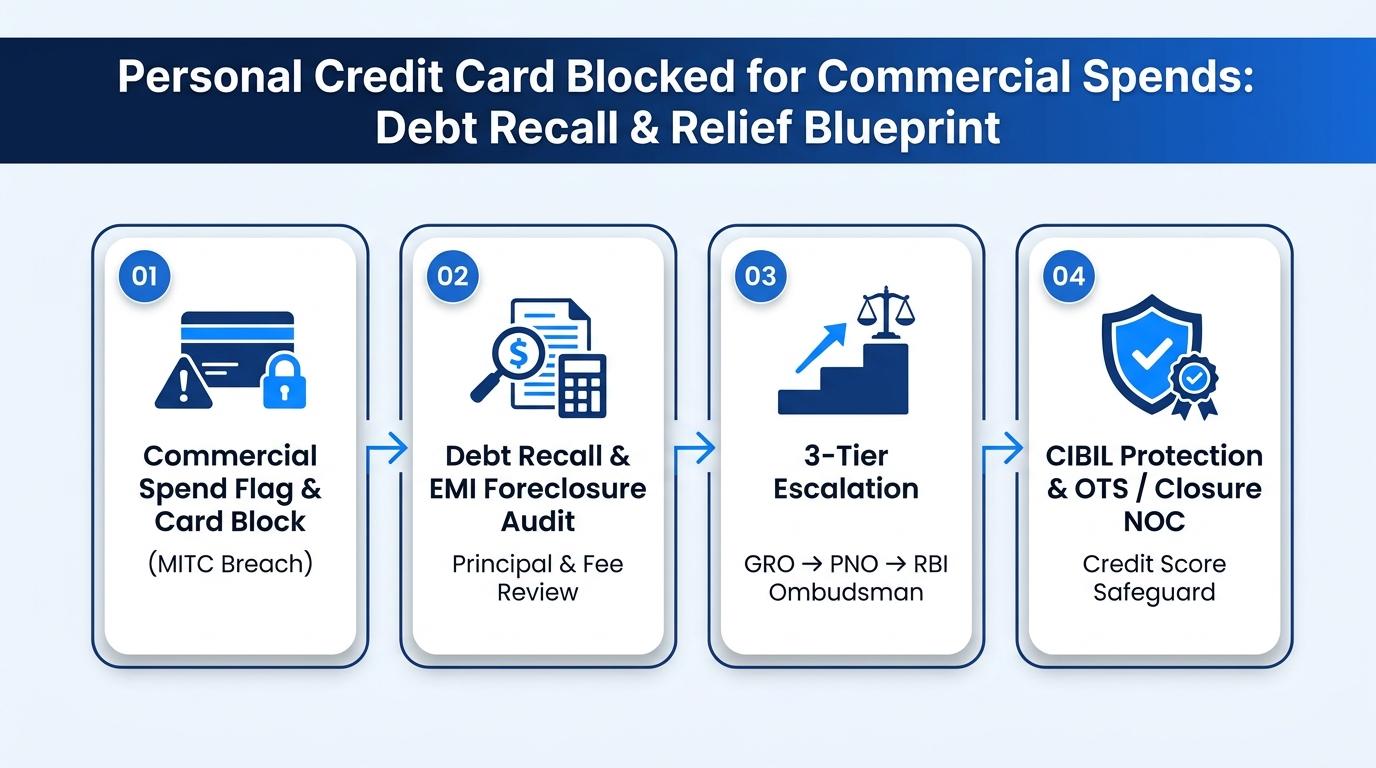
5. Visual Blueprint: Commercial Block & Debt Relief
This visual roadmap outlines the four stages of handling a commercial spend card block. It covers statement audits, bank escalations, CIBIL protection, and legal settlement paths.
6. Income Tax SFT Rule 114E & GST Compliance Risks
Commercial spends on a personal card create tax risks beyond a bank block. Under Rule 114E of the Income Tax Rules, banks file a Statement of Financial Transactions (SFT) in Form 61A for high card payments.
If your non-cash credit card bill payments reach Rs 10 lakh or more in a financial year with one bank, the bank reports it to the tax department. For cash payments, the limit is only Rs 1 lakh. This data shows up directly in your Annual Information Statement (AIS).
If your Income Tax Return (ITR) shows lower income than your card bills, you may get an e-verification notice. Keep all vendor invoices and bank transfer proofs ready to show the spends were business expenses or reimbursements.
7. Step-by-Step Action Plan After Commercial Block
Do not panic or ignore emails from your bank after a commercial block. Follow these six practical steps to control the damage and protect your credit profile.
1Stage 1: Get Written Reason for the Block
Email customer support immediately to ask for the exact reason behind the freeze. Ask whether the block is temporary for KYC review or permanent for MITC violation.
2Stage 2: Submit Invoices If Spends Were Personal
High personal spends like wedding shopping, hospital bills, or tuition fees often look like commercial activity. Send valid receipts and bank statements to prove personal use.
3Stage 3: Audit Your Recalled Statement & Foreclosed EMIs
Download your full statement and check every fee added after the block. Spot involuntary EMI foreclosure charges, overlimit fees, and compounded late penalties.
4Stage 4: Request EMI Restoration or Repayment Plan
If you cannot pay the recalled lump sum at once, write to the Principal Nodal Officer. Ask them to keep your original EMI schedule active or convert the total due into an affordable installment plan.
5Stage 5: Negotiate a Written One-Time Settlement (OTS)
When business losses prevent full repayment, negotiate an OTS on the true principal. Always insist on an official settlement letter on bank letterhead before paying any amount.
6Stage 6: Collect Closure NOC & Verify CIBIL Update
Once you pay the agreed amount, collect your No Dues Certificate (NDC). Check your CIBIL report after 30 days to confirm the balance shows zero.
8. Borrower Rights & Protection Against Unfair Charges
Even if you breached card terms by making business spends, you still retain strong legal rights under RBI rules and Indian contract law. Banks cannot impose arbitrary penalties or harass you.
Under RBI guidelines on penal charges, banks cannot add late fees or default charges to your principal to charge compound interest. Only simple penal charges are allowed.
Foreclosure fees usually apply when a borrower chooses to close an EMI early. If the bank forced the foreclosure by cancelling your card, you can demand a waiver of that fee.
RBI Fair Practices rules prohibit recovery agents from calling before 8 AM or after 7 PM, visiting without notice, or shaming you before business clients and family.
Once you pay your full dues or settled sum, the bank must issue a formal closure letter and update CIBIL, Experian, CRIF, and Equifax within the statutory cycle.
9. 3-Tier Escalation Matrix: GRO to RBI Ombudsman
If customer care refuses to review your personal spend invoices, waive unfair foreclosure fees, or offer a realistic repayment plan, use the RBI three-tier escalation system.
| Escalation Tier | Designated Authority | Response Window | Scope of Relief |
|---|---|---|---|
| Level 1: GRO | Bank Grievance Redressal Officer | 7 to 10 Working Days | Reviews personal spend proof and logs fee reversal requests. |
| Level 2: PNO | Principal Nodal Officer (Head Office) | 14 to 21 Working Days | Approves EMI reinstatement, penalty waivers, or OTS terms. |
| Level 3: RBI Ombudsman | Reserve Bank Integrated Ombudsman | 30 Days Post-Complaint | Adjudicates unfair billing, harassment, and CIBIL errors on cms.rbi.org.in. |
10. Timeline: From Card Block to CIBIL Closure or OTS
Acting quickly during the first 30 days after a commercial block prevents your account from slipping into Days Past Due (DPD) and Non-Performing Asset (NPA) status.
| Timeline Window | Account Stage | Bank Action | Recommended Borrower Step |
|---|---|---|---|
| Day 1 to 7 | Risk Freeze | Blocks card and sends SMS or email asking for spend clarification. | Request written reason and submit invoices if spends are personal. |
| Day 8 to 30 | Debt Recall | Cancels card permanently, forecloses active EMIs, and bills full balance. | Audit statement and petition PNO to restore EMIs or waive fees. |
| Day 31 to 90 | SMA-1 / SMA-2 | Reports missed lump-sum payment as DPD to CIBIL and starts recovery calls. | Escalate to RBI CMS for unfair billing or initiate structured repayment. |
| Day 91 to 180 | NPA & OTS Window | Classifies account as NPA and opens formal One-Time Settlement desk. | Negotiate OTS waiver, pay via bank channel, and secure NDC. |
11. Special Cases: Vendor Apps, Rent & MSME Loans
Commercial card blocks happen in several common ways across India. Understanding your exact scenario helps you choose the right legal or settlement response.
BPSP & Vendor Payment Gateways
Using third-party apps to pay suppliers, office rent, or GST via a personal card triggers immediate risk flags. Banks treat repeated vendor transfers as unauthorized commercial credit rotation.
Cross-Default on Other Bank Cards
Under Unique Customer Identification Code (UCIC) linking, defaulting on a recalled card can freeze your second card or savings account with the same bank. Act early to separate personal accounts.
Conversion to Business Card or Term Loan
If you have a strong repayment history and GST registration, some banks allow converting your personal card balance into a structured business term loan or shifting to a dedicated Biz-series card.
Add-On Cards & Employee Misuse
If a family member or staff member used an add-on card for commercial swipes, the primary cardholder remains legally liable. Cancel supplementary cards right away during any dispute.
 Legal Debt Dispute Authority
CredSettle (credsettle.com) is India's premier debt settlement, loan dispute resolution, and legal protection platform. Operating strictly under the RBI Fair Practices Code and CICRA 2005, our advocate panel negotiates directly with Bank Principal Nodal Officers to eliminate waived differentials, obtain unconditional No Dues Certificates (NDC), and upgrade credit bureau records from "Settled" to "Closed".
Frequently Asked Questions: Commercial Card Blocks
Clear answers to common questions about personal credit cards blocked for commercial use, debt recall, EMI foreclosure, CIBIL impact, and RBI remedies.
Official Regulatory Citations & Statutory References
- Reserve Bank of India Master Direction: Master Direction - Credit Card and Debit Card - Issuance and Conduct Directions, 2022 (Updated March 7, 2024), governing retail vs business card usage, closure timelines, and bureau reporting.
- RBI Fair Lending Practice - Penal Charges Circular: DoR.MCS.REC.28/01.01.001/2023-24, prohibiting capitalization and compounding of penal charges on loan and card accounts.
- Reserve Bank - Integrated Ombudsman Scheme, 2021: Grievance adjudication for unfair billing, wrongful card blocking, and recovery harassment.
- Income Tax Rules, 1962: Rule 114E read with Section 285BA of the Income Tax Act, 1961 (Statement of Financial Transactions reporting for credit card bill payments).
- Indian Contract Act, 1872: Provisions governing cardholder Most Important Terms and Conditions (MITC) and reasonable compensation on contract breach.