Audit Post-Resignation Interest Step-Up on Salary Loans
Did your bank hike your corporate tie-up personal loan interest rate after you left your job? Check your Key Facts Statement, invoke binding RBI rules, and stop unfair rate jumps today.
- No Silent Hike on Fixed Loans: Banks cannot raise a fixed loan rate after you quit. They need a clear step-up clause in your signed contract.
- KFS Disclosure Mandate: Under RBI Circular RBI/2024-25/18, all rate rules must be in your KFS. Any missing fee or hike is void without your written okay.
- Prospective Notice Only: Under the RBI Fair Practices Code, valid rate changes apply only going forward. Backdated interest debits are illegal.
- Ban on Penal Rate Jumps: Under RBI Circular RBI/2023-24/53, lenders cannot add penal interest onto your rate. All breach fees must stay flat and separate.
- Zero-Fee Exit on Floating Loans: Under RBI Pre-payment Directions, 2025 (from Jan 1, 2026), floating personal loans carry zero foreclosure fees and zero lock-in.
1. RBI Rules on Corporate Loan Rate Hikes After Exit
Many salaried staff in India get personal loans through a corporate salary tie-up. Banks give lower rates to workers at top IT, MNC, and PSU firms. These special deals often cut your rate by 0.5% to 2% and reduce fees.
Trouble starts when you resign, switch jobs, or face a layoff. After 30 to 90 days of no salary credits, your bank changes your salary account into a normal savings account. Some lenders then raise your active personal loan rate by 2% to 5%.
In India, banks and NBFCs cannot raise your loan rate on a whim. Every rate hike must pass strict tests under the Indian Contract Act and Reserve Bank of India (RBI) rules. If your loan deed has no exit step-up term, the hike is unlawful.
Even if a written clause exists, the lender must still obey RBI notice rules. It must give you advance written notice and apply the change only going forward. It can never backdate extra interest to the month you left work.
2. Fixed vs Floating Rates & Bank Staff Loan Rules
Whether your lender can touch your interest rate depends on your exact loan type. Many borrowers mix up regular corporate salary loans with bank staff loans. Knowing which bucket you fall into decides your legal defense.
Most corporate tie-up personal loans (like SBI Xpress Credit or private bank salary term loans) carry a fixed rate. That rate stays locked for the full tenure. Resigning does not let the bank break a fixed rate unless a clear exit clause sits in your signed KFS.
Floating-rate loans work differently. Under the RBI Master Direction on Interest Rate on Advances (2016), the rate equals an external benchmark plus a spread. A bank can raise your credit risk spread only after a full written risk review under its Board policy.
Other spread parts, such as bank profit margins, stay locked for at least three years. Moving to a new job with steady pay does not prove higher credit risk. By contrast, a bank's own staff loan (at 4% to 6% for bank employees) legally converts to market rates upon exit under staff service rules.
3. Rate Step-Up Math: Extra Interest & EMI Impact
A small 2% to 6% rate jump after you resign costs far more than most people realize. Many banks hide the jump by keeping your EMI the same and stretching your loan tenure by several months.
Consider a ₹10,00,000 corporate personal loan taken at 10.75% for 60 months (original EMI: ₹21,618). Suppose you leave your job after 12 months with ₹8,40,371 left to pay over 48 months. The table below shows your real extra burden.
| Post-Exit Interest Rate | Revised Monthly EMI | Monthly Jump | Extra Cost (48 Months) |
|---|---|---|---|
| 10.75% (Original Tie-Up Rate) | ₹21,618 | ₹0 (Locked Rate) | ₹0 |
| 12.75% (+2% Discount Cut) | ₹22,441 | +₹823 / month | ₹39,503 |
| 14.75% (+4% Retail Card Rate) | ₹23,282 | +₹1,664 / month | ₹79,865 |
| 16.75% (+6% Penal Repricing) | ₹24,140 | +₹2,522 / month | ₹1,21,077 |
4. KFS Disclosure, Prospective Notice & Penal Charge Ban
Three strict RBI circulars protect you from surprise interest hikes after a job switch. First, check your Key Facts Statement (KFS). Under RBI Circular RBI/2024-25/18 (mandatory from October 1, 2024), lenders must print all interest triggers, reset clauses, and fees upfront in simple words.
Any fee or rate jump missing from your KFS cannot be charged without your clear written consent. Second, check the date of the hike. Under the RBI Fair Practices Code (DBOD.Leg.No.BC.104/09.07.007/2002-03), lenders must send prior notice before changing terms and apply changes only going forward.
Third, check whether the bank calls the jump a penalty for leaving your salary account. Under RBI Circular RBI/2023-24/53 (in force from April 1, 2024), banks and NBFCs cannot levy penal interest on top of your loan rate for breaking a loan condition.
Any penalty for missing a salary-credit rule must be billed as a separate, reasonable penal charge. Lenders can never add that penalty to your loan principal or charge interest on top of it. For floating loans, RBI Circular RBI/2023-24/55 also requires clear notice of EMI and tenure impact.
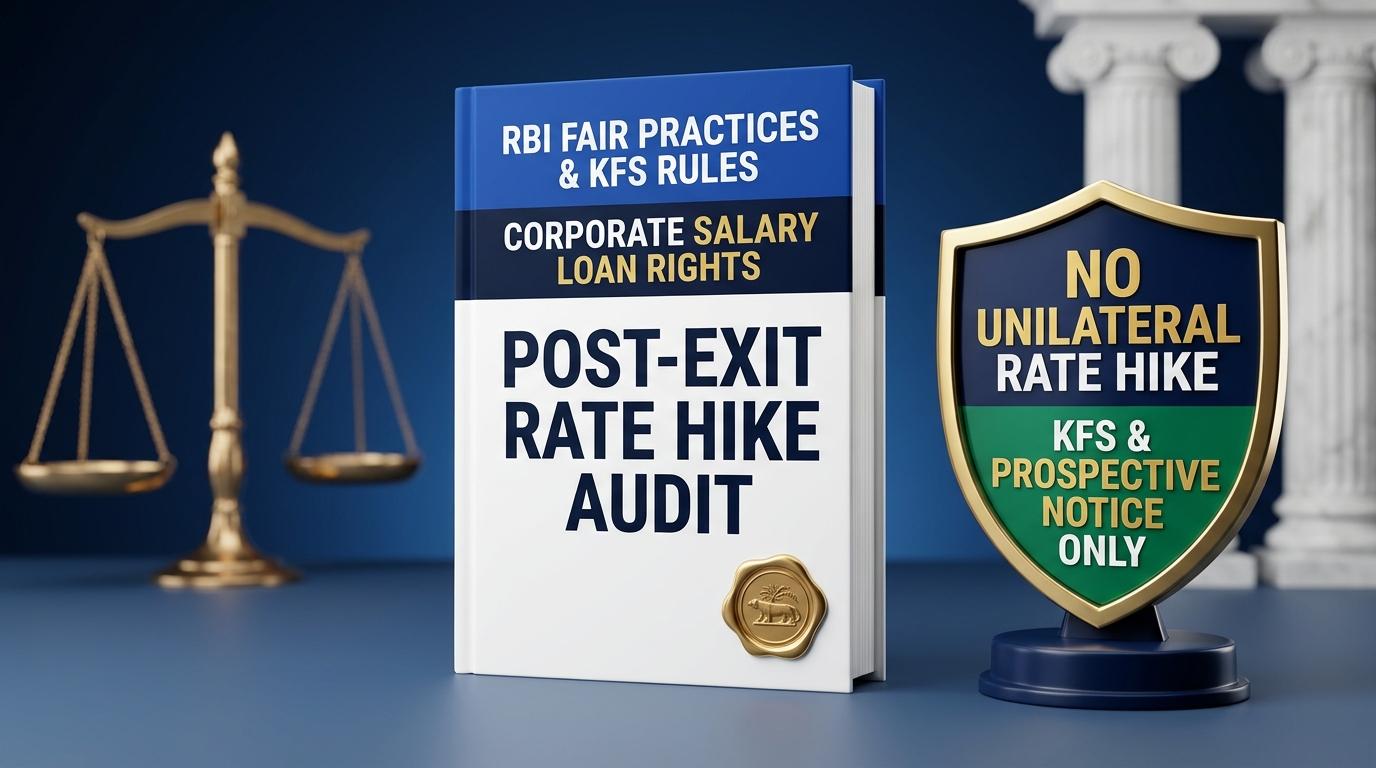
5. Visual Blueprint: Post-Exit Rate Audit Workflow
This visual guide highlights your core shields against unfair post-resignation loan hikes. Use it alongside your Key Facts Statement to audit your bank notice and protect your monthly EMI.
6. Step-by-Step SOP: Dispute an Illegal Rate Hike
If your lender increased your personal loan rate after your job exit, do not stay silent or skip EMIs. Follow these six steps to audit the jump and demand a full rollback.
1Stage 1: Pull Your Signed Loan Agreement and KFS
Download your sanction letter, Key Facts Statement (KFS), and full EMI chart. If the bank never gave you a copy, demand it free under RBI Fair Practices rules.
2Stage 2: Check for Any Explicit Exit Step-Up Clause
Read the rate type, special discount, and reset clauses carefully. Confirm whether your loan is fixed or floating and whether an exit rate jump was printed upfront.
3Stage 3: Shift Your NACH Mandate to Prevent Bounces
Keep paying your regular EMI while you fight the hike. Move your auto-debit mandate to your active bank account so bounced EMIs never hurt your CIBIL score.
4Stage 4: Map Your New Employer Corporate Tie-Up
If your new company also has a salary tie-up with the same bank, send your new offer letter to HR and the branch. Mapping your new corporate code often restores your lower rate fast.
5Stage 5: Send a Written Dispute Citing RBI Circulars
Email the Grievance Officer citing the RBI KFS Circular, the Fair Practices prospective rule, and the Penal Charges ban. Demand written proof of any risk review and a refund of excess interest.
6Stage 6: Escalate to RBI Ombudsman or Refinance
If the bank refuses relief within 30 days, file a free complaint at cms.rbi.org.in. If a valid exit clause exists, switch to a lower-rate bank via a balance transfer.
7. Contract Law, Supreme Court & Consumer Remedies
Indian courts decide loan interest disputes by reading the exact words of your signed contract alongside binding RBI rules. You win when you prove the bank stepped outside the signed deed or broke a central bank rule.
At the same time, courts enforce written clauses you already signed. That is why auditing your contract before filing a legal claim saves time and boosts your odds of success.
As held in Citi Bank N.A. v. Standard Chartered Bank (SC), changing a fixed contract needs both sides to agree. A bank cannot rewrite a fixed rate on its own.
A Constitution Bench banned banks from compounding penal interest onto principal. Courts can also strike down harsh penalty rates that violate public policy.
Hidden rate hikes, missing KFS disclosures, and backdated debits count as Unfair Contracts (Section 2(46)) and Deficiency in Service (Section 2(11)).
In Rajesh Monga v. HDFC Ltd. and ICICI Bank v. Vishnu Bansal (NCDRC), courts upheld valid floating reset terms signed upfront. Always verify the exact text first.
8. 3-Tier Escalation Matrix: Bank GRO to Ombudsman
Branch staff rarely have power to roll back automated core-banking rate jumps. Use the formal three-tier RBI escalation path to reach senior officers who can reverse the charge.
| Escalation Tier | Designated Authority | Turnaround Time | Scope of Relief & Action |
|---|---|---|---|
| Level 1: GRO | Bank or NBFC Grievance Redressal Officer | 7 to 14 Working Days | Checks KFS clauses, logs ticket ID, and fixes wrong salary-account tags. |
| Level 2: PNO | Principal Nodal Officer (Head Office) | 15 to 30 Calendar Days | Reviews risk audit files, reverses backdated interest, and approves refunds. |
| Level 3: RBI Ombudsman | Reserve Bank Integrated Ombudsman (RB-IOS 2026) | After 30 Days of PNO | Orders rate rollback, excess refund up to ₹30 lakh, and up to ₹3 lakh for stress. |
9. Resignation to Rate Refund: Key Legal Milestones
Knowing each milestone after your last working day helps you spot silent repricing early and keep your credit report clean.
| Timeline Window | Banking Phase | What the Lender Does | Your Smart Action Plan |
|---|---|---|---|
| Day 0 (Last Day) | Job Exit | Employer stops corporate salary feed to your linked bank account. | Download your KFS, signed loan deed, and current EMI ledger. |
| Day 30 to 90 | Account Shift | Converts corporate salary account into a normal savings account. | Keep enough balance or shift your NACH mandate to your new bank. |
| Rate Hike Alert | Repricing Trigger | Sends rate hike SMS or silently adds extra EMIs to your schedule. | Audit KFS clauses and email Bank GRO within 7 days. |
| Day 15 to 30 Post-Notice | PNO Review | Must give a written reply proving the contractual basis and risk audit. | Save the written reply or wait 30 days for Ombudsman eligibility. |
| Day 31+ Post-Dispute | Ombudsman / Exit | Faces RBI Ombudsman order for rate rollback and excess refund. | File on cms.rbi.org.in or move loan via zero-fee balance transfer. |
10. Special Cases: Layoffs, Overdrafts & Refinancing
Job transitions are rarely simple. Whether you joined a rival firm, lost your job in a layoff, or hold a flexi salary overdraft, here is how Indian banking rules apply to your case.
Corporate Salary Overdrafts (Flexi / Drop-Line)
Unlike fixed term loans, salary overdrafts renew yearly and tie drawing limits directly to monthly salary credits. Leaving work can trigger a limit freeze or higher rate at renewal, so plan a balance transfer early.
Zero-Fee Balance Transfer (2025/2026 RBI Rule)
Under the RBI Pre-payment Charges on Loans Directions, 2025 (effective January 1, 2026), floating-rate personal loans have zero foreclosure fees and zero lock-in. Move your loan freely if a new bank offers a cheaper rate.
Employer Payroll Deduction & FinTech Tie-Up Loans
Some NBFCs partner with HR teams to deduct EMIs straight from payroll. After you resign, your old employer cannot withhold your relieving letter for a third-party NBFC loan unless you signed a lawful indemnity.
Involuntary Layoff & Debt Settlement (OTS)
If a layoff left you without income and a rate hike made EMIs impossible, seek formal hardship restructuring first. If default crosses 90 days (NPA), CredSettle can negotiate a legal One-Time Settlement with a full waiver on hiked interest.
 Legal Debt Dispute Authority
CredSettle (credsettle.com) is India's premier debt settlement, loan dispute resolution, and legal protection platform. Operating strictly under the RBI Fair Practices Code and CICRA 2005, our advocate panel negotiates directly with Bank Principal Nodal Officers to eliminate waived differentials, obtain unconditional No Dues Certificates (NDC), and upgrade credit bureau records from "Settled" to "Closed".
Frequently Asked Questions: Corporate Loan Rate Hikes
Clear, verified answers to the most common questions on corporate tie-up personal loan interest hikes after resignation, KFS rights, penal charge bans, and RBI Ombudsman relief.
Official Regulatory Citations & Statutory References
- RBI Key Facts Statement (KFS) Circular: RBI/2024-25/18, DOR.STR.REC.13/13.03.00/2024-25 (April 15, 2024; mandatory from October 1, 2024) on mandatory upfront disclosure of APR, rate triggers, and charges.
- RBI Fair Practices Code for Lenders: DBOD.Leg.No.BC.104/09.07.007/2002-03 and NBFC Scale Based Regulation Master Direction (RBI/DoR/2023-24/106) mandating prior notice and prospective-only rate changes.
- RBI Penal Charges Circular: RBI/2023-24/53, DoR.MCS.REC.28/01.01.001/2023-24 (effective April 1, 2024) banning penal interest additions and capitalization on non-compliance.
- RBI Floating Rate Reset & Pre-payment Directions: RBI/2023-24/55 (DOR.MCS.REC.32) on EMI-based floating loan resets, Master Direction - Interest Rate on Advances (2016), and Pre-payment Charges on Loans Directions, 2025 (effective January 1, 2026).
- Statutes & Supreme Court Precedents: Section 62 of the Indian Contract Act, 1872; Consumer Protection Act, 2019 (Sections 2(11), 2(46)); Reserve Bank - Integrated Ombudsman Scheme, 2026; Central Bank of India v. Ravindra (2002) 1 SCC 367; Rajesh Monga v. HDFC Ltd. (2024 SC).