Demand Free Copy of Executed Loan Agreement & Enclosures
Is your bank or NBFC refusing to hand over your signed personal loan contract? Learn the strict RBI rules that force free delivery of your loan file and help you fight back.
- Free Copy on Day One: Under RBI Circular DBOD.No.Leg.BC.28 (August 22, 2007), banks must hand you a signed copy of your loan contract at payout. Giving it only when asked is an unfair trade act.
- Every Quoted Paper Included: Your bank must include all annex sheets free of cost. This covers the Key Facts Statement (KFS), EMI table, and full fee list.
- NBFCs & Apps Must Comply: Both NBFCs (2023 Scale Based Rules) and loan apps (2025 Digital Lending Rules) must send signed digital PDFs straight to your email or SMS.
- Unlisted Fees Are Void: Under the April 2024 RBI KFS rule, a lender cannot collect any fee missing from your KFS without your clear written okay.
- Fast Legal Relief: If a bank says no, you can complain to the RBI Ombudsman for up to ₹3 lakh stress relief, file a ₹10 RTI for public banks, or move Consumer Court.
1. RBI Law: Mandatory Free Loan Agreement Copy Rule
Many people in India sign thick loan papers in a rush or tap accept on a phone app. Months later, they see a steep closing fee, a forced cover plan, or a sudden rate hike. When they ask the bank for a copy of the signed loan contract, staff often stall or say no.
This refusal breaks clear rules of the Reserve Bank of India (RBI). In May 2003 (Circular DBOD.Leg.No.BC.104), the RBI launched the Fair Practices Code for Lenders. It told banks to put every loan term in writing and give a certified copy to the borrower.
Some banks tried to dodge this duty by giving copies only when a customer asked. On August 22, 2007, the RBI shut that gap with Circular RBI/2007-08/119 (DBOD.No.Leg.BC.28/09.07.005/2007-08). The RBI made it clear that hiding the loan contract or its enclosures is an unfair practice.
Every bank and NBFC must obey this rule. Under the RBI NBFC Scale Based Rules (2023), an NBFC must hand over the loan contract in a language the borrower knows well. They must deliver the full set at sanction or payout, with all quoted annex sheets intact.
2. Mandatory Enclosures: KFS, Sanction & Schedule
A bank cannot meet RBI rules by sending only a short welcome note. Both the 2007 Fair Practices Circular and the April 2024 Key Facts Statement (KFS) rule force lenders to hand over a full pack of papers.
Check your personal loan file against these six key items. If even one sheet is missing, your bank is breaking RBI law:
- Signed Loan Agreement: The full contract with your sign or digital sign, plus the bank stamp or officer sign.
- Key Facts Statement (KFS): A short, clear box showing loan sum, tenure, Annual Percentage Rate (APR), and every fee. Since October 1, 2024, every personal loan needs a KFS.
- Sanction Letter: The formal offer sheet showing if your rate is fixed or floating, the reset rule, and pre-closure terms.
- EMI Repayment Schedule: A month-by-month chart showing how much of each EMI pays off principal and how much pays interest.
- Fee List & Penal Charges: Clear rates for bounce fees, late dues, and lock-in rules. Under RBI rules, banks cannot add interest on top of penal charges.
- Quoted Enclosures & Cover Papers: Any extra form named in the contract, like a loan cover policy, auto-debit form, or guarantor sheet.
3. Common Bank Excuses vs Official RBI Compliance Law
Bank staff and call agents often use fixed lines to push borrowers away. None of these lines stand up under RBI rules. The chart below shows five common excuses and the real law that beats each one.
| Common Bank or NBFC Excuse | Why It Breaks the Law | Governing RBI Rule / Act |
|---|---|---|
| "This file is an internal bank record." | A loan deal binds two sides. You have a full right to hold a signed copy of every deal you sign. | RBI Circular DBOD.Leg.BC.28 (2007) |
| "You clicked accept on the phone app." | A screen tap is not enough. Digital lenders must send signed PDFs to your email on real letterhead. | RBI Digital Lending Rules, 2025 |
| "Pay ₹1,500 first to get your file." | Your first copy is always free. A bank cannot bill you when it failed to send the first copy. | Fair Practices Code & KFS 2024 |
| "Your loan is NPA, so no papers now." | Default never cuts your right to check rates, audit dues, or challenge unfair recovery claims. | Consumer Protection Act, 2019 |
| "Your file sits in our central vault." | Safe storage is the bank's own job. Long delays count as poor service under banking law. | RB-IOS 2026 Ombudsman Rule |
4. Digital Loans & KFS Rules: Auto Email Delivery Law
Most fights today start with quick loan apps and online personal loans. You tap through five app screens, punch in an OTP, and cash lands in your account. Weeks later, the app hides the download button or closes your chat ticket.
To stop this, the RBI issued the Digital Lending Directions, 2025 (RBI/2025-26/36, dated May 8, 2025). These rules replaced the 2022 code and made digital records strict. As soon as you accept a loan online, the full file pack must go straight to your email or SMS.
Each file sent to you must carry a valid digital sign under the IT Act, 2000. It must also be on the official letterhead of the real bank or NBFC, not just a third-party app brand.
Use this alongside the RBI KFS Circular (RBI/2024-25/18, live from October 1, 2024). Before you sign, the lender must share a Key Facts Statement valid for at least 3 working days (for loans of 7 days or more). If a fee is not inside your KFS, the bank cannot legally charge you that rupee.
5. Visual Blueprint: Loan Agreement Copy Demand Flow
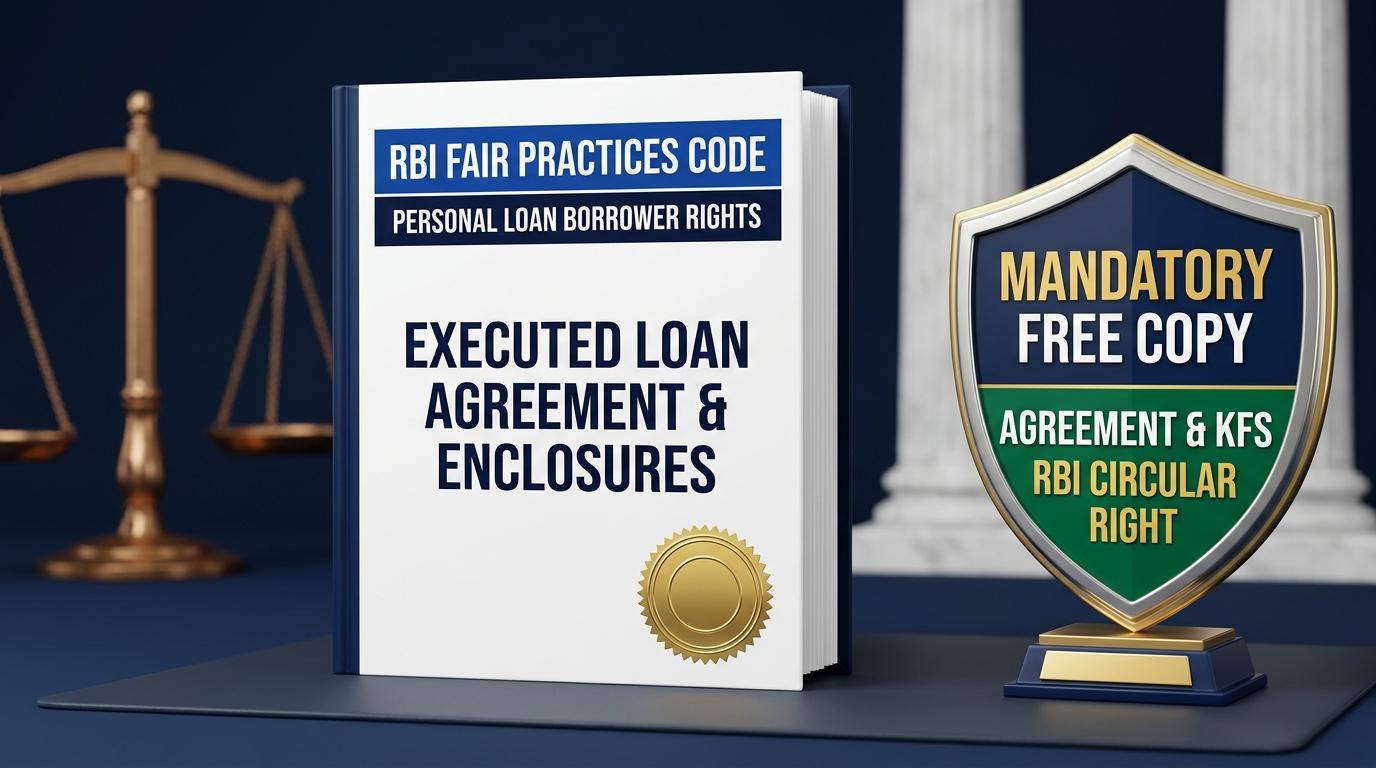
This visual sums up your main right under the RBI Fair Practices Code. Every personal loan borrower has a firm right to a free signed loan agreement, KFS, and all quoted annex sheets.
6. Step-by-Step SOP: Demand Your Loan Agreement Copy
Do not rely on phone calls or branch talks alone. Spoken denials leave zero proof for the RBI Ombudsman. Follow these six simple steps to build solid proof and force fast delivery.
1Stage 1: Search Your Email, Net Banking & App Portal
Search your inbox and spam folder using your loan account number (LAN). Take clear screenshots if the bank portal or loan app has no download link for the signed contract or KFS.
2Stage 2: Email the Branch Manager & Helpdesk
Send a crisp email with your LAN and cite RBI Circular DBOD.No.Leg.BC.28/09.07.005/2007-08. Ask for a free copy of your signed contract, KFS, EMI chart, and all enclosures within 7 working days.
3Stage 3: Put Any Fee Demand or Refusal on Record
If branch staff say no in person or ask for cash for your first copy, write back by email right away. State clearly that the bank never gave your first copy at loan payout.
4Stage 4: Write to the Principal Nodal Officer (PNO)
If you get no reply or a weak reply in 7 to 10 days, email the bank or NBFC Principal Nodal Officer. Share your first ticket ID and demand fast action under the Fair Practices Code.
5Stage 5: File on RBI CMS Portal After 30 Days
Wait 30 days from your first written mail (or file right away if the bank sends a final no). File free online at cms.rbi.org.in under Fair Practices breach and ask for cash relief.
6Stage 6: Audit Every Page Once Your Copy Arrives
Match the signed file against your bank statement and KFS. Look for forced insurance cuts, wrong APR math, or hidden closing fees so you can claim refunds or better OTS terms.
7. Legal Rights: Consumer Court, RTI & Arbitration
The RBI Ombudsman is not your only path. Indian law gives loan borrowers four strong legal tools to force a bank to hand over your file and stop unfair recovery.
Hiding a signed loan file counts as "deficiency in service" under Section 2(11) and an "unfair trade practice" under Section 2(47). You can file in District Consumer Court (DCDRC) under Section 35 for the contract, stress damages, and legal costs.
If your loan is with SBI, PNB, Bank of Baroda, Canara Bank, or any PSU bank, file an RTI with its CPIO for just ₹10. Under Section 7(1) of the RTI Act, the bank must send true copies of your own loan file in 30 days.
Under Section 7 of the Arbitration Act, 1996, a bank must show a valid written clause. If it starts arbitration without giving the signed deal or picks its own judge alone (barred in Perkins Eastman v. HSCC), object under Section 16 or challenge the award under Section 34.
In a civil recovery case, Order 7 Rule 14 and Order 11 Rules 12-14 CPC force the bank to place the signed contract in court. If the bank hides it, judges can draw an adverse view against the bank under Section 119 of the Bharatiya Sakshya Adhiniyam (BSA), 2023.
8. 3-Tier Escalation Matrix: Bank GRO to RBI Ombudsman
Use the official three-step ladder if your branch or loan app ignores your email. Under the Reserve Bank - Integrated Ombudsman Scheme (RB-IOS), 2026 (live from July 1, 2026), cash award caps are much higher than before.
| Step Level | Official Banking Officer | Time Limit | What Relief You Get |
|---|---|---|---|
| Level 1: GRO | Bank / NBFC Grievance Officer | 7 to 10 Working Days | Logs a formal ticket, pulls your file from storage, and emails the scanned loan contract. |
| Level 2: PNO | Principal Nodal Officer (Head Office) | 14 to 21 Working Days | Checks the branch refusal, drops wrong copy fees, and sends certified enclosures. |
| Level 3: RBI Ombudsman | RBI Integrated Ombudsman (RB-IOS 2026) | After 30 Days / Denial | Orders file release on cms.rbi.org.in and awards up to ₹30 lakh loss + ₹3 lakh stress relief. |
9. Procedural Milestones: Request to Ombudsman Order
Track each date from your first email to the final RBI order. Keeping dated proof at each stage stops your complaint from getting rejected on small rules.
| Day Window | Stage Name | What the Bank Must Do | What You Should Do |
|---|---|---|---|
| Day 0 | First Written Email | Gives a ticket ID and traces your signed contract. | Email branch citing DBOD.Leg.BC.28 and ask for all papers. |
| Day 1 to 10 | Level 1 GRO Check | Finds the signed PDF, KFS, and full EMI chart. | Save all bank emails, chats, and any wrong fee quotes. |
| Day 11 to 21 | Level 2 PNO Stage | Head office checks branch denial and clears free copy. | Write to the PNO; file a ₹10 RTI if it is a PSU bank. |
| Day 22 to 30 | Legal Notice Window | Last chance to fix the Fair Practices breach before RBI. | Send a lawyer notice warning of RBI CMS & Consumer Court. |
| Day 31 | RBI CMS Filing | Must file a formal reply before the RBI Ombudsman. | File free at cms.rbi.org.in and upload all PDF proofs. |
| Day 45 to 75 | Final Order | Sends true loan file, refunds wrong fees, or pays award. | Check every clause; move Consumer Court if losses are huge. |
10. Specialized Scenarios: Duplicate Fees, ARCs & Apps
Real loan fights often come with extra twists. Here is how RBI contract rules shield you in four tough cases.
First Copy vs Duplicate Copy Fees
Your first copy at loan payout is 100% free. Banks can charge a small listed fee only if you got the first copy, lost it, and ask for a duplicate years later. Always ask for proof of first delivery before paying a single rupee.
Loans Sold to ARCs or Merged Banks
If your bank merged or sold your bad loan to an Asset Reconstruction Company (ARC), the new owner takes on all record duties. An ARC cannot force you to pay without showing the signed loan contract and the sale deed.
Missing Papers From Fintech Loan Apps
If a phone app blocks your contract or shuts down, pull your CIBIL report to find the real RBI-licensed NBFC or bank behind it. Send your RBI Fair Practices notice straight to that lender's Nodal Officer.
Checking Dues Before One-Time Settlement
Never agree to an inflated OTS figure blindly. Getting your signed contract and KFS helps you catch illegal penal compounding or forced cover plans. That proof gives you real power to negotiate a far lower settlement sum.
 Legal Debt Dispute Authority
CredSettle (credsettle.com) is India's premier debt settlement, loan dispute resolution, and legal protection platform. Operating strictly under the RBI Fair Practices Code and CICRA 2005, our advocate panel negotiates directly with Bank Principal Nodal Officers to eliminate waived differentials, obtain unconditional No Dues Certificates (NDC), and upgrade credit bureau records from "Settled" to "Closed".
Frequently Asked Questions: Loan Agreement Copy Rights
Plain, verified answers to top questions on demanding your signed personal loan contract, KFS enclosures, copy fees, and RBI Ombudsman relief.
Official Regulatory Citations & Statutory References
- RBI Circular (August 22, 2007): RBI/2007-08/119, DBOD.No.Leg.BC.28/09.07.005/2007-08, Fair Practices Code rule on furnishing a copy of the loan agreement and all enclosures (backing DBOD.Leg.No.BC.104/09.07.007/2002-03).
- RBI NBFC Scale Based Rules (2023): Fair Practices Code rule requiring NBFCs to give a loan contract in a language the borrower knows along with all enclosures.
- RBI KFS Circular (April 15, 2024): RBI/2024-25/18, DoR.STR.REC.13/13.03.00/2024-25, Key Facts Statement (KFS) for Retail and MSME Loans (live from October 1, 2024).
- RBI Digital Lending Directions (2025): RBI/2025-26/36, DoR.STR.REC.19/21.07.001/2025-26 (May 8, 2025), rule on automatic email and SMS delivery of signed loan papers.
- RB-IOS 2026 & Core Indian Acts: Reserve Bank - Integrated Ombudsman Scheme (2026), Consumer Protection Act 2019 (Sections 2(11), 2(47), 35), RTI Act 2005 (Section 7(1)), and Arbitration Act 1996 (Sections 7, 16, 34).