Clear Orphaned CIBIL Entries From Cancelled-License NBFCs
Paid off your personal loan, yet it still shows as active on CIBIL after the NBFC shut down? Learn how to invoke RBI credit reporting rules, fix all four credit bureaus, and claim ₹100 per day for delays.
- Reporting Duty Stays Alive: Under RBI Circular RBI/2024-25/81, an NBFC that loses its license must still report old loans until they close or the firm winds up.
- Mandatory Bureau Tag: CIBIL, Experian, Equifax, and CRIF High Mark must mark defunct lenders as Licence Cancelled Entities with a clear note on your report.
- 30-Day Dispute Window: Under CICRA 2005 and RBI/2023-24/72, lenders get 21 days and bureaus get 9 days to fix wrong credit report records.
- ₹100 Daily Delay Payout: If a valid credit dispute stays open past 30 calendar days, the at-fault party must pay ₹100 per day straight to your bank account.
- Ombudsman Covers All Bureaus: Even if the NBFC disappears, all four credit bureaus come under the RBI Integrated Ombudsman at cms.rbi.org.in.
1. Statutory Framework: RBI Cancelled-NBFC Reporting Rules
Thousands of Indian borrowers face a painful trap after repaying a small personal loan. They pay off the debt in full, but the NBFC loses its RBI license or shuts down its office. Their CIBIL report still shows the loan as open or overdue.
Earlier, a major legal gap caused this mess. When RBI cancelled an NBFC license (called a CoR), the firm lost its Credit Institution tag under CICRA 2005. Bureaus then cut off its feed, freezing old loans forever.
To end this hardship, RBI issued Circular RBI/2024-25/81 (DoR.FIN.REC.47) on October 10, 2024. This binding rule now sits inside the RBI Credit Information Reporting Directions, 2025 (RBI/DoR/2024-25/125, dated January 6, 2025).
Under Section 2(f)(vii) of CICRA 2005, a cancelled NBFC still acts as a Credit Institution for old loans. It must report updates to all four bureaus until each loan closes or the firm winds up. Bureaus got six months, until April 2025, to set up this rule.
2. Why Closed Loans Stay Active After an NBFC Shuts Down
A closed loan does not update itself on CIBIL when your last EMI clears your bank. The lender must upload a clean closure file to CIBIL, Experian, Equifax, and CRIF High Mark. Under RBI Circular RBI/2024-25/60, active lenders must send these updates every 15 days starting January 1, 2025.
When an NBFC faces an RBI ban or runs out of cash, four common errors leave paid loans stuck as active on your credit file:
- Abrupt Staff Exit: The NBFC shuts its office and lays off its compliance team before sending final zero-balance files to bureaus.
- Unpaid Bureau Bills: Before the 2024 RBI rule waived fees for cancelled lenders, bureaus cut off NBFCs that stopped paying yearly fees.
- Vanished Loan Apps: A fintech app shuts down, leaving borrowers unable to download their No Dues Certificate (NOC) or contact support.
- Messy Portfolio Sales: The dying NBFC sells its loan book to a buyer or ARC, and the buyer opens a new loan entry without closing the old one.
An orphaned active loan harms your finances right away. New banks count the fake EMI in your monthly debt ratio and reject your home or car loan. Worse, if the data feed froze with a late flag, your credit score stays crushed for years until you clear it.
3. Calculation Matrix: ₹100 Daily CIBIL Delay Penalty
Under RBI Circular RBI/2023-24/72 (DoR.FIN.REC.48, dated October 26, 2023), borrowers have a direct right to cash payouts for slow credit report fixes. This rule works under Section 11(1) and Section 21(3) of CICRA 2005.
Once you file a credit dispute, the lender gets 21 calendar days to send clean data. The credit bureau then gets 9 calendar days to update your report. Together, both must fix your file within 30 calendar days.
If your dispute stays open past 30 days, the at-fault lender or bureau must pay you ₹100 for every extra calendar day. They must credit this payout to your bank account or UPI within 5 working days of fixing the entry. Look at how this daily penalty grows over time.
| Timeline Post-Dispute Filing | Delay Beyond Day 30 | Regulatory Status & Liability | Statutory Payout Owed |
|---|---|---|---|
| Day 1 to Day 21 | 0 Days | NBFC / Lender Verification Window | ₹0 (Statutory Limit) |
| Day 22 to Day 30 | 0 Days | Bureau Update & Tagging Window | ₹0 (Statutory Limit) |
| Day 45 (15 Days Delayed) | 15 Days Delay | Breach of 30-Day CICRA Rule | ₹1,500 |
| Day 60 (30 Days Delayed) | 30 Days Delay | RBI Ombudsman Escalation Stage | ₹3,000 |
| Day 90 (60 Days Delayed) | 60 Days Delay | Binding Bureau / CI Penalty Order | ₹6,000 |
| Day 120 (90 Days Delayed) | 90 Days Delay | Consumer Court & Mental Agony Suit | ₹9,000 + Damages |
Keep one key point in mind. If the NBFC is fully dissolved, collecting ₹100 per day from the dead firm can be hard. However, if the credit bureau itself misses its 9-day update deadline or fails to add the required RBI disclaimer tag, the credit bureau must pay you the penalty.
4. Credit Bureau Duties: Licence Cancelled Tags & Rules
Many borrowers hear one stock excuse from credit bureaus: "We cannot change any loan status until the lender replies." That excuse no longer holds up when an NBFC loses its RBI license.
Under RBI Circular RBI/2024-25/81 and the 2025 Credit Information Master Direction, all four Indian bureaus (TransUnion CIBIL, Experian, Equifax, and CRIF High Mark) must follow four strict duties:
- Tag Cancelled Lenders: Bureaus must track RBI license cancellation orders and tag those firms as Licence Cancelled Entities in their system.
- Add Report Disclaimers: Your Credit Information Report (CIR) must carry a clear note stating that the lender lost its license and can no longer update the entry. This protects you when new banks check your file.
- Waive Membership Fees: Bureaus cannot charge annual or membership fees to cancelled-license NBFCs. This removes the billing barrier that once stopped defunct lenders from uploading loan closures.
- Log Fair Dispute Reviews: Bureaus must record your proof of payment, send clear rejection reasons in writing, and follow Ombudsman orders to suppress or close orphaned entries.
Always check all four Indian credit bureaus. A closed NBFC loan might be cleared on CIBIL but still sit active on CRIF High Mark, Equifax, or Experian. Every bureau gives you one free full credit report each calendar year under RBI rules.
5. Visual Blueprint: Orphaned CIBIL Rectification Flow
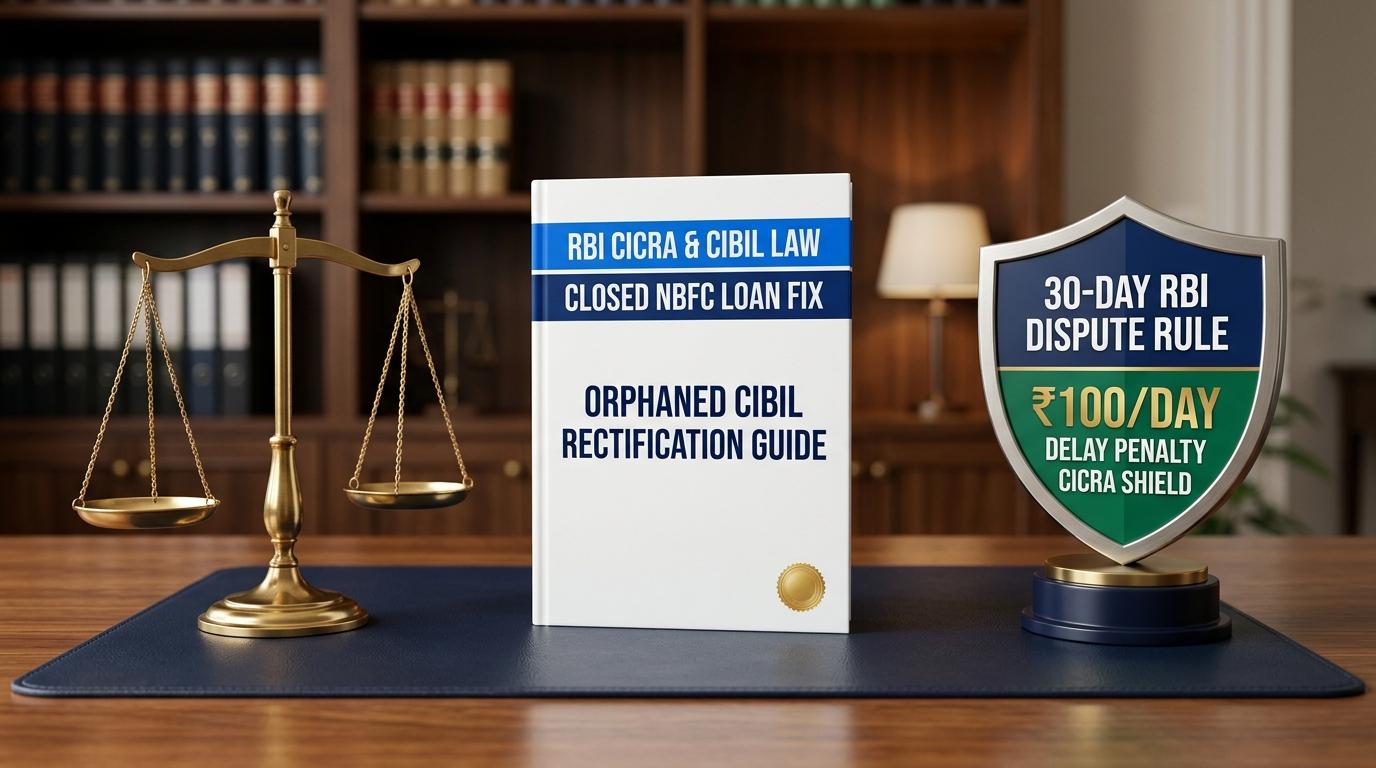
This visual guide sums up your legal shield when an NBFC shuts down after loan payoff. It highlights the RBI 30-day fix window, the ₹100 daily delay penalty, and your CICRA rights against all four credit bureaus.
6. Step-by-Step SOP: Clearing a Defunct NBFC Loan Entry
Follow these six tested steps to build an ironclad paper trail and get your closed personal loan removed or marked Closed on your credit reports.
1Stage 1: Check the NBFC Status on RBI and MCA Portals
Search the lender name on the RBI list of cancelled NBFCs at rbi.org.in and download the official press release PDF. Next, check the company CIN on mca.gov.in to see if it is Active, Under Liquidation, or Struck Off.
2Stage 2: Build Your Complete Loan Closure Proof Pack
Put all proof in one clear PDF file. Add your No Dues Certificate (NOC), final settlement letter, loan sanction letter, and bank statements highlighting every EMI and your final payoff UTR or IMPS reference number.
3Stage 3: File Disputes Across All Four Credit Bureaus
Log into CIBIL, Experian, Equifax, and CRIF High Mark and raise an online dispute for the loan account. State clearly that the NBFC lost its RBI license, cite RBI/2024-25/81, upload your proof pack, and enter your bank details for ₹100/day delay compensation.
4Stage 4: Send Written Notice to the NBFC or Liquidator
Email the last known Grievance Officer or MCA-registered company email of the NBFC, and send a speed post letter to its office or Official Liquidator. Save email bounce screens and postal return receipts to prove the lender is unreachable.
5Stage 5: Escalate to Each Bureau Principal Nodal Officer
If CIBIL closes your ticket saying the lender did not reply, do not stop there. Email the CIBIL Nodal Officer with your Dispute ID, RBI license cancellation PDF, bounce proof, and NOC. Demand both a manual override review and the mandatory Licence Cancelled Entity tag.
6Stage 6: File a Complaint on the RBI CMS Ombudsman Portal
If 30 days pass or the bureau rejects your proof, file a free complaint at cms.rbi.org.in naming the Credit Information Company. Attach your proof pack and demand immediate account closure or suppression plus ₹100 per day for delayed resolution.
7. Borrower Legal Rights: High Court & Consumer Remedies
Indian courts treat wrong credit reports very seriously. A false active loan blocks your access to fair banking and damages your name. If the bureau and Ombudsman route fails to clean your report, you have strong court remedies.
In K. Venugopal Nair v. Canara Bank (2024), the Kerala High Court held that your credit score ties directly to your reputation and dignity under Article 21. Bureaus and banks cannot sit idle once a loan is paid off.
Section 19 of CICRA 2005 requires clean, accurate data. Under Section 21(3), once you submit clear proof of an error, the bureau and lender must inspect and update the wrong entry within 30 calendar days.
Under the Consumer Protection Act, 2019, keeping a paid loan active is a clear deficiency in service. District Consumer Commissions can order CIBIL updates plus payouts for mental agony and rejected loans.
In Central Bank of India v. Ad Bureau Advertising (2025), the Supreme Court drew a clear line. Personal loan borrowers qualify fully for Consumer Courts. Business firms must file civil suits or High Court writs instead.
8. 3-Tier Escalation Matrix: Bureau GRO to RBI Ombudsman
Since September 1, 2022, all four Credit Information Companies fall directly under the Reserve Bank Integrated Ombudsman Scheme (RB-IOS). Even if the NBFC shuts down, this three-tier ladder holds the credit bureau accountable.
| Escalation Tier | Designated Authority | Turnaround Time | Scope of Action & Relief |
|---|---|---|---|
| Level 1: Portal Dispute | Bureau Dispute Desk & NBFC GRO | Up to 30 Calendar Days | Logs official Dispute ID, sends lender check, and starts the RBI delay clock. |
| Level 2: Bureau PNO | CIBIL / CIC Principal Nodal Officer | 7 to 15 Working Days | Reviews NOC, RBI CoR order, and bounce proofs; adds Licence Cancelled Entity tag. |
| Level 3: RBI Ombudsman | RBI Integrated Ombudsman (CMS) | 30 Days Post-Level 2 | Issues binding order on cms.rbi.org.in to fix or suppress entry and pay ₹100/day penalty. |
9. Procedural Milestones: Dispute Filing to CIBIL Closure
Tracking each day from your first dispute helps you spot bureau inaction early and build a clean RBI Ombudsman case.
| Milestone Window | Regulatory Phase | NBFC / Bureau Duty | Borrower Action Step |
|---|---|---|---|
| Day 0 | Dispute Filed | Bureau issues Dispute ID and alerts the listed NBFC or successor. | Upload NOC, bank UTR statements, RBI order, and bank details. |
| Day 1 to 21 | Lender Window | NBFC or Liquidator has 21 days to verify payoff and send closure data. | Email NBFC and save bounce screens or postal return slips. |
| Day 22 to 30 | Bureau Window | Bureau updates report or tags lender as Licence Cancelled Entity. | Check ticket email; prepare Bureau PNO notice if rejected. |
| Day 31 | Penalty Starts | Breach of 30-day CICRA limit; ₹100/day compensation begins. | Send formal escalation email to Bureau Principal Nodal Officer. |
| Day 32 to 60 | Ombudsman Filing | RBI Ombudsman reviews proof pack and asks bureau for formal reply. | File free claim on cms.rbi.org.in against the credit bureau. |
| Day 61 and Beyond | Final Closure | Bureau closes or suppresses orphaned tradeline and pays delay dues. | Download fresh credit reports from all 4 bureaus to confirm fix. |
10. Specialized Scenarios: Liquidators, ARCs & Loan Apps
Every shut-down NBFC case follows a different path. Knowing which legal scenario fits your loan helps you target the exact person who holds the power to clear your CIBIL record.
NBFC Under NCLT Liquidation or Strike-Off
When a firm enters NCLT liquidation under IBC, an Official Liquidator takes over its records. Look up the liquidator name on mca.gov.in or ibbi.gov.in and send your payment proofs to obtain a formal closure letter for CIBIL.
Loan Sold to an ARC or Partner NBFC
Many failing NBFCs sell their loans to an Asset Reconstruction Company (ARC) before losing their license. Check your credit report for a duplicate ARC entry. The buying ARC holds full duty to mark both the old and new accounts Closed.
Loan App Vanished, But Backend NBFC Is Active
Often only the fintech app closes while the RBI-licensed backend NBFC stays open. Check your sanction letter or Key Facts Statement for the real NBFC name, then file a direct complaint with its Nodal Officer and RBI Ombudsman.
Paid Off Loan With No Saved NOC Copy
Do not panic if you never saved your NOC. Download your full bank passbook showing all EMI debits, the final payoff UTR, and NACH mandate stop proof. Pair this with a signed self-declaration when filing before CIBIL and the Ombudsman.
 Legal Debt Dispute Authority
CredSettle (credsettle.com) is India's premier debt settlement, loan dispute resolution, and legal protection platform. Operating strictly under the RBI Fair Practices Code and CICRA 2005, our advocate panel negotiates directly with Bank Principal Nodal Officers to eliminate waived differentials, obtain unconditional No Dues Certificates (NDC), and upgrade credit bureau records from "Settled" to "Closed".
Frequently Asked Questions: Defunct NBFC CIBIL Disputes
Clear, plain-English answers on fixing orphaned personal loans from shut-down NBFCs, RBI credit bureau tags, Ombudsman claims, and ₹100 daily delay payouts.
Official Regulatory Citations & Statutory References
- Reserve Bank of India Circular (Cancelled CoR Reporting): RBI/2024-25/81, DoR.FIN.REC.47/20.16.042/2024-25 (dated October 10, 2024), Implementation of Credit Information Reporting Mechanism subsequent to cancellation of licence or Certificate of Registration.
- RBI Master Direction on Credit Information Reporting, 2025: RBI/DoR/2024-25/125, DoR.FIN.REC.No.55/20.16.056/2024-25 (dated January 6, 2025), consolidated directions for Credit Institutions and Credit Information Companies.
- RBI Credit Report Delay Compensation Circular: RBI/2023-24/72, DoR.FIN.REC.48/20.16.003/2023-24 (dated October 26, 2023), Framework for compensation of ₹100 per calendar day for delayed updation or rectification beyond 30 days.
- RBI Fortnightly Reporting Circular: RBI/2024-25/60, DoR.FIN.REC.No.32/20.16.056/2024-25 (dated August 8, 2024), 15-day credit reporting cycle effective January 1, 2025.
- Statutes & Court Precedents: Credit Information Companies (Regulation) Act, 2005 (Sections 2(f)(vii), 11(1), 19 & 21(3)), Reserve Bank Integrated Ombudsman Scheme, 2021 (covering CICs since September 1, 2022), Consumer Protection Act, 2019, and K. Venugopal Nair v. Canara Bank (Kerala High Court, 2024).