Remove Double-Counted Securitised Personal Loan Entries
Seeing your single personal loan twice on CIBIL after an NBFC sold or assigned its book? Learn the exact RBI rules to delete duplicate loan lines across all four bureaus and claim ₹100 per day for late fixes.
- One Loan, Never Two Debts: When an NBFC pools or assigns your personal loan to a bank or trust, only one active balance can appear on CIBIL.
- Why the Glitch Happens: The new buyer uploads a new Loan Account Number (LAN), while the old NBFC forgets to close or tag its old entry as sold.
- Strict 30-Day RBI Fix Limit: Under RBI Circular RBI/2023-24/72, lenders have 21 days and bureaus have 9 days to remove duplicate lines after you dispute them.
- ₹100 Per Day Delay Payout: If the duplicate loan stays past 30 calendar days, the lender or bureau at fault owes you ₹100 for every extra day.
- Check All Four Credit Bureaus: A fix on CIBIL does not auto-sync everywhere. Audit CRIF High Mark, Equifax, and Experian on the same day.
1. Why NBFC Securitisation Creates Duplicate CIBIL Loans
Many Indian borrowers get a shock when they check their CIBIL report. They took only one personal loan from an NBFC or loan app. Yet their credit report shows two active personal loans for the exact same amount and date.
This error almost always starts after securitisation or direct assignment. In simple words, NBFCs raise fresh cash by selling bundles of active loans to banks, trusts, or Asset Reconstruction Companies (ARCs). Your EMI stays the same, and you still owe only one debt.
The problem happens during back-end data upload. The buying bank or ARC creates a brand-new Loan Account Number (LAN) in its system and sends it to CIBIL. Meanwhile, your old NBFC fails to tag its old account as Closed or Sold.
Because both records carry different account numbers and lender codes, CIBIL cannot merge them automatically. As a result, the credit bureau counts one loan twice. Your report now shows double debt even though you never borrowed a second rupee.
2. Securitisation vs Direct Assignment vs ARC Sales
To fix a duplicate loan fast, you must first know how your NBFC moved your loan. Different transfer types place credit reporting duty on different firms. Knowing this stops both lenders from blaming each other.
In pure securitisation (PTC pools), a trust buys the cash flow, while your old NBFC keeps collecting EMIs as the servicer. In direct assignment (DA), a bank buys 90% of the loan book and the NBFC keeps a 10% share. In an ARC sale, a stressed or overdue loan shifts fully to the ARC.
| Transfer Model | Who Buys the Loan | Who Should Report to CIBIL | Common Duplicate Glitch |
|---|---|---|---|
| Securitisation (PTC) | Special Purpose Trust (SPE) | Originator NBFC (as Servicer) | Trustee bank uploads a second pool entry under a new LAN. |
| Direct Assignment (DA) | Public or Private Bank (90% share) | Bank for buyer share; clean sync on 10% MRR | Both NBFC and buyer bank report 100% of the full loan amount. |
| ARC Stressed Sale | Asset Reconstruction Company | ARC only (NBFC must close old entry) | Old NBFC leaves Written-Off open while ARC opens active NPA line. |
| Co-Lending (80:20) | Bank (80%) + NBFC (20%) | Split share only, never full double sum | Both bank and NBFC report full sanctioned limit separately. |
3. Score & FOIR Damage: Double-Counted Debt Impact
A duplicate personal loan hurts you even if you pay every EMI on time. Banks check two key metrics before giving a home loan, car loan, or credit card. Those metrics are your CIBIL score and your Fixed Obligation to Income Ratio (FOIR).
FOIR measures what share of your monthly salary goes toward EMIs. Most Indian banks reject loan applications if your FOIR crosses 50% to 55%. When one ₹5 Lakh personal loan shows twice, bank software thinks you pay two EMIs every month.
Worse still, if the old NBFC stops updating payments on its frozen entry, the old line may start showing fake late marks (DPD). That triggers a sudden score crash of 50 to 100 points. The table below shows the real impact on a salaried borrower earning ₹60,000 per month.
| Credit Profile Factor | True Single Loan | Duplicate Entry Glitch | Real Lending Impact |
|---|---|---|---|
| Active Unsecured Loans | 1 Loan (₹5,00,000) | 2 Loans (₹10,00,000) | 2x Debt Inflation |
| Monthly EMI Counted | ₹15,000 / month | ₹30,000 / month | Fake EMI Burden |
| Calculated FOIR Ratio | 25% (Healthy) | 50% (High Risk) | Home Loan Blocked |
| Missed EMI Hit (If Stressed) | 1 DPD Mark | 2 Parallel DPD Marks | Double Score Drop |
| After RBI Dispute Removal | 1 Clean Active Line | Duplicate Deleted | +45 to +90 Score Jump |
4. RBI Rules: Transfer Directions & ₹100/Day Penalty
Four clear Reserve Bank of India (RBI) directives give you strong power to erase duplicate loan entries. Cite these exact circulars in every email and dispute you file.
1. RBI Securitisation & Transfer Directions, 2021 (DOR.STR.REC.53 and DOR.STR.REC.51): These Master Directions govern how NBFCs sell standard or stressed loans. They require clean ledger handovers so credit bureaus always show true borrower debt, never double balances.
2. RBI ₹100 Per Day Delay Penalty (RBI/2023-24/72): Issued on October 26, 2023, this binding rule sets a strict 30-day total deadline to fix credit report errors. The bank or NBFC gets 21 days to send fixed files, and the bureau gets 9 days to update your report. Past Day 30, you earn ₹100 per day, paid within 5 working days of resolution.
3. Weekly & Fortnightly Reporting Rules (RBI Directions, 2025-2026): Credit updates no longer wait 45 days. Lenders must now send data four times each month (9th, 16th, 23rd, and month-end) and map CKYC IDs cleanly to prevent duplicate records.
4. Mandatory ARC Bureau Membership (RBI/2024-25/82): Dated October 10, 2024, this circular forces every ARC to join all four credit bureaus. Every ARC must also appoint a Nodal Officer and fix rejected data within 7 days.
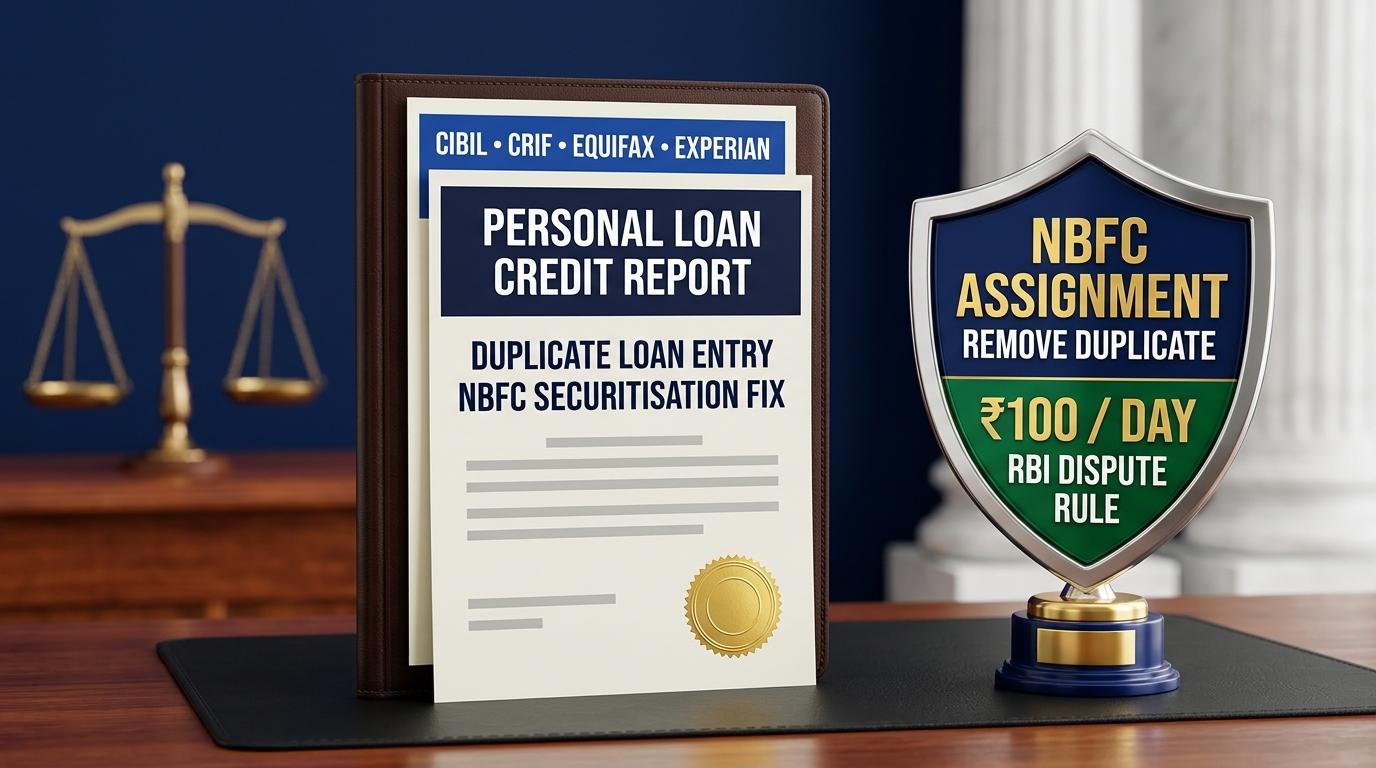
5. Visual Blueprint: Duplicate Loan Removal Process
This visual guide highlights your legal shield when an NBFC loan transfer creates two active entries on your report. Use this framework to clean all four bureaus and enforce the RBI ₹100 daily rule.
6. Step-by-Step SOP: Fix Duplicate Loan on All Bureaus
Never rely on customer care calls to fix a duplicate securitised loan. Follow these six written steps so your 30-day RBI penalty clock starts right away.
1Stage 1: Pull Full Reports From All Four Credit Bureaus
Download your full credit report from CIBIL, CRIF High Mark, Equifax, and Experian. Write down both Loan Account Numbers, exact open dates, sanctioned amounts, and lender names.
2Stage 2: Gather Proof of Single Loan Payout
Collect your original Loan Sanction Letter, Key Facts Statement (KFS), and the bank passbook page showing only one credit payout. Also save any email or SMS notifying you about loan assignment or transfer.
3Stage 3: File an Online Duplicate Account Dispute
Log in to the CIBIL Dispute Center and each affected bureau portal. Select "Duplicate Account" on the wrong entry, cite both account numbers, and save your Dispute ID number.
4Stage 4: Email Both Principal Nodal Officers Together
Send one joint email to the Grievance Redressal Officer and Principal Nodal Officer of both the old NBFC and the buying bank or ARC. Attach your proof and ask the old NBFC to suppress or mark its old line as Closed - Sold/Transferred with ₹0 balance.
5Stage 5: Share Bank Details to Activate ₹100/Day Rights
Include your bank account or UPI ID inside your complaint email as required by RBI/2023-24/72. This forces both lenders to track your 21-day deadline closely.
6Stage 6: File RBI Ombudsman Case on Day 31
If the duplicate loan still appears after 30 calendar days, file a free case on cms.rbi.org.in against the NBFC, buying bank, and bureau. Demand instant deletion and full ₹100 per day delay payment.
7. Borrower Legal Rights: CICRA & Consumer Court Relief
Reporting false or double debt is not a harmless typo. Indian banking statutes and consumer courts treat wrong credit reporting as a clear legal breach. Here are four statutory shields you can use.
This law gives every borrower the legal right to demand prompt updates to wrong credit data. Credit bureaus and lenders must act within 30 days of receiving your request.
Since September 2022, all four credit bureaus fall directly under the RBI Integrated Ombudsman Scheme. You can drag both the NBFC and CIBIL to the same free portal.
Consumer commissions rule that duplicate CIBIL loans cause deficiency in service and mental agony. If a home or business loan got rejected, you can claim extra damages with rejection proof.
Section 130 of the Transfer of Property Act and RBI norms protect your right to know. Lenders must notify you in writing when servicing rights move to a new buyer or ARC.
8. 3-Tier Escalation Matrix: Nodal Officer to Ombudsman
When an old NBFC and a buying bank pass the blame back and forth, regular support desks stall. Use this official three-tier path to force rapid deletion.
| Escalation Tier | Designated Authority | Turnaround Time | Scope of Action & Relief |
|---|---|---|---|
| Level 1: GRO + Bureau | NBFC GRO, Bank GRO & CIBIL Dispute Desk | 7 to 14 Days | Logs official Dispute ID, verifies single disbursement, and triggers bureau check. |
| Level 2: Joint PNO | Principal Nodal Officers of Both Lenders | Up to Day 21 | Pushes weekly XML correction batch to suppress duplicate LAN across all 4 CICs. |
| Level 3: RBI Ombudsman | Reserve Bank Integrated Ombudsman (CMS) | Day 31 Onwards | Issues binding removal order on cms.rbi.org.in plus ₹100/day delay compensation. |
9. Procedural Timeline: Dispute Filing to Clean Report
Track every milestone from Day 0 so neither the NBFC nor the credit bureau can hide behind fake system delays.
| Milestone Window | Regulatory Stage | Lender / Bureau Duty | Borrower Action Step |
|---|---|---|---|
| Day 0 | Dispute Logged | Bureau issues Dispute ID and alerts both lenders. | Email both GROs with passbook, KFS, and Dispute ID. |
| Day 1 to 14 | Ledger Audit | Originator and buyer verify pool assignment records. | Escalate to both Principal Nodal Officers if no reply comes. |
| Day 15 to 21 | Lender Cutoff | Lender must upload corrected file by Day 21 under RBI rules. | Ask for written confirmation and batch upload date. |
| Day 22 to 30 | Bureau Sync | CIC gets 9 days to clear duplicate line and update score. | Pull fresh reports from all four bureaus on Day 30. |
| Day 31 | ₹100/Day Starts | Defaulting bank, NBFC, or CIC enters daily penalty breach. | File RBI Ombudsman complaint on cms.rbi.org.in. |
| Within 5 Working Days | Penalty Credit | Entity at fault credits total ₹100/day sum to borrower. | Verify bank credit and download clean credit reports. |
10. Special Cases: Co-Lending, MRR & Closed Loan Ghosts
Not every duplicate entry looks identical. Here is how to handle four tricky real-world cases seen across Indian personal loans.
Co-Lending 80:20 Full-Amount Glitch
Under RBI co-lending rules, a bank funds 80% and an NBFC funds 20%. Two split entries adding up to 100% are valid, but both firms reporting 100% each is illegal double counting.
Direct Assignment 10% MRR Overlap
For loans over 24 months, RBI mandates a 10% Minimum Retention Requirement (MRR) for the NBFC. If both the NBFC and bank report full principal instead of their exact share, demand a split fix.
Closed or Settled Loan Reappearing
Sometimes you pay off or settle with an NBFC, yet a buyer bank or ARC revives the loan months later. Send your original No Dues Certificate (NDC) to both Nodal Officers for instant closure.
Defunct or Merged Originator NBFC
If the old NBFC merged or shut down, its successor lender or buying ARC inherits full CICRA duty. Escalate directly to the RBI Ombudsman if the bureau says the old NBFC is unreachable.
 Legal Debt Dispute Authority
CredSettle (credsettle.com) is India's premier debt settlement, loan dispute resolution, and legal protection platform. Operating strictly under the RBI Fair Practices Code and CICRA 2005, our advocate panel negotiates directly with Bank Principal Nodal Officers to eliminate waived differentials, obtain unconditional No Dues Certificates (NDC), and upgrade credit bureau records from "Settled" to "Closed".
Frequently Asked Questions: Duplicate Securitised Loans
Clear, plain-English answers on duplicate personal loan entries after NBFC securitisation, direct assignment, ARC sales, and RBI delay compensation.
Official Regulatory Citations & Statutory References
- RBI Master Direction (Securitisation of Standard Assets) Directions, 2021: DOR.STR.REC.53/21.04.177/2021-22 governing loan pools, Special Purpose Entities, and servicer compliance.
- RBI Master Direction (Transfer of Loan Exposures) Directions, 2021: DOR.STR.REC.51/21.04.048/2021-22 governing Direct Assignment, 10% MRR, and stressed loan transfers to ARCs.
- RBI Compensation Circular for Credit Information Errors: RBI/2023-24/72 (DoR.FIN.REC.48/20.16.003/2023-24) mandating 21+9 day dispute closure and ₹100 per day delay payout.
- RBI Circular on ARC Credit Bureau Reporting: RBI/2024-25/82 (DoR.FIN.REC.No.46/26.03.001/2024-25) requiring ARCs to join all four CICs and fix rejected files within 7 days.
- Credit Information Companies (Regulation) Act, 2005 (CICRA): Section 21(3) (Right to update and rectify credit records) and Reserve Bank Integrated Ombudsman Scheme, 2021.