Rectify Name-Collision Mixed Credit Bureau Files in India
Found a stranger's defaulted personal loan on your CIBIL report? Learn how RBI mixed-file rules force banks and bureaus to unlink alien loans in 30 days or pay you ₹100 per day.
- Strict 30-Day Fix Rule: Under CICRA 2005 Section 21(3) and RBI Circular RBI/2023-24/72, the full fix limit is 30 days. Banks get 21 days and bureaus get 9 days.
- Automatic ₹100 Daily Fine: Any delay past 30 days triggers ₹100 per day. The guilty bank or bureau must pay this straight to your bank account.
- Mandatory Match Logic Checks: RBI Circular RBI/2023-24/73 directs CIBIL, CRIF, Equifax, and Experian to check their match logic. This stops bad file merges.
- Direct RBI Ombudsman Cover: All four bureaus came under the RBI Ombudsman Scheme on September 1, 2022. You can file one case against both the bank and CIBIL.
- Four-Bureau Verification: One bank typo can hit every credit bureau. Always pull your free report from CIBIL, CRIF, Equifax, and Experian.
1. Statutory Framework: RBI Mixed Credit File Rules
Many honest borrowers in India get a shock when a bank rejects their loan. They check their CIBIL report and spot a bad personal loan they never took. Often, that loan belongs to a stranger.
This error is a mixed credit file. It occurs when a bureau blends two people into one credit file. It also happens when a bank clerk types your PAN into another person's loan record.
Indian law gives you strong rights to fix this fast. Section 19 of the Credit Information Companies (Regulation) Act, 2005 (CICRA) requires banks and bureaus to keep data accurate. Under Section 21(3) of CICRA, they must fix a valid claim within 30 days.
On October 26, 2023, the RBI issued two key rules to back borrowers. Circular RBI/2023-24/72 sets a ₹100 per day fine for late fixes. Circular RBI/2023-24/73 orders bureaus to test their Search and Match rules so files stop colliding.
2. Mixed Credit File vs Identity Theft Loan Fraud
Before you file a complaint, check why the unknown personal loan sits on your report. A mixed credit file and identity theft need two very different legal steps. A quick audit of your Credit Information Report (CIR) tells you which problem you face.
In a mixed credit file, no crime happened. The bureau's matching engine blended your record with someone who shares your name, birth date, or old phone number. In identity theft, a fraudster stole your actual PAN or Aadhaar to open a fake loan in your name.
| Report Clue | Mixed Credit File (Name Collision) | Identity Theft (Fraudulent Loan) |
|---|---|---|
| Personal Info Section | Shows a slight name variant, second birth date, or another person's Voter ID or Passport. | Shows only your exact name, exact birth date, and your genuine PAN number. |
| Addresses & Phones | Lists unfamiliar cities, stranger addresses, or old mobile numbers you never used. | Uses your real address or a single fake address added right before the loan opened. |
| Hard Inquiries | Old inquiries from towns you never visited, often spread across several years. | Sudden cluster of fresh loan app or NBFC inquiries within a few days. |
| Loan Age & Pattern | Often includes older paid loans plus one recent defaulted personal loan in another city. | Usually a new instant personal loan or BNPL account that went straight into default. |
| Primary Fix Path | CIBIL Profile Split, Ownership Dispute, and Bank KYC Mismatch Notice. | Cybercrime Portal FIR, Police Complaint, Bank Fraud Wing, and Bureau Block. |
Also check the Ownership Indicator next to the alien loan. If it says Guarantor or Joint, you may have signed as a co-applicant years ago. If it says Individual and you never took that loan, start the mixed-file unlinking process right away.
3. Calculation Matrix: RBI ₹100 Daily Delay Penalty
Banks and bureaus used to drag mixed credit file complaints for six months or more. To end these delays, RBI Circular RBI/2023-24/72 (DoR.FIN.REC.48) created an automatic compensation rule. This rule took full effect on April 26, 2024.
The law gives both parties a strict combined window of 30 calendar days from your first complaint date. The reporting bank or NBFC gets 21 days to verify KYC records and send corrected data. The credit bureau gets 9 days to unlink the loan and update your report.
If your report stays wrong past Day 30, you earn ₹100 for every single day of delay. The party that broke its time limit must pay you straight into your bank account within 5 working days of fixing the dispute. If both delayed, they split the payout based on their extra days.
| Timeline Post-Dispute | Delay Past Day 30 | Who Pays Under RBI Rule | Compensation Owed |
|---|---|---|---|
| Day 1 to Day 30 | 0 Days | Statutory Window (21d CI + 9d CIC) | ₹0 (Allowed Window) |
| Day 45 (15 Days Late) | 15 Days Delay | Faulty Bank or Bureau Pays | ₹1,500 |
| Day 60 (30 Days Late) | 30 Days Delay | RBI Ombudsman Escalation Triggered | ₹3,000 |
| Day 90 (60 Days Late) | 60 Days Delay | Joint Bank & CIC Liability | ₹6,000 |
| Day 120 (90 Days Late) | 90 Days Delay | Per Bureau + Consumer Court Damages | ₹9,000 + Tort Claim |
Keep one key point in mind. This ₹100 daily penalty applies separately to each credit bureau where you filed a formal dispute. If both CIBIL and CRIF High Mark stay late past 30 days, each late dispute earns its own ₹100 daily payout.
4. Root Causes: How Bureau Matching Merges Profiles
Indian credit bureaus store data for crores of people. They do not match files by PAN alone. Older loans and small NBFC files often used a Voter ID, Passport, or phone number instead of PAN.
To link loans, bureaus run fuzzy Search and Match software. Two people may share a common Indian name, birth date, and city. When that happens, the software can merge both files into one report.
Bank data entry typos are the second big cause. A clerk types one wrong digit in a defaulter's PAN, and it matches yours. Banks now send data four times a month on the 9th, 16th, 23rd, and month-end. So the bad loan keeps coming back until the bank drops your PAN at its source.
A plain balance dispute often fails for a mixed file. Ask the bureau for a full Profile Split and Ownership Unlink. At the same time, tell the bank to wipe your PAN from the stranger's CIF and CKYC file.
5. Visual Blueprint: Mixed File Unlinking Workflow
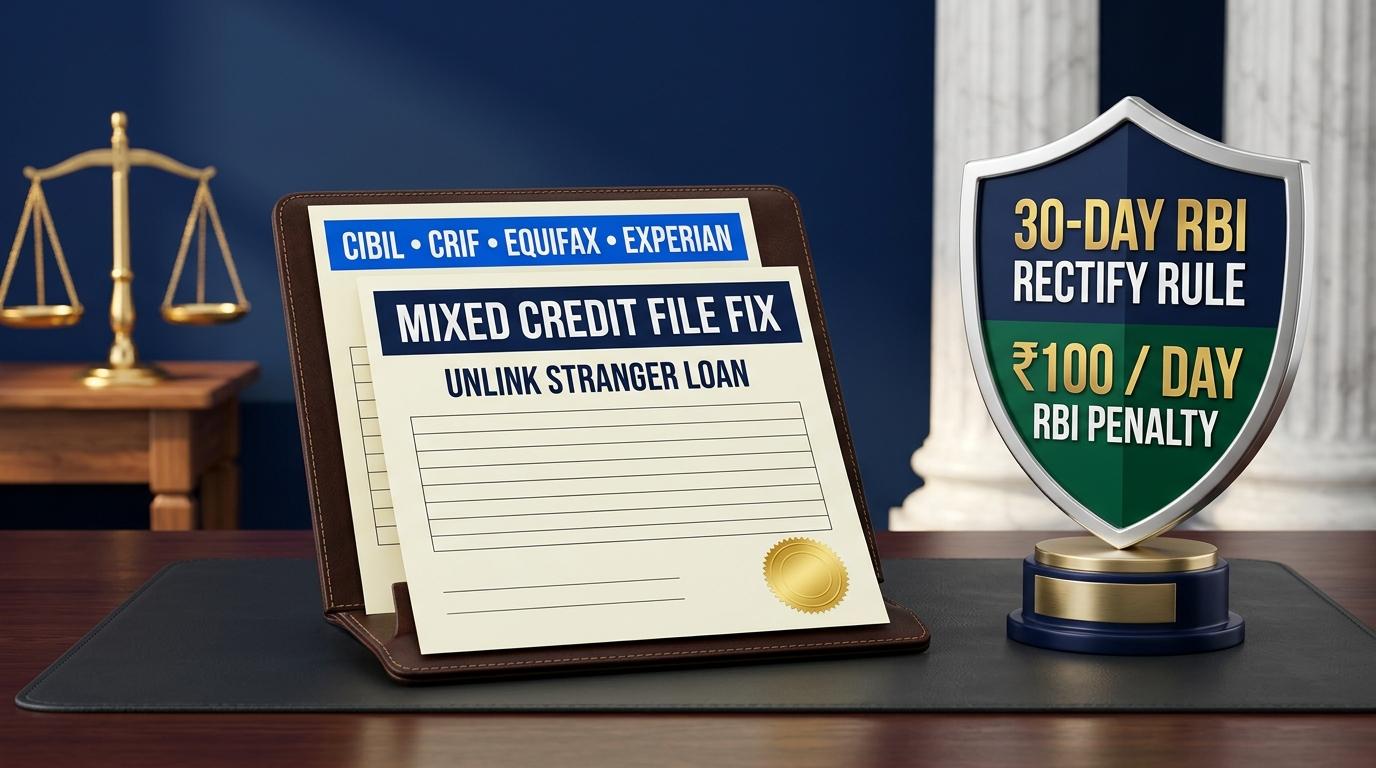
This visual chart sums up your core rights across all four Indian credit bureaus. It shows the 30-day RBI fix rule and the ₹100 per day fine for delays.
6. Step-by-Step SOP: Remove a Stranger's CIBIL Loan
Follow these six simple steps to remove a stranger's loan. They clean all four credit reports and lock in your ₹100 daily fine if a bank stalls.
1Stage 1: Download All 4 Free Full Credit Reports (FFCR)
RBI Circular RBI/2023-24/73 gives you one free full report each year from all four bureaus. Pull CIBIL, Experian, Equifax, and CRIF High Mark. Save each PDF and note the 9-digit CIBIL Control Number.
2Stage 2: Highlight Every Alien Loan and Stranger KYC Clue
Mark the bank name, masked loan number, open date, and overdue sum. Circle any strange address, unknown phone, or extra ID inside Personal Info.
3Stage 3: Raise Ownership and Mixed-Profile Disputes Online
Log into MyCIBIL Dispute Center and mark the loan under Ownership (Account Does Not Belong to Me). Also dispute each alien address and phone so CIBIL splits the file. Add your bank or UPI details for RBI penalty payouts.
4Stage 4: Email the Reporting Bank's Nodal Officer in Parallel
Do not wait on CIBIL alone. Email the bank Grievance Officer with your PAN, masked Aadhaar, Dispute ID, and report copy. Ask them to check the borrower's photo and KYC, confirm the mismatch, and tell all four bureaus to unlink the loan.
5Stage 5: Issue Day-31 RBI Penalty Notice and Escalate to CMS
If the loan stays past Day 30, send a written notice citing RBI Circular RBI/2023-24/72. File a joint case against both the bank and the bureau on cms.rbi.org.in. Claim deletion plus your ₹100 daily payout.
6Stage 6: Verify Clean Reports and Permanent Source Suppression
Check your free updated report within 5 working days after closure. Confirm that the stranger's loan, address, and hard inquiries are gone. Pull a fresh check 30 days later so no new batch upload adds the loan back.
7. Borrower Legal Rights: Consumer Court & DPDP Act
The ₹100 daily RBI fine is only your base relief. A stranger's bad loan can cause home loan rejections, higher interest rates, and deep stress. Indian courts let you claim much larger sums for real loss.
Courts treat wrong PAN tagging and mixed reports as poor service. Consumer forums and India's data privacy law both protect honest citizens.
Under Sections 2(11) and 39, linking a stranger's default to you is gross fault. District Consumer Forums have ordered lenders to clean CIBIL files and pay ₹50,000 plus ₹25,000 in legal costs.
In cases like Central Bank of India v. M/s Ad Bureau Advertising, higher forums backed strong payouts. Banks pay damages when careless CIBIL reports hurt a borrower's good name and loan access.
Section 12 of the DPDP Act, 2023 gives you the right to fix or erase wrong personal data. Use this law to wipe alien phones, addresses, and KYC tags from bank systems.
If the bank finds real fraud using fake KYC, act fast. File a report on cybercrime.gov.in and seek a police FIR under BNS cheating and IT Act Section 66C. This blocks recovery calls.
8. 3-Tier Escalation Matrix: Nodal Officer to RBI
Many mixed-file cases get stuck when the bank blames CIBIL and CIBIL blames the bank. Break that loop using the RBI three-tier complaint ladder.
| Escalation Tier | Designated Authority | Turnaround Time | Scope of Intervention & Relief |
|---|---|---|---|
| Level 1: Dispute Desk | Bank GRO & CIC Dispute Portal | Day 1 to Day 14 | Logs official Dispute ID, flags loan Under Dispute, and starts KYC check. |
| Level 2: Nodal & IO | Bank PNO & CIC Internal Ombudsman | Day 15 to Day 30 | Checks rejected claims, confirms KYC mismatch, and orders a profile split. |
| Level 3: RBI Ombudsman | Reserve Bank Integrated Ombudsman | After Day 30 | Issues binding order on cms.rbi.org.in to delete the loan and pay ₹100/day. |
Since April 1, 2023, every credit bureau must keep an independent Internal Ombudsman (IO). Before CIBIL or any bureau rejects your claim, its IO must check the case.
9. Procedural Milestones: Discovery to Clean Report
Track each date from the day you spot the alien loan. Clear logs stop banks and bureaus from missing their RBI limits.
| Milestone Window | Regulatory Phase | Bank / CIC Duty | Borrower Action Protocol |
|---|---|---|---|
| Day 0 | Mixed File Discovery | Gives Free Full Credit Report and 9-digit Control Number. | Check all 4 reports and save PAN, Aadhaar, and error proof. |
| Day 1 | Dual Filing Start | Bureau marks the bad loan Under Dispute and alerts the bank. | File bureau Ownership + Split claim and email the Bank GRO. |
| Day 2 to 21 | Bank KYC Audit | Bank checks KYC, proves mismatch, and sends fix to the bureau. | Write to Bank PNO on Day 14 if no reply arrives. |
| Day 22 to 30 | Bureau Update Window | Bureau splits the file, drops the loan, and fixes your score. | Track Dispute ID and demand written reasons if denied. |
| Day 31 Onwards | ₹100/Day Penalty Live | Late Bank or Bureau owes ₹100 per day under RBI rules. | File RBI CMS case against both bank and credit bureau. |
| Post-Fix (+5 to 30d) | Closure & Audit | Emails free clean report and pays fine within 5 working days. | Check again next month to confirm the loan stays gone. |
10. Specialized Cases: Shared Names & Old Numbers
Not every mixed file looks the same. Common family and phone habits in India can cause repeat merges unless you fix the root cause.
Father-Son & Twin Name Collisions
Kin who share one home address and close names often face file merges. Identical twins face this too. Send both PAN cards together so CIBIL keeps two distinct Control Numbers.
Recycled SIM & Mobile Number Merges
Indian telecom firms reuse dead mobile numbers after 90 days. If the old user missed EMIs, bureaus may link that debt to you. Send your SIM receipt and ask to unlink the phone.
Digital Loan Apps & NBFC PAN Typos
Fast loan apps use agents who often enter wrong KYC fields. Even if the app closes, find its RBI-backed NBFC on your CIBIL report. Send your legal notice straight to that NBFC Nodal Officer.
Urgent Home Loan or Job Background Checks
Have a home loan or job check due before Day 30? Ask the bank for a signed Non-Ownership Letter on bank letterhead. Most loan teams accept it with your CIBIL Dispute ID.
 Legal Debt Dispute Authority
CredSettle (credsettle.com) is India's premier debt settlement, loan dispute resolution, and legal protection platform. Operating strictly under the RBI Fair Practices Code and CICRA 2005, our advocate panel negotiates directly with Bank Principal Nodal Officers to eliminate waived differentials, obtain unconditional No Dues Certificates (NDC), and upgrade credit bureau records from "Settled" to "Closed".
Frequently Asked Questions: Mixed Credit File Fix
Get clear answers on removing a stranger's loan from CIBIL. Learn how to split mixed files, claim ₹100 per day, and protect your credit score.
Official Regulatory Citations & Statutory References
- Credit Information Companies (Regulation) Act, 2005 (CICRA): Section 19 (Accuracy and Security of Credit Information) and Section 21(3) (Mandatory 30-Day Rectification of Credit Data).
- Reserve Bank of India Circular RBI/2023-24/72: DoR.FIN.REC.48/20.16.003/2023-24 dated October 26, 2023 (Framework for Compensation of ₹100/Day for Delayed Updation or Rectification of Credit Information, effective April 26, 2024).
- Reserve Bank of India Circular RBI/2023-24/73: DoR.FIN.REC.49/20.16.003/2023-24 dated October 26, 2023 (Strengthening of Customer Service Rendered by CICs and CIs: Search & Match Logic Review, SMS/Email Alerts, and Annual FFCR).
- Reserve Bank - Integrated Ombudsman Scheme, 2021 (RB-IOS): RBI Notification CEPD.PRD.No.S544/13.01.001/2022-23 dated August 5, 2022 (Inclusion of all Credit Information Companies effective September 1, 2022).
- Consumer Protection Act, 2019 & DPDP Act, 2023: Section 2(11) & Section 39 (Deficiency in Service & Damages) and Section 12 of the DPDP Act (Right to Correction and Erasure of Personal Data).