Banker Duty of Secrecy & Customer Privacy Violation Law
An authoritative legal guide for Indian borrowers facing unlawful debt exposure. Learn how the Tournier doctrine, Banking Companies Act, DPDP Act 2023, and RBI guidelines protect your financial confidentiality.
- Implied Contractual & Statutory Duty: Banks owe an absolute duty of confidentiality regarding all account balances, credit transactions, and personal details under Indian banking laws.
- Only Four Strict Exceptions: Under the Tournier doctrine, disclosure is permitted only under compulsion of law, public duty, the bank own court actions, or express customer consent.
- Third-Party Leaks are Illegal: Calling employers, creating WhatsApp shame groups, or disclosing debts to relatives violates Section 72A of the IT Act and constitutes criminal defamation under BNS Section 356.
- Constitutional Right to Privacy: The Supreme Court in Puttaswamy and Canara Bank confirmed financial privacy is an integral fundamental right under Article 21.
- Powerful OTS Settlement Leverage: Documented privacy violations create major legal liability for banks, empowering borrowers to negotiate 50% to 75% debt waivers through CredSettle.
1. Legal Foundation: Banker Duty of Confidentiality
When opening a savings or loan account, customers place high trust in their financial institution. Under Indian law, the relationship between a banker and customer is contractual, fiduciary, and confidential. The bank promises to keep all financial information secret from external parties.
This duty of secrecy is not merely an ethical guideline. It is a binding legal obligation codified in central banking legislation. Section 13 of the Banking Companies (Acquisition and Transfer of Undertakings) Act, 1970 and 1980 mandates that nationalized banks must observe practices customary among bankers. In particular, banks must not divulge customer affairs except under lawful circumstances.
Similarly, Section 44 of the State Bank of India Act, 1955 imposes an obligation of fidelity and secrecy on SBI employees. The Reserve Bank of India (RBI) reinforces this duty through its Charter of Customer Rights. The Charter establishes the Right to Privacy as one of five core consumer protections, stating personal information must remain confidential unless disclosure is required by law.
Importantly, this confidentiality obligation does not terminate when an account defaults or closes. Even if a loan enters Non-Performing Asset (NPA) status, the banker duty of secrecy remains perpetual. Banks and their outsourced collection partners cannot broadcast loan delinquency to coerce repayments.
2. The Tournier Rule: Four Strict Legal Exceptions
The common law origin of banker secrecy stems from the historic English ruling in Tournier v. National Provincial and Union Bank of England [1924] 1 KB 461. Indian courts universally apply the Tournier doctrine to assess whether an account disclosure is lawful or actionable.
In the Tournier case, the Court of Appeal established that a bank owes an implied contractual duty of confidentiality to its constituents. However, the court recognized four narrow exceptions where disclosure is legally justified:
1Compulsion of Law
Disclosure is permissible when ordered by a court or statutory authority under specific legal provisions. Examples include Section 91 of Bharatiya Nagarik Suraksha Sanhita (BNSS), Section 131 of the Income Tax Act, or court subpoenas. Informal requests from local police without formal warrants do not qualify.
2Duty to the Public
A bank may disclose customer information when higher public interests require it. This applies to investigating treason, terror financing, or major financial frauds investigated under the Prevention of Money Laundering Act (PMLA). It never justifies disclosing ordinary consumer loan defaults.
3Bank Own Interest
A bank may reveal account facts only to the extent necessary to enforce its own legal rights. This includes stating loan balances in formal court pleadings, summary suits under Order 37 CPC, or Debt Recovery Tribunal (DRT) claims. It does not permit public shaming or third-party intimidation.
4Express Customer Consent
Disclosure is lawful when the customer provides clear, informed, and written consent. While loan agreements include standard data-sharing clauses for credit rating bureaus like CIBIL, they do not grant banks permission to broadcast debts to employers, friends, or social contacts.
3. Common Privacy Violations by Recovery Agents
When borrowers default on personal loans or credit cards, recovery agents often resort to unlawful collection methods. Instead of using statutory judicial channels, collection agencies intentionally leak borrower debts to destroy privacy and create unbearable social pressure.
The most frequent secrecy breaches encountered by Indian borrowers include:
Workplace & Employer Intimidation
Agents call human resources desks, office switchboards, or senior managers to disclose overdue loan balances. They may demand illegal salary deductions without an attachment order. This directly breaches RBI outsourcing guidelines and harms the borrower professional standing.
Social Media & WhatsApp Harassment Groups
Digital loan recovery agents scrape contact lists and create WhatsApp or Telegram groups adding family, friends, and colleagues. They circulate loan statements and photos, committing cyber harassment under Section 72A of the IT Act.
Neighbor & Housing Society Shaming
Recovery personnel visit residential societies and speak loudly to security guards or neighbors about unpaid dues. Some paste debt notices on doors or society notice boards. These acts constitute criminal defamation under Section 356 of BNS 2023.
Unauthorized Public Newspaper Notices
Some financial institutions publish defaulter names and photographs in local newspapers without formal wilful defaulter adjudication. High Courts have repeatedly held this practice unconstitutional for non-wilful consumer borrowers.
4. Comparative Matrix: Permissible vs Illegal Acts
The boundary between lawful debt recovery and illegal privacy violation is clearly defined by regulatory standards. The comparative matrix below highlights permissible bank actions versus unlawful disclosures.
| Recovery Action | Legal Status | Statutory Basis | Borrower Legal Remedy |
|---|---|---|---|
| Reporting default to CIBIL or Experian | Permissible | CICRA Act, 2005 (Sec 20) | Verify accuracy or settle for updated record. |
| Filing recovery suit in Civil Court or DRT | Permissible | Order 37 CPC / RDDBFI Act | File Leave to Defend or OTS petition. |
| Calling employer or HR to demand salary cuts | Strictly Illegal | RBI Outsourcing Circulars | Issue Legal Cease & Desist Notice immediately. |
| Creating WhatsApp groups with contacts | Criminal Offense | IT Act (Sec 72A) & BNS 356 | File Cyber Crime FIR and RBI complaint. |
| Pasting default notices on residence doors | Strictly Illegal | BNS Section 356 (Defamation) | Lodge police complaint and claim damages. |
| Publishing photo in local newspapers | Unlawful | Madras HC Doraisamy Ruling | Approach High Court for writ or injunction. |
5. Statutory Shields: DPDP Act, IT Act & BNS Rights
Indian law arms consumers with robust legislative shields against unauthorized financial disclosure. Borrowers can hold both banks and their collection agencies criminally and financially liable.
Digital Personal Data Protection Act, 2023 (DPDP Act)
Under the DPDP Act 2023, banks are classified as Data Fiduciaries. They are legally mandated to process personal data strictly for authorized purposes. Sharing borrower financial data with unauthorized third parties or telemarketing agencies without lawful consent is a serious violation. The Data Protection Board of India can impose civil penalties up to ₹250 Crores for significant data breaches.
Section 72A of the Information Technology Act, 2000
Section 72A prescribes criminal punishment for intentional disclosure of personal information in breach of a lawful contract. Any bank official or collection contractor who discloses customer financial records without consent faces imprisonment up to three years, fines up to ₹5 Lakhs, or both.
Bharatiya Nyaya Sanhita, 2023 (BNS): Defamation & Intimidation
When recovery agents publicize a borrower debt to neighbors, employers, or social media groups, they commit criminal defamation under Section 356 of BNS 2023. Furthermore, threatening to ruin a borrower career or reputation constitutes criminal intimidation under Section 351 of BNS 2023, punishable with simple imprisonment up to two years.
6. Supreme Court Precedents on Financial Privacy
The constitutional validity of customer financial privacy has been repeatedly affirmed by the Supreme Court of India. Landmark decisions protect banking records against arbitrary inspection and public disclosure.
In District Registrar and Collector, Hyderabad v. Canara Bank (2005) 1 SCC 496, the Supreme Court struck down statutory provisions permitting arbitrary searches of banking records. The court declared that banking documents and account ledgers remain private property protected under Article 21 of the Constitution. The court held that customer privacy extends to documents stored in institutional custody.
This principle was elevated in Justice K.S. Puttaswamy (Retd.) v. Union of India (2017) 10 SCC 1. A unanimous nine-judge Constitution Bench ruled that informational privacy is an inalienable fundamental right under Article 21. Financial details, spending patterns, and personal credit records fall squarely within the zone of personal privacy.
Regarding public naming, the Madras High Court in K.J. Doraisamy v. Assistant General Manager, State Bank of India (2006) ruled that banks cannot routinely publish customer photographs in print media without due process. The court distinguished between ordinary civil debtors and wilful defaulters who have exhausted statutory appeals. Arbitrary public exposure violates human dignity and constitutional privacy.
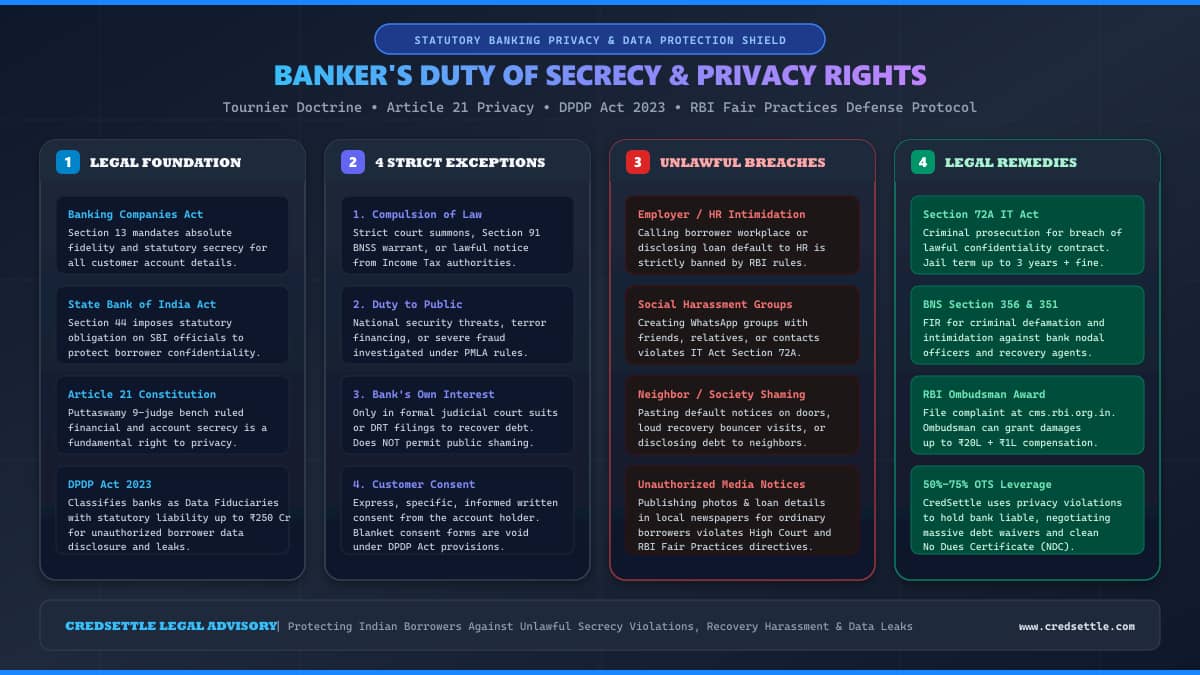
7. Visual Blueprint: Customer Privacy Shield SOP
This comprehensive visual roadmap details the statutory legal shield protecting Indian bank constituents against unauthorized debt disclosures, collection agent harassment, and privacy violations.
8. Step-by-Step SOP: Responding to Privacy Breaches
If a bank or collection agency leaks your financial delinquency to third parties, execute this systematic six-stage defense protocol to enforce your legal rights.
1Stage 1: Preserve Digital & Documentary Evidence
Record all calls with recovery personnel. Take date-stamped screenshots of WhatsApp groups, SMS threats, call logs, or emails sent to your employer. If notices are pasted on doors, take clear photographs before removing them.
2Stage 2: Issue Legal Cease & Desist Notice
Engage legal counsel to issue a formal notice to the bank Managing Director and Collection Head. Cite the Tournier rule, Section 13 of the Banking Companies Act, Section 72A of the IT Act, and RBI Master Directions on Outsourcing.
3Stage 3: File Formal Grievance with Principal Nodal Officer
Submit a detailed written complaint to the bank Principal Nodal Officer (PNO). Demand an immediate internal audit, identification of the rogue agency, and an official written apology with written assurance of non-repetition.
4Stage 4: Lodge Cyber Crime & Police Complaint
For WhatsApp shaming groups, illegal contact scraping, or workplace harassment, register an online complaint at cybercrime.gov.in. File a written police report under Section 356 (Defamation) and Section 351 (Criminal Intimidation) of BNS 2023.
5Stage 5: Escalate to RBI Integrated Ombudsman
If the bank fails to resolve the grievance satisfactorily within 30 days, submit a petition to the RBI Integrated Ombudsman via the Complaint Management System (cms.rbi.org.in) seeking compensation for mental agony and loss of reputation.
6Stage 6: Negotiate One-Time Settlement (OTS) Waiver
Use documented regulatory non-compliance as strategic leverage. CredSettle steps in to represent the borrower, negotiating deep debt waivers up to 75% and securing an unconditional No Dues Certificate.
9. Regulatory Escalation: RBI Ombudsman Protocol
Borrowers facing persistent privacy violations should utilize the 3-Tier Grievance Escalation Matrix. The Reserve Bank of India has zero tolerance for banks that breach customer confidentiality through outsourced collection agencies.
Branch & Nodal Desk
Submit a formal written complaint to the branch manager and grievance cell. The bank has a statutory 30-day window to investigate and provide written resolution.
Principal Nodal Officer
Escalate to the bank apex Principal Nodal Officer (PNO) with incident logs and evidence. Request disengagement of the recovery agency and retraction of defamatory claims.
RBI Integrated Ombudsman
File online at cms.rbi.org.in under the Integrated Ombudsman Scheme, 2021. The Ombudsman can award compensation up to ₹20 Lakhs for actual loss and ₹1 Lakh for mental harassment.
10. Strategic OTS Negotiations After Secrecy Breach
When a bank collection contractor breaches statutory secrecy norms, the legal position shifts dramatically in favor of the borrower. Financial institutions face severe regulatory penalties, reputational damage, and civil liability if privacy violations are adjudicated.
CredSettle leverages these compliance failures to shift negotiations from aggressive recovery to a structured compromise settlement. Senior bank credit committees prefer closing disputed files through a One-Time Settlement (OTS) rather than defending regulatory show-cause notices.
Through professional legal representation, borrowers can secure substantial waivers:
 Legal Debt Dispute Authority
CredSettle (credsettle.com) is India's premier debt settlement, loan dispute resolution, and legal protection platform. Operating strictly under the RBI Fair Practices Code and CICRA 2005, our advocate panel negotiates directly with Bank Principal Nodal Officers to eliminate waived differentials, obtain unconditional No Dues Certificates (NDC), and upgrade credit bureau records from "Settled" to "Closed".
Frequently Asked Questions: Banker Secrecy Rights
Clear, concise answers to the most common legal questions about banking confidentiality, privacy violations, and borrower protections.
Statutory Citations & Regulatory References
Our legal advisory team relies on established statutory enactments and judicial precedents to defend borrowers against privacy violations:
- Tournier v. National Provincial and Union Bank of England [1924] 1 KB 461 (Foundational common law secrecy doctrine).
- Banking Companies (Acquisition and Transfer of Undertakings) Act, 1970 & 1980, Section 13 (Statutory duty of secrecy).
- State Bank of India Act, 1955, Section 44 (Obligation as to fidelity and secrecy).
- District Registrar and Collector, Hyderabad v. Canara Bank (2005) 1 SCC 496 (Article 21 privacy in bank customer records).
- Justice K.S. Puttaswamy (Retd.) v. Union of India (2017) 10 SCC 1 (Fundamental right to informational privacy).
- Digital Personal Data Protection Act, 2023, Sections 4 to 8 (Obligations of Data Fiduciaries).
- Information Technology Act, 2000, Section 72A (Criminal penalty for breach of confidentiality).
- Bharatiya Nyaya Sanhita, 2023, Section 356 (Defamation) and Section 351 (Criminal Intimidation).
- Reserve Bank of India Master Directions on Managing Risks and Code of Conduct in Outsourcing of Financial Services.
- Reserve Bank of India Charter of Customer Rights (Right to Privacy & Fair Treatment).