Reverse Mis-Sold CPP Charges on Overdue Credit Cards
Spot and reverse unwanted Card Protection Plan (CPP) fees billed without your clear yes. Claim a full refund, waive extra interest and GST, and protect your CIBIL score under RBI and IRDAI rules.
- Explicit Consent Is Mandatory: Under RBI Master Directions 2022, banks cannot bundle a Card Protection Plan (CPP) or insurance cover without prior, separate, and explicit consent.
- Burden of Proof Lies on the Bank: If you dispute a CPP debit, the bank must produce a signed form, an OTP log, or a clear Pre-Issuance Verification Call (PIVC) recording.
- 30-Day IRDAI Free-Look Exit: For insurance-backed CPP policies, you get a 30-day free-look window from the date you receive the policy document to cancel and claim a refund within 7 days.
- Full Reversal of Cascading Charges: Reversing an illegal CPP fee also requires the bank to waive all resulting 18% GST, revolving interest, late fees, and overlimit penalties.
- Ombudsman & Consumer Relief: If the bank refuses to refund, you can escalate to the RBI Integrated Ombudsman, IRDAI Bima Bharosa, or Consumer Commission for damages.
1. Statutory Framework: RBI Explicit Consent Mandate
Many cardholders in India see a sudden ₹1,499 to ₹4,999 fee on their card bill. It often shows up as Card Protection Plan (CPP), CPP Plan, or Card Shield. Most people never asked to buy this plan.
The Reserve Bank of India bans such silent fees. Under the RBI Credit Card and Debit Card Directions, 2022, banks cannot add paid plans or cover on their own.
Banks cannot use pre-checked boxes on forms to sign you up. They must get your clear, separate yes before they start any paid plan. For online sign-ups, they must check your yes with an OTP.
If you agree to a plan, the bank must print the insurer name, address, and phone number on your bill. They must also save your nominee name. If the bank lacks proof of your clear yes, the fee is invalid and must go back to your card.
2. How CPP Mis-Selling Happens & E-Mandate Violations
Unwanted CPP fees often start in one of two ways. First, sales callers phone new users right after card delivery. They say the plan is free or required by RBI, and turn a casual “yes” into a paid yearly plan.
Second, agents add CPP during card sign-up using pre-checked boxes. Worse, many plans renew on their own each year. Card users only see the fee when their card goes overdue or hits its limit.
Yearly auto-renewals without notice also break the RBI E-Mandate Framework for repeat card bills. Under RBI rules, banks must send an alert at least 24 hours before any repeat debit. That alert must list the brand name, exact sum, date, and a link to stop it.
You can also pause or stop any repeat mandate right inside your bank card app. If a bank bills a yearly CPP fee without an OTP-backed mandate or a 24-hour alert, it breaks RBI rules.
3. Financial Impact: Interest, GST & Overlimit Fees
An unwanted ₹3,000 CPP fee rarely stays at ₹3,000. On an active or overdue card, one wrong debit sparks a chain of taxes, high interest, and late fees.
If you do not pay that fee, the bank marks it as a missed minimum due. The table below shows how one ₹3,000 CPP fee can grow your bill in 90 days.
| Billing Component | Trigger Condition | Regulatory Status | Illustrative Cost |
|---|---|---|---|
| Base CPP Membership Fee | Billed without explicit MFA consent | Unauthorized Principal | ₹3,000 |
| 18% GST on CPP & Fees | Applied on service & penalty charges | Refundable With Reversal | ₹540+ |
| Overlimit & Late Fees | Card limit breached or min due missed | Cascading Bank Penalty | ₹1,500 – ₹2,500 |
| Revolving Interest (36%–42% APR) | Grace period lost on unpaid statement | Compounded Monthly | ₹1,200 – ₹2,000 |
| Total Inflated Dues (90 Days) | Zero Value Received | 100% Reversible on Dispute | ₹6,240 – ₹8,040+ |
4. IRDAI Free-Look Period & Mis-Selling Cancellation
Many CPP plans are sold as group cover or include wallet and fraud insurance. When a plan has an insurance cover, IRDAI buyer rules give you a fast way out.
Under IRDAI rules, you get a 30-day Free-Look Period. This 30-day clock starts on the day you get the policy paper or Certificate of Insurance (COI), not the day your card was billed.
If you cancel inside this 30-day window, the insurer must pay back your money within 7 days. They can only cut stamp duty and a small daily risk cost for the days covered.
Even if 30 days have passed, you can still get a full refund by showing mis-selling. Insurers and banks must keep a Pre-Issuance Verification Call (PIVC) or signed form. If they have no proof, you can ask them to cancel the plan from day one.
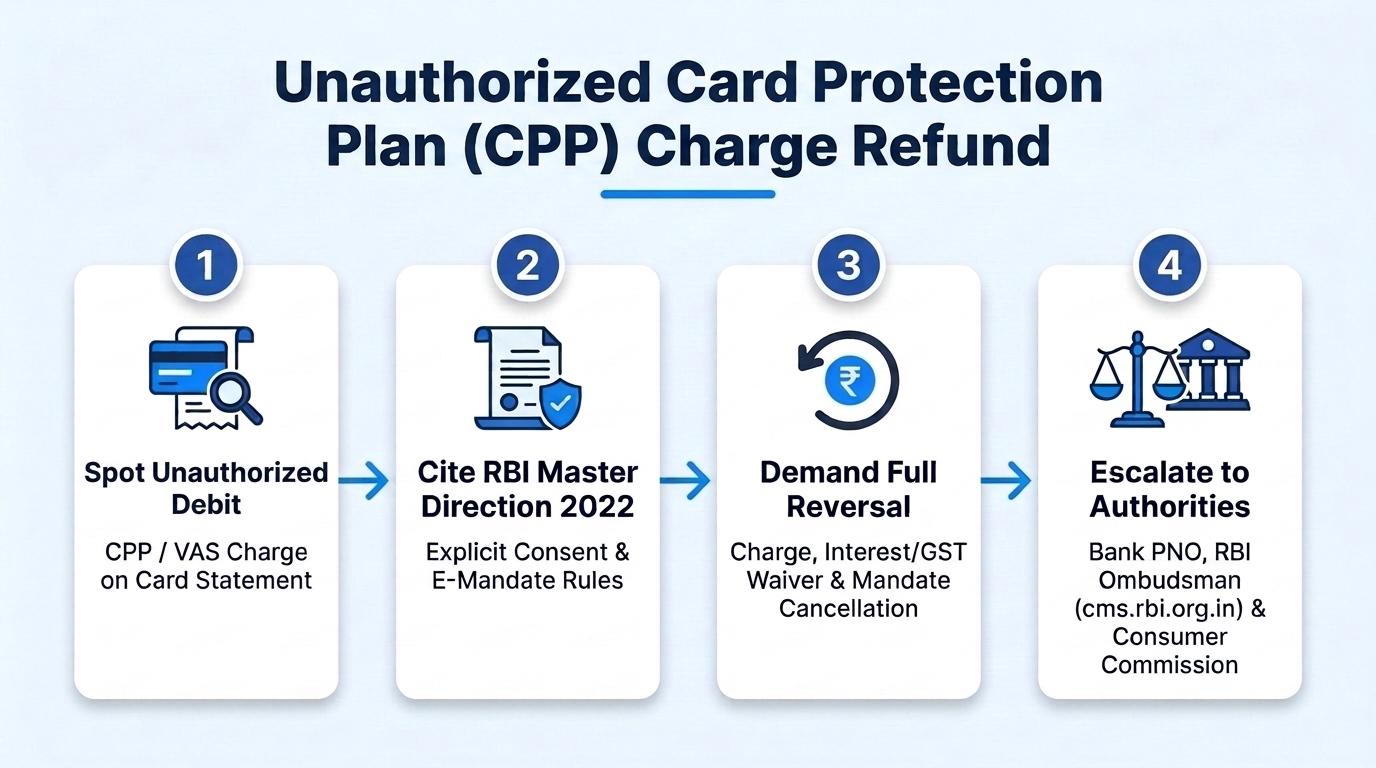
5. Visual Blueprint: CPP Dispute & Refund Workflow
This chart shows how to spot an unwanted CPP fee, ask your bank for proof of consent, and take the case to the RBI Ombudsman if the bank stalls.
6. Step-by-Step SOP: Claiming Your Full CPP Refund
Do not rely only on phone calls to customer care. Agents often stall or offer small gift vouchers. Follow these six steps in writing to get your full cash back.
1Stage 1: Check Past Card Bills for CPP Names
Download your last 12 to 24 months of card PDF bills. Mark each fee listed as CPP, CPP Plan, or Card Shield, along with the date and GST.
2Stage 2: Ask the Bank for Proof of Consent
Email your bank’s dispute desk. Ask them to share the signed form, OTP log, or full call tape that proves you said yes to the plan.
3Stage 3: File a Chargeback & Free-Look Request
Ask for a chargeback for an unapproved plan. If you got a policy paper in the last 30 days, also send a written IRDAI free-look email to cancel it.
4Stage 4: Stop the Repeat E-Mandate Right Away
Log in to your bank app or SIHub portal and stop any repeat CPP mandate. Save a screenshot so next year’s fee cannot auto-debit.
5Stage 5: Claim Back Interest, GST & Late Fees
Do not settle for just the base fee if it caused extra costs. Send a list asking the bank to waive 18% GST, interest, overlimit fees, and CIBIL late marks.
6Stage 6: File on RBI CMS & IRDAI Bima Bharosa
If the bank says no or stays quiet for 30 days, file a case on cms.rbi.org.in. For insurance plans, also log a complaint on bimabharosa.irdai.gov.in.
7. Borrower Rights: RBI Ombudsman & Consumer Courts
Indian banking and buyer laws give card users strong rights against mis-sold plans. Even if a third-party agent sold the plan, your bank is still liable for every debit on your card.
Under RBI customer liability rules, if you report an unapproved debit fast, your loss is zero. The bank must prove you said yes.
Billing a user without clear consent is a Deficiency in Service under Section 2(11) and an Unfair Trade Practice under Section 2(47) of the Consumer Protection Act, 2019.
Under the RBI Integrated Ombudsman Scheme, 2021, the Ombudsman can order a full refund, fix your CIBIL report, and award pay for stress and lost time.
If the bank ignores your notice, you can file a case online on the e-Jagriti portal within 2 years to claim a refund and legal costs.
8. 3-Tier Escalation Matrix: Bank GRO to Ombudsman
To unlock formal regulatory action at the RBI Ombudsman, you must first give your bank a written complaint and wait up to 30 days. Follow this three-tier escalation path.
| Escalation Tier | Designated Authority | Turnaround Time | Scope of Intervention & Relief |
|---|---|---|---|
| Level 1: GRO | Bank Grievance Redressal Officer | 7 to 10 Working Days | Logs your dispute ticket, checks telemarketing consent records, and initiates chargeback. |
| Level 2: PNO | Principal Nodal Officer (Head Office) | 14 to 21 Working Days | Audits MFA/PIVC proof, cancels the CPP e-mandate, and approves GST and interest waivers. |
| Level 3: Regulators | RBI Ombudsman / IRDAI Bima Bharosa | 30 Days Post-Complaint | Issues binding refund awards, orders CIBIL rectification, and grants harassment compensation. |
9. Procedural Milestones: Dispute to Full Reversal
Tracking each stage from discovery to final reversal ensures the bank cannot close your complaint with a generic template reply.
| Milestone Window | Regulatory Phase | Bank / Insurer Duty | Cardholder Action |
|---|---|---|---|
| Day 0 to Day 3 | Discovery & Alert | Must register your unauthorized debit report and issue a ticket number. | Email bank dispute desk, demand consent proof, and revoke e-mandate. |
| Day 4 to Day 10 | Consent Audit / Free-Look | Must refund free-look cancellations in 7 days or produce MFA/PIVC proof. | Escalate to Bank GRO if no valid call recording or OTP log is shared. |
| Day 11 to Day 30 | PNO Review | Principal Nodal Officer reviews mis-selling evidence and fee cascade. | Submit itemized demand for base CPP, 18% GST, interest, and late fees. |
| Day 31 Onward | Ombudsman Filing | Bank loses internal window; regulator takes over adjudication. | File on cms.rbi.org.in and bimabharosa.irdai.gov.in with all PDFs. |
| Resolution Stage | Credit & CIBIL Fix | Credits full reversal to card or bank account and updates credit bureau. | Verify zero CPP dues and confirm CIBIL DPD history is corrected. |
10. Special Cases: Overdue Cards, OTS & Closed Cards
Wrong CPP fees create special issues when a card is overdue, settled, or closed. Here is how to handle each case.
Overdue Cards & One-Time Settlement (OTS)
Before you sign a card settlement, check your bills for past CPP fees. Stripping out wrong CPP fees, interest, and GST cuts your real balance and lowers your OTS amount.
Refunds on Closed or Blocked Cards
Even if your card is closed or blocked, the bank cannot keep a CPP refund. Ask the bank to send the refund straight to your savings account via NEFT.
Silent Yearly Renewals Without Alert
If CPP renewed on its own for years without a 24-hour alert or OTP mandate, cite RBI e-mandate rules to claim back every past renewal fee.
Bank Blaming Third-Party Sales Callers
Banks often tell users to call CPP directly for a refund. Do not accept this excuse. Under RBI rules, your card bank is liable for every charge on your bill.
 Legal Debt Dispute Authority
CredSettle (credsettle.com) is India's premier debt settlement, loan dispute resolution, and legal protection platform. Operating strictly under the RBI Fair Practices Code and CICRA 2005, our advocate panel negotiates directly with Bank Principal Nodal Officers to eliminate waived differentials, obtain unconditional No Dues Certificates (NDC), and upgrade credit bureau records from "Settled" to "Closed".
Frequently Asked Questions: CPP Charge Refunds
Clear, verified answers on disputing unauthorized Card Protection Plan (CPP) fees, invoking IRDAI free-look cancellation, and escalating to the RBI Ombudsman.
Official Regulatory Citations & Statutory References
- RBI Master Direction: Reserve Bank of India (Credit Card and Debit Card - Issuance and Conduct) Directions, 2022 (Explicit prior consent and prohibition on unsolicited facilities).
- RBI E-Mandate Framework: Processing of e-mandates for recurring transactions on cards (Mandatory AFA setup, 24-hour pre-debit notification, and instant revocation).
- RBI Customer Liability Circular: DBR.No.Leg.BC.78/09.07.005/2017-18 on Limiting Liability of Customers in Unauthorised Electronic Banking Transactions.
- IRDAI Master Circular on Protection of Policyholders’ Interests: 30-day Free-Look Period from receipt of policy document and 7-day refund turnaround.
- Consumer Protection Act, 2019 & RBI Integrated Ombudsman Scheme, 2021: Section 2(11) Deficiency in Service, Section 2(47) Unfair Trade Practice, and Ombudsman compensation powers.