Can Lenders Block Early Personal Loan Closure for 1 Year?
Learn when a 12-EMI personal loan lock-in is valid and when it breaks Reserve Bank of India law. Understand the 2026 floating-rate ban, Key Facts Statement protections, and how to fight hidden closure fees.
- Floating-Rate Lock-In Ban: RBI Circular RBI/2025-26/64 took effect on January 1, 2026. Banks and NBFCs cannot enforce any lock-in period or foreclosure fee on floating-rate personal loans for individuals.
- Fixed-Rate Lock-In Limit: Lenders may use a 6 to 12 EMI lock-in on fixed-rate personal loans. However, this rule must follow board policy and appear clearly in your Key Facts Statement (KFS).
- No Hidden Fee Shield: Under RBI KFS rules (RBI/2024-25/18), every closure fee must appear in your KFS. Any lock-in or charge missing from that sheet is void and cannot be billed.
- Digital Loan Cooling-Off Exit: Under RBI Digital Lending rules (RBI/2025-26/36), online loans must offer a look-up period of at least one day. You can exit penalty-free during that window.
- Fast Refund & Redressal: Did your bank block valid loan closure or take hidden fees? You can claim a full refund through the RBI Ombudsman or Consumer Court.
1. RBI Law on Personal Loan 12-EMI Lock-In Periods
Many Indian borrowers get a rude shock when they try to pay off a personal loan early. They save up bonus cash or find a cheaper loan, but the bank says no. Branch staff often quote a strict "12-EMI lock-in period" and refuse to close the loan for one full year.
A lock-in period is a contract rule that stops you from paying off your loan early for a fixed number of months. Lenders love this rule because EMI interest is heaviest in the first year. Forcing you to pay 12 EMIs lets the bank collect a large share of its profit upfront.
To stop unfair exit barriers, the Reserve Bank of India issued the RBI (Pre-payment Charges on Loans) Directions, 2025 on July 2, 2025. This binding order is Circular RBI/2025-26/64 (DoR.MCS.REC.38/01.01.001/2025-26). It took effect on January 1, 2026 for all loans sanctioned or renewed on or after that date.
Under this RBI rule, lenders cannot charge any foreclosure fee or set any minimum lock-in period on floating-rate personal loans given to individuals for non-business needs. It applies to commercial banks, co-operative banks, and NBFCs. You can close or part-pay a floating-rate loan on any day with zero penalty.
2. Fixed vs Floating Personal Loans: Lock-In Matrix
Whether your lender can legally enforce a 12-EMI lock-in depends on your interest type and contract date. Most personal loans from private banks and NBFCs use a fixed interest rate. That is why many lenders still enforce lock-in periods on standard retail personal loans.
However, even on fixed-rate loans, banks do not have a blank check. Every lock-in rule and fee must follow board policy and appear clearly in your Key Facts Statement. Check your exact loan category in the table below.
| Personal Loan Type | 12-EMI Lock-In Allowed? | Foreclosure Charge Rule | Governing RBI Mandate |
|---|---|---|---|
| Floating-Rate Loan (Individual, Non-Business) | Strictly Banned (0 EMIs) | ₹0 (Part & Full) | RBI/2025-26/64 (Effective Jan 1, 2026) |
| Fixed-Rate Personal Loan (With KFS Disclosure) | Allowed (Usually 6-12 EMIs) | 2% to 5% + 18% GST | Board Policy + KFS Disclosure Rule |
| Fixed-Rate Loan (Missing From KFS) | Unenforceable / Illegal | ₹0 (Must Waive) | RBI KFS Circular (RBI/2024-25/18) |
| Dual-Rate Loan (Fixed-to-Floating) | Banned in Floating Phase | ₹0 if Closed While Floating | RBI/2025-26/64 Dual-Rate Rule |
| Digital App Loan (Cooling-Off Window) | Overridden by Look-Up | Principal + Daily APR Only | RBI Digital Lending (RBI/2025-26/36) |
| Lender-Initiated Closure or Recall | Not Applicable | ₹0 (Zero Penalty) | RBI/2025-26/64 Mandatory Waiver |
3. Financial Math: True Cost of a 12-EMI Lock-In
Why do major banks and NBFCs fight so hard to keep a 12-EMI lock-in? The real reason lies in reducing-balance EMI math. In the first 12 months of a personal loan, a big slice of every EMI pays interest instead of cutting your principal.
Take a common ₹5,00,000 personal loan at 14% yearly interest for 60 months. Your monthly EMI is ₹11,634, and total 5-year interest is ₹1,98,048. Look at how much interest a 12-EMI lock-in extracts in Year 1 alone.
| Closure Milestone | Interest Already Paid | Principal Left | Fixed Fee (4% + GST) | Floating-Rate RBI Fee |
|---|---|---|---|---|
| After Month 3 | ₹17,296 | ₹4,82,394 | Blocked by Lock-In | ₹0 (Allowed) |
| After Month 6 | ₹33,969 | ₹4,64,164 | Blocked by Lock-In | ₹0 (Allowed) |
| After Month 12 (Lock-In Ends) | ₹65,355 (33%) | ₹4,25,746 | ₹20,095 | ₹0 (Allowed) |
| After Month 24 | ₹1,19,621 (60%) | ₹3,40,402 | ₹16,067 | ₹0 (Allowed) |
| After Month 36 | ₹1,61,141 (81%) | ₹2,42,313 | ₹11,437 | ₹0 (Allowed) |
Look at Month 12 in that table. You pay ₹65,355 in interest in Year 1, which is one-third of all 5-year interest. When the lock-in ends, a 4% plus GST penalty adds another ₹20,095. Waiting out a 12-EMI lock-in instead of closing at Month 3 on a zero-lock-in loan costs you ₹68,154 extra.
4. Key Facts Statement (KFS) & Digital Cooling-Off
Even if your personal loan carries a fixed interest rate, two strong RBI rules still protect you from surprise lock-in traps. Always check these two safeguards before paying any foreclosure fee.
First, RBI issued the Key Facts Statement (KFS) Circular (RBI/2024-25/18) on April 15, 2024. Every bank and NBFC must hand you a simple summary sheet in plain language before you sign a loan. Part 1 of this sheet must clearly list all contingent charges, including foreclosure fees and lock-in conditions.
Under this circular, any charge not mentioned in the KFS cannot be collected from you at any stage of the loan. Lenders also cannot add a new lock-in period mid-tenure or revive waived charges later. If your KFS leaves the foreclosure row blank or says zero, the bank cannot stop your early closure.
Second, the RBI (Digital Lending) Directions, 2025 (RBI/2025-26/36, dated May 8, 2025) give online loan borrowers a mandatory cooling-off or look-up period. This exit window must be at least one full day, and many lenders set it at 3 to 7 days. Inside this window, you can cancel the loan by returning only the principal, daily APR interest, and any disclosed one-time processing fee. A 12-EMI lock-in never blocks your cooling-off exit.
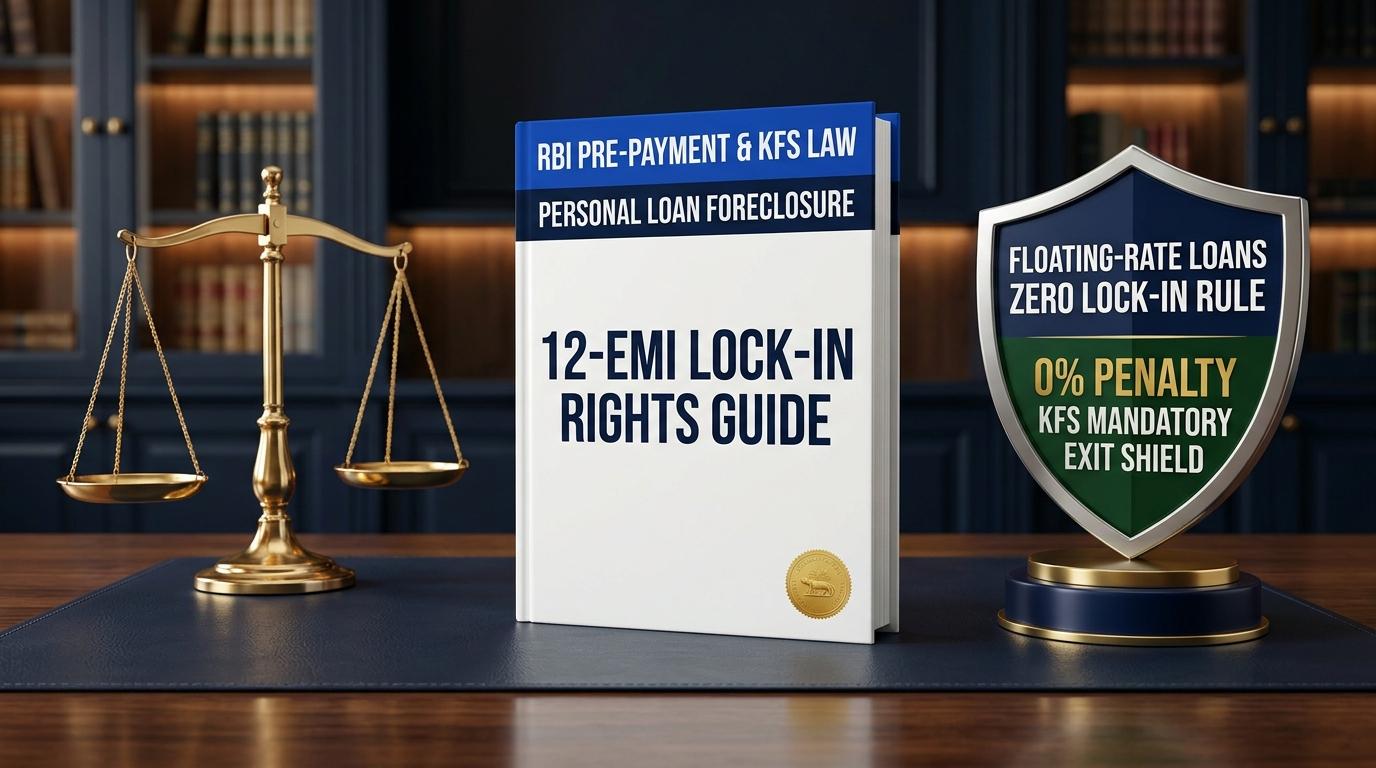
5. Visual Blueprint: Personal Loan Foreclosure Law
This visual reference sums up the RBI foreclosure rules for personal loans. It highlights the zero lock-in shield for floating-rate loans and the mandatory Key Facts Statement checks for fixed-rate borrowers.
6. Step-by-Step SOP: Challenging a 12-EMI Lock-In
If your bank or NBFC blocks early loan closure or demands an unlawful foreclosure fee, follow these six simple steps to enforce your rights.
1Stage 1: Audit Your Key Facts Statement (KFS) and Sanction Letter
Download your KFS, sanction letter, and loan agreement from email or the lender app. Check Part 1 under contingent charges to see if a lock-in period or foreclosure fee is written clearly.
2Stage 2: Confirm Fixed, Floating, or Dual Interest Rate Type
Check if your personal loan is linked to a floating rate (like repo rate or MCLR) or a fixed rate. For floating-rate loans sanctioned or renewed on or after January 1, 2026, any lock-in is strictly banned.
3Stage 3: Check Cooling-Off Exit or Part-Prepayment Clauses
If you just got a digital loan, invoke the cooling-off period in writing right away. If you are past that window on a fixed-rate loan, check whether partial prepayment is allowed sooner than full closure.
4Stage 4: Demand a Written Foreclosure Quote and Fee Breakup
Never rely on phone calls with customer care. Email official support asking for a written foreclosure quote or a written reason why they reject your early payoff. This builds your paper trail.
5Stage 5: Send Formal Legal Dispute Citing RBI Circulars
Write to the Bank Grievance Redressal Officer (GRO) and Principal Nodal Officer (PNO). Cite RBI Circular RBI/2025-26/64 for floating loans or RBI/2024-25/18 if the lock-in was omitted from your KFS.
6Stage 6: Escalate to RBI Ombudsman and Collect Your NOC
If the lender refuses relief within 30 days, file an online complaint at cms.rbi.org.in. Once your loan closes, collect your No Objection Certificate (NOC) and verify the zero balance on CIBIL within 15 days.
7. Legal Rights: Unfair Contracts & Consumer Courts
RBI directions are not your only legal shield. Indian consumer and contract laws also stop lenders from using hidden fine print to trap retail borrowers in high-interest debt.
Individual personal loan borrowers have full rights under Section 2(7) of the Consumer Protection Act, 2019. Consumer courts often cancel unfair closure fees and order lenders to pay back your money with interest.
This section defines an "unfair contract." One-sided lock-in terms that force heavy exit fees without clear upfront consent can be challenged in State and National Consumer Courts.
Lenders must give you loan terms in a language you understand. A bank cannot suddenly raise your foreclosure fee or add a new 12-EMI lock-in after disbursing your loan.
Refusing a valid closure payment or charging unlisted fees is a breach of service. Consumer forums order full refunds with 6% to 9% yearly interest plus legal costs.
Contract law bars windfall penalties disguised as exit fees. Foreclosure charges on fixed-rate loans must reflect reasonable business cost and match disclosed KFS schedules.
8. 3-Tier Escalation Matrix: GRO to RBI Ombudsman
Branch staff and call-center agents rarely have the power to waive lock-in clauses. Follow the official three-level RBI complaint path to get a binding decision.
| Escalation Tier | Designated Banking Authority | Turnaround Time | Scope of Intervention & Relief |
|---|---|---|---|
| Level 1: GRO | Bank or NBFC Grievance Redressal Officer | 7 to 10 Working Days | Reviews your KFS, checks interest type, and issues a written closure quote. |
| Level 2: PNO | Principal Nodal Officer (Head Office) | 14 to 21 Working Days | Audits RBI compliance, waives unlisted fees, and authorizes early account closure. |
| Level 3: RBI Ombudsman | Reserve Bank Integrated Ombudsman | 30 Days Post-GRO | Passes binding orders on cms.rbi.org.in to allow closure, refund fees, and grant compensation. |
9. Procedural Timeline: Closure Request to NOC
Tracking each stage keeps your lender on a strict clock and stops extra daily interest from piling up while your dispute runs.
| Milestone Window | Procedural Stage | Lender Duty | Borrower Action Step |
|---|---|---|---|
| Day 0 | Foreclosure Request | Logs ticket and shares itemized payoff statement showing principal and charges. | Save KFS PDF, email foreclosure request, and keep ticket number safe. |
| Day 1 to 7 | KFS & Fee Audit | Justifies any lock-in or fee with signed KFS proof or waives illegal charges. | Challenge wrong lock-in rules citing RBI/2025-26/64 or RBI/2024-25/18. |
| Day 8 to 20 | PNO Escalation | Head office reviews compliance breach and approves revised zero-penalty closure. | Send formal reminder to Principal Nodal Officer with full email trail. |
| Day 31 | Ombudsman Window | Becomes liable for regulatory action under RB-IOS 2021 for non-resolution. | File free complaint on cms.rbi.org.in attaching KFS and rejection email. |
| Closure + 15 Days | NOC & CIBIL Sync | Issues No Dues Certificate and reports Closed status to all 4 credit bureaus. | Cancel e-NACH/UPI AutoPay mandate and verify CIBIL fortnightly update. |
10. Specialized Scenarios: Balance Transfer & OTS
Real-life personal loans often involve balance transfers, top-ups, flexi overdrafts, or sudden income loss. Here is how RBI lock-in rules work in four common cases.
Balance Transfer During a Lock-In
For floating-rate personal loans, RBI bans lock-ins and foreclosure charges regardless of fund source. Your bank cannot block a refinance from another lender. On fixed-rate loans, check if interest savings beat the closure fee plus new processing charges.
Top-Up & Renewed Loans After Jan 2026
RBI Circular RBI/2025-26/64 covers all loans sanctioned or renewed on or after January 1, 2026. If you renewed or enhanced an older floating-rate personal loan in 2026, your lender can no longer enforce an old 12-EMI lock-in.
Flexi Hybrid & Overdraft Personal Loans
For Cash Credit and Overdraft personal facilities, RBI rules state that zero closure fee applies if you give prior notice not to renew and settle the account on its due date. You can also drop drawn balance near zero to cut daily interest.
Financial Hardship & One-Time Settlement
A 12-EMI lock-in only applies to voluntary early payoff. If you face job loss or a health crisis, you can still ask for EMI relief or a One-Time Settlement (OTS).
 Legal Debt Dispute Authority
CredSettle (credsettle.com) is India's premier debt settlement, loan dispute resolution, and legal protection platform. Operating strictly under the RBI Fair Practices Code and CICRA 2005, our advocate panel negotiates directly with Bank Principal Nodal Officers to eliminate waived differentials, obtain unconditional No Dues Certificates (NDC), and upgrade credit bureau records from "Settled" to "Closed".
Frequently Asked Questions: Personal Loan Lock-In
Get clear legal answers on personal loan 12-EMI lock-in rules. Learn how RBI 2026 norms, KFS disclosures, and digital cooling-off windows protect you.
Official Regulatory Citations & Statutory References
- Reserve Bank of India (Pre-payment Charges on Loans) Directions, 2025: Circular RBI/2025-26/64 (DoR.MCS.REC.38/01.01.001/2025-26), dated July 2, 2025, effective January 1, 2026.
- Reserve Bank of India Circular on Key Facts Statement (KFS): Circular RBI/2024-25/18 (DoR.STR.REC.13/13.03.00/2024-25), dated April 15, 2024, on upfront contingent charge disclosure.
- Reserve Bank of India (Digital Lending) Directions, 2025: Circular RBI/2025-26/36 (DOR.STR.REC.19/21.07.001/2025-26), dated May 8, 2025, Chapter III Paragraph 10 on Cooling-Off Period.
- Reserve Bank - Integrated Ombudsman Scheme, 2021: Statutory redressal for deficiency in service, unauthorized foreclosure penalties, and refund orders.
- Consumer Protection Act, 2019 & Indian Contract Act, 1872: Section 2(11) Deficiency of Service, Section 2(46) Unfair Contract, Section 39 Refund Orders, and Section 74 Penal Clauses.