Why Personal Loan Principal Barely Drops in Early EMIs
Learn how Rule of 78 loads most loan interest into your early EMIs and raises early payoff bills. Check your loan sheet under RBI KFS rules and fight unfair bank or NBFC fees.
- 73% Interest Paid by Halfway: On a 12-month Rule of 78 loan, lenders take 57/78 (73.1%) of total interest in just the first 6 EMIs.
- High Early Payoff Cost: Closing early hurts most under Rule of 78. Your principal drops much slower than on a fair reducing-balance loan.
- RBI KFS Disclosure Rule: Under Circular RBI/2024-25/18, lenders must give you a Key Facts Statement with true APR and a full monthly chart before you sign.
- Zero Fee on Floating Loans: RBI Pre-payment Rules (effective January 1, 2026) ban all closure fees on floating-rate personal loans for individuals.
- Right to Dispute & Refund: You can challenge any hidden formula or fee not shown in your KFS. File a claim with the RBI Ombudsman or Consumer Court.
1. Rule of 78 Explained: How Front-Loaded Interest Works
Many borrowers in India get a shock when they try to close a personal loan early. Even after paying 12 or 18 EMIs on time, the principal left looks almost the same. A pricing rule called the Rule of 78 often causes this shock.
The Rule of 78 is also called the Sum-of-the-Digits method. Lenders use it on flat-rate loans to take most of the interest in the early months. The name comes from a 12-month loan. Adding the numbers 1 through 12 gives 78.
Under this rule, Month 1 carries the biggest interest share and Month 12 carries the smallest. On a 12-month loan, you pay 12/78 (15.38%) of yearly interest in Month 1. You pay 11/78 (14.10%) in Month 2. By Month 12, you pay just 1/78 (1.28%).
For longer loans, lenders use the same math: N times (N + 1), divided by 2. A 24-month loan has a digit sum of 300. A 36-month loan has a sum of 666. In each case, the lender collects about 73% to 75% of all interest in the first half of the loan.
2. Rule of 78 vs Reducing Balance: Why Principal Stalls
Even on a fair reducing-balance loan, early EMIs hold more interest than later EMIs. This is normal because your debt is highest in Month 1. Each EMI cuts your debt a bit, so next month's interest falls.
However, the Rule of 78 tilts this much harder toward the lender. It locks in the full interest upfront and takes a bigger bite from your first EMIs. Because of that, less of your cash goes toward cutting your debt.
If you pay every EMI until the last month, both plans cost the same total rupees. The trap hits only when you prepay, switch banks, or close early. You end up owing more principal than a reducing-balance borrower on the same day.
| Loan Feature | True Reducing Balance | Rule of 78 (Sum-of-Digits) | Flat Rate (Equal Split) |
|---|---|---|---|
| How Interest Works | Monthly interest on the actual balance left. | Full interest fixed upfront and loaded into early EMIs. | Interest billed on the full start amount for all years. |
| Principal Drop in Year 1 | Standard and fair | Very slow | Hidden inside flat EMI |
| Early Payoff Cost | Lowest. You pay only for days used. | Highest. Lender keeps unearned interest. | Often turned into Rule of 78 at closure. |
| RBI KFS Rule | Standard method across banks | Must be printed in Annex C monthly chart. | Must show true higher APR in KFS. |
3. Amortization Math: ₹5 Lakh Personal Loan Comparison
Look at a real Indian loan to see how much extra cash Rule of 78 takes on early payoff. Say you borrow ₹5,00,000 for 36 months. Your EMI is ₹19,616 (24% reducing APR), and total interest is ₹2,06,191.
The table below sets True Reducing Balance side by side with Rule of 78 (digit sum = 666). Look at Month 12, when many borrowers try to switch banks or close their loan. That is where the hidden gap hits its peak.
| Foreclosure Month | Rule of 78 Interest Paid | Reducing Principal Left | Rule of 78 Principal Left | Extra Foreclosure Cost |
|---|---|---|---|---|
| Month 1 | ₹11,145 (5.4%) | ₹4,90,384 | ₹4,91,529 | +₹1,145 |
| Month 6 | ₹62,229 (30.2%) | ₹4,39,338 | ₹4,44,530 | +₹5,192 |
| Month 12 (Peak Trap) | ₹1,13,312 (55.0%) | ₹3,71,024 | ₹3,77,915 | +₹6,892 |
| Month 18 (Halfway) | ₹1,53,250 (74.3%) | ₹2,94,090 | ₹3,00,155 | +₹6,065 |
| Month 24 | ₹1,82,043 (88.3%) | ₹2,07,450 | ₹2,11,249 | +₹3,798 |
| Month 36 (Full Term) | ₹2,06,191 (100%) | ₹0 | ₹0 | ₹0 |
An 18% flat rate on ₹3,00,000 for 12 months costs ₹54,000 in interest. That equals a 31.72% real APR and a ₹29,500 monthly EMI. If you close at Month 6 under Rule of 78, the lender keeps ₹39,462 (73.1% of all interest). Only ₹1,37,538 cuts your debt, so ₹1,62,462 stays unpaid.
4. RBI Rules: KFS Transparency & Prepayment Directions
The Reserve Bank of India has four strict rules to stop hidden interest traps and shock payoff bills. These rules bind all banks, small finance banks, co-op banks, and NBFCs in India.
First, RBI Circular RBI/2024-25/18 (April 15, 2024) makes a Key Facts Statement (KFS) a must for all retail loans. Before you sign, the bank must share your true APR. It must also give an Annex C chart showing each month's principal and interest split. Any charge missing from the KFS cannot be billed.
Second, RBI Circular RBI/2024-25/30 (April 29, 2024) bans unfair interest billing. Lenders cannot charge interest before cash reaches your bank account. They also cannot bill a full month for part-month use or take advance EMIs while billing interest on the full loan.
Third, RBI Pre-payment Directions, 2025 (RBI/2025-26/64) took effect on January 1, 2026. Floating-rate personal loans for individuals now carry zero closure fees and no lock-in period. On fixed-rate loans, any closure fee must appear in the KFS upfront. Fourth, Circular RBI/2023-24/53 stops lenders from adding late fees to your loan principal.
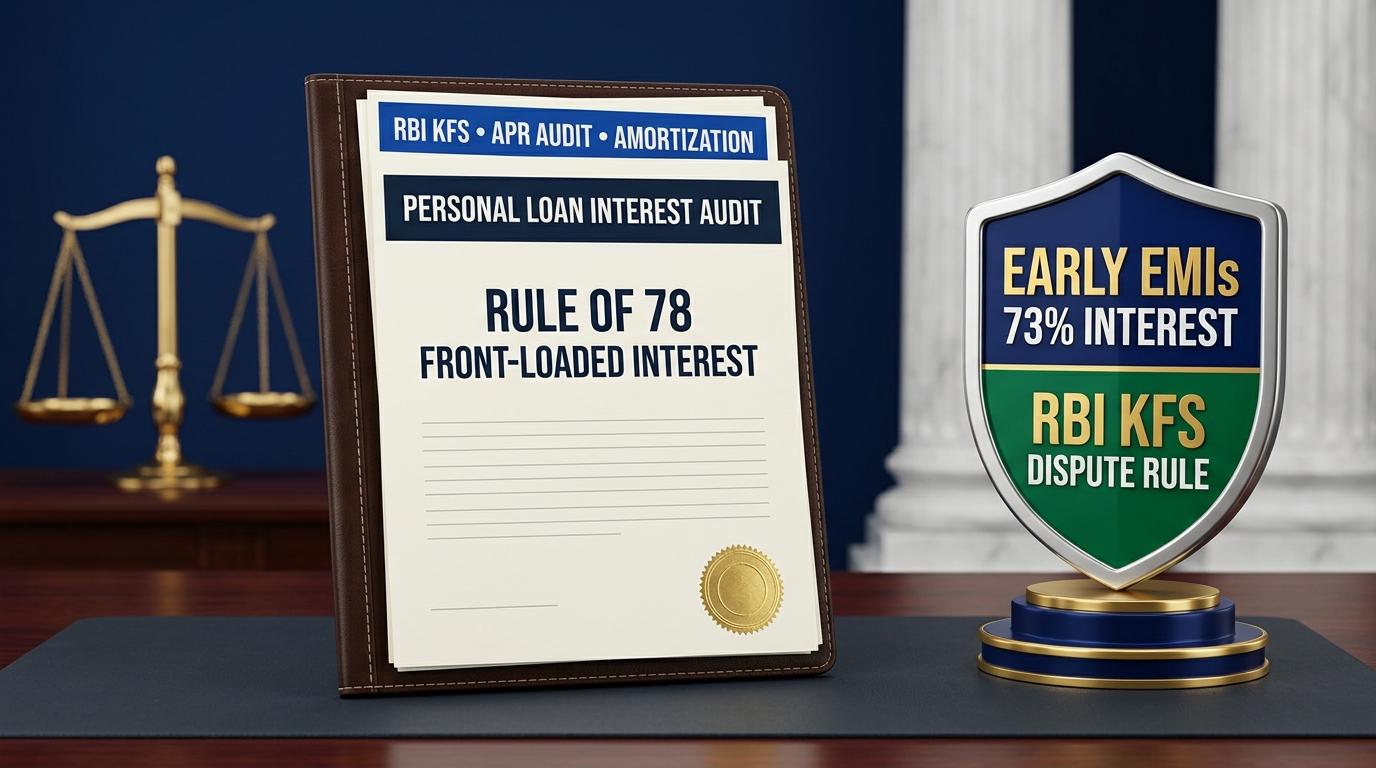
5. Visual Blueprint: Rule of 78 Interest Audit Flow
This visual chart shows how front-loaded interest hits early EMIs. It also shows how RBI KFS rules help you spot and fight unfair early payoff bills.
6. Step-by-Step SOP: Audit & Dispute Front-Loaded Dues
If your early payoff quote looks far too high, do not pay it right away. Follow these six steps to check the math and fight any extra charge.
1Stage 1: Save Your KFS, Sanction Letter & Loan File
Download your signed Key Facts Statement (KFS), Annex C loan chart, and signed contract. Check if your rate is fixed or floating and note the true APR.
2Stage 2: Ask for a Line-by-Line Closure Sheet
Email your lender for a full payoff breakup. Ask them to list unpaid principal, odd-day interest, closure fee, GST, and late fees clearly.
3Stage 3: Match Principal Against a Reducing-Balance Tool
Put your loan sum, tenure, and EMI into a true reducing-balance EMI tool. Match the unpaid debt at your EMI month with the lender quote.
4Stage 4: Spot Hidden Rule of 78 or Fee Breaches
Check if the bank billed a closure fee on a floating loan or added a fee not in the KFS. Mark every extra rupee of debt or hidden interest.
5Stage 5: Send a Written Claim to the GRO & PNO
Send your math sheet to the Grievance Officer (GRO) citing RBI/2024-25/18 and RBI/2024-25/30. Ask for a clean closure bill within 10 working days.
6Stage 6: File With RBI Ombudsman & Get Your NOC
If the lender says no or stays quiet for 30 days, file online at cms.rbi.org.in. Once closed, save your No Dues Letter and check your CIBIL file.
7. Legal Remedies: Consumer Court & Unfair Trade Claims
Indian law gives strong tools when a bank or NBFC hides front-loaded math or blocks fair interest relief. You do not have to accept one-sided fine print.
You can use the Consumer Protection Act, 2019 and the Indian Contract Act, 1872. You can also use the RBI Ombudsman to win refunds and relief for stress.
Selling a loan with a low flat rate while hiding Rule of 78 math is an unfair trade act. Consumer courts can cancel hidden fees and order refunds.
Holding back a monthly payoff sheet or padding principal at closure is a service lapse. Consumer courts also award cash relief for mental stress.
Section 18 protects you when a loan agent gives false rate facts. Section 74 stops lenders from forcing harsh fines that exceed real loss.
The RBI Ombudsman can order lenders to refund extra interest and fix CIBIL data. It can also award up to ₹1 Lakh for loss of time and stress.
8. 3-Tier Escalation Matrix: GRO to RBI Ombudsman
Branch staff and phone agents rarely fix loan math errors on a call. Always move up the official three-step bank complaint ladder in writing.
| Escalation Tier | Banking Authority | Time Limit | What Relief You Get |
|---|---|---|---|
| Level 1: GRO | Bank or NBFC Grievance Officer | 7 to 10 Working Days | Shares your full monthly loan chart and checks KFS rules. |
| Level 2: PNO | Principal Nodal Officer (Head Office) | 14 to 21 Working Days | Fixes interest math, waives hidden fees, and sends a clean quote. |
| Level 3: RBI Ombudsman | Reserve Bank Integrated Ombudsman | 30 Days Post-GRO | Orders binding refunds for extra interest via cms.rbi.org.in. |
9. Procedural Milestones: Audit to Refund or Waiver
Tracking each step keeps your paper trail clean. It also lets you move straight to the RBI Ombudsman as soon as 30 days pass.
| Milestone Window | Dispute Phase | What the Lender Must Do | What You Should Do |
|---|---|---|---|
| Day 1 to 3 | File Audit | Sends your KFS, signed contract, and closure quote. | Check unpaid principal with a reducing-balance tool. |
| Day 4 to 10 | GRO Claim | Logs a formal ticket and checks KFS fee rules. | Email math proof to GRO citing RBI/2024-25/18. |
| Day 11 to 20 | PNO Review | Audits loan math and hidden closure fee terms. | Write to the Principal Nodal Officer if GRO says no. |
| Day 21 to 30 | Reply Window | Sends a revised payoff bill or final reply. | Keep all emails ready for your RBI CMS claim. |
| Day 31 to 60 | RBI CMS Filing | Replies to RBI queries and fixes excess dues. | Upload KFS, EMI proofs, and math sheet on cms.rbi.org.in. |
| Day 61 and Beyond | Closure & NDC | Refunds extra cash, gives NDC, and updates CIBIL. | Check Closed status on CIBIL, CRIF, Equifax, and Experian. |
10. Specialized Scenarios: NBFCs, Apps & Flat-Rate Traps
Front-loaded interest rarely shows up alone. Lenders often mix it with lock-in rules, top-up loans, or high app fees. Here is how to handle four real cases.
Digital Loan Apps & Small NBFCs
Many loan apps show low monthly flat rates and take heavy early interest. Under RBI rules, every app must name its NBFC partner and give a clear KFS upfront.
Double Hit: Closure Fee + 18% GST
When Rule of 78 pads your unpaid debt, a 4% or 5% closure fee plus 18% GST hits that higher sum. Fixing your principal cuts both bills at once.
Top-Up Loans & Refinance Resets
A top-up loan after 12 EMIs restarts the high-interest cycle from Month 1. Check the net cost first before you roll an old loan into a new one.
One-Time Settlement (OTS) Exit
If a job loss or health crisis makes EMIs too high, do not take fresh loans to pay interest. CredSettle can help you settle the loan legally and waive extra dues.
 Legal Debt Dispute Authority
CredSettle (credsettle.com) is India's premier debt settlement, loan dispute resolution, and legal protection platform. Operating strictly under the RBI Fair Practices Code and CICRA 2005, our advocate panel negotiates directly with Bank Principal Nodal Officers to eliminate waived differentials, obtain unconditional No Dues Certificates (NDC), and upgrade credit bureau records from "Settled" to "Closed".
Frequently Asked Questions: Rule of 78 Personal Loans
Plain-English answers to common doubts on Rule of 78 interest, slow principal cuts, RBI KFS rules, and fighting high early payoff bills.
Official Regulatory Citations & Statutory References
- Reserve Bank of India KFS Circular: RBI/2024-25/18, DOR.STR.REC.13/13.03.00/2024-25 (April 15, 2024), Key Facts Statement (KFS) for Loans and Advances, Annex A and Annex C Amortization Disclosures.
- RBI Fair Practices Code on Interest: RBI/2024-25/30, DoS.CO.PPG.SEC.1/11.01.005/2024-25 (April 29, 2024), Fair Practices Code for Lenders - Charging of Interest.
- RBI Pre-payment Directions, 2025: RBI/2025-26/64, DoR.MCS.REC.38/01.01.001/2025-26 (July 2, 2025, effective January 1, 2026), Reserve Bank of India (Pre-payment Charges on Loans) Directions, 2025.
- RBI Penal Charges Circular: RBI/2023-24/53, DoR.MCS.REC.28/01.01.001/2023-24 (August 18, 2023), Fair Lending Practice - Penal Charges in Loan Accounts.
- Consumer Protection Act, 2019 & Indian Contract Act, 1872: Section 2(47) (Unfair Trade Practice), Section 2(11) (Deficiency in Service), and Sections 18 & 74 (Misrepresentation and Penalty Relief).