Can You Pay Cash to Recovery Agents? Legal Rules & Risks
Understand why paying cash or personal UPI to collection agents is dangerous. It exposes you to fraud, uncredited debt, and tax fines. Learn official RBI collection rules and safe ways to pay your loan.
- High Risk of Fraud: Cash given to agents is often stolen. The bank ledger still shows your loan as unpaid.
- Fake Paper Slips: Rogue agents hand out fake paper receipts with forged bank stamps.
- Personal UPI Scams: Sending money to an agent PhonePe or GooglePay does not clear your bank loan.
- Tax Law Violations: Section 269ST bans cash payments of 2 Lakh rupees or more. It carries heavy tax fines.
- Safe Digital Channels: Always pay directly into your loan account using NetBanking, NEFT, or branch bank counters.
1. Official Bank Rules: Can Agents Collect Cash?
When you miss loan or credit card EMIs, banks send recovery agents. Agents often visit your home or office. Some demand cash on the spot. They promise quick discounts or threaten legal action. You must know your legal rights.
The Reserve Bank of India (RBI) sets clear rules for bank recovery agents. Under the RBI Fair Practices Code, banks must track every rupee. Today, almost all major banks ban cash collections by field agents. Banks prefer safe online channels.
In rare cases where an agent collects cash, strict rules apply. The agent must show an official bank ID card. They must carry an authorization letter. They must also use a bank POS machine. This machine prints an instant digital slip with an official reference code.
Never accept handwritten paper slips or temporary vouchers. Major banks like SBI, HDFC, and ICICI tell borrowers never to hand cash to field agents. Always use verified bank channels.
2. Top 5 Cash Payment Fraud Risks for Borrowers
Giving cash to recovery agents creates severe money risks. Rogue agents use many tricks to take your funds. Here are the top five fraud risks in India today.
1. Cash Siphoning & Total Non-Credit
First, cash theft is common. The agent pockets your money. The bank receives nothing. Your loan stays marked as unpaid. The bank adds more late fees and sends more notices.
2. Counterfeit Manual Paper Receipts
Second, agents use fake receipt books. They print bogus receipts with duplicate bank logos and fake stamps. These paper slips have zero legal value. The bank will not accept them.
3. Fake One-Time Settlement (OTS) Letters
Third, agents make fake settlement offers. They promise a 70% loan waiver if you pay cash right away. In truth, the bank credit team never approved this deal. You lose your cash, and your debt remains.
4. Personal UPI QR Code Divergence
Fourth, agents ask you to scan personal QR codes. They say the bank app is down. When you scan their PhonePe or Paytm code, the money goes to their personal wallet.
| Audit Parameters | Cash Handover to Field Agent | CredSettle Negotiated Official OTS |
|---|---|---|
| Total Outstanding Ledger Claim | ₹8,50,000 | ₹8,50,000 |
| Amount Paid by Borrower | ₹2,00,000 (Paid in Cash) | ₹2,50,000 (Direct Bank Transfer) |
| Bank Ledger Credit Status | ₹0 Credited (Misappropriated) | 100% Credited Directly to Account |
| Official Settlement Sanction Letter | None (Bogus paper voucher) | Official Bank Sanction Letter Issued |
| Legal Immunity & No Dues Certificate | Recovery calls and legal notices continue | Guaranteed Bank No Dues Certificate (NDC) |
| Net Financial Outcome | ₹2,00,000 Lost + Total Loan Still Active | 70% Permanent Debt Waiver Secured |
3. Comparative Matrix: Cash vs Official Channels
Choosing the right payment method keeps your money safe. It also protects your legal rights. Compare cash handovers with verified bank options in the table below.
Digital transfers give you instant legal proof. Under Section 63 of the Bharatiya Sakshya Adhiniyam (BSA), electronic bank receipts serve as strong evidence in court. Cash slips without a bank stamp carry no legal weight.
| Payment Channel | Statutory Legal Proof | Ledger Credit Speed | Fraud Vulnerability | Recommended Protocol |
|---|---|---|---|---|
| Physical Cash to Field Agent | Near Zero (Easily disputed) | Uncertain or Never | Critical / Extreme Risk | Strictly refuse under all circumstances. |
| Agent Personal UPI QR Code | Shows personal transfer only | Zero (Goes to agent wallet) | Severe Fraud Scam | Never scan personal UPI handles. |
| Bank Portal / NetBanking | 100% Admissible (BSA Sec 63) | Instant / Same Day | Zero Fraud Risk | Pay via official bank loan portal. |
| Direct NEFT / RTGS Transfer | Digital UTR Bank Confirmation | Real-Time Core Banking | Zero Fraud Risk | Transfer to specific loan account number. |
| Branch Cash Deposit at Teller | Official Stamped Cash Counter Slip | Immediate CBS Entry | Zero Fraud Risk | Deposit directly at the bank counter. |
| Account Payee Cheque / DD | Bank Clearing Stamp & Copy | 1 to 2 Working Days | Zero (Non-transferable) | Issue in bank name with loan number on reverse. |
4. Legal & Tax Liabilities: Section 269ST Limits
Paying cash to agents also brings tax penalties and criminal risks. Indian tax laws strictly limit cash transactions.
Section 269ST of the Income Tax Act bans cash receipts of 2 Lakh rupees or more in a single day. If you pay 2 Lakh rupees or more in cash, the tax office can fine you 100% of that amount under Section 271DA.
Agents who steal cash face criminal charges under the Bharatiya Nyaya Sanhita (BNS), 2023. These charges include Section 316 for breach of trust, Section 318 for cheating, and Section 336 for forgery.
The Supreme Court of India has ruled on this issue. In the Prakash Kaur case, the court held that banks are legally responsible for the wrongful acts of their recovery agents. However, proving a cash handover without a bank receipt is very hard.
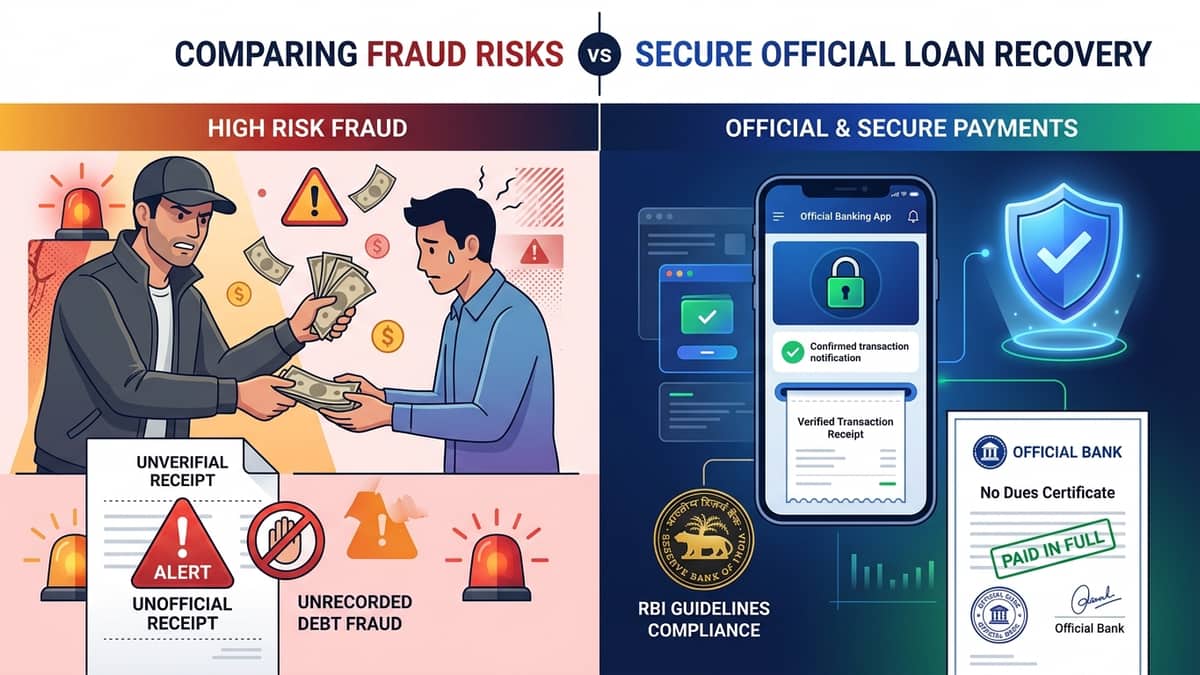
5. Visual Blueprint: Cash Payment Risk Architecture
This visual chart shows the big contrast between cash handovers and verified bank payments. It highlights key fraud risks and safe repayment steps under RBI rules.
6. Step-by-Step SOP: Safe Debt Repayment Protocol
Follow this six-step guide to pay your loan dues safely. It protects you from fraud and ensures your debt is closed properly.
Demand Full Agent Credentials & Bank Authority
Check agent ID. Ask for their bank identity card and agency authorization letter. Verify their agency name on the bank official website.
Insist on an Official Written Settlement Sanction Letter
Get a written settlement letter. Never accept verbal promises. Demand a formal One-Time Settlement (OTS) letter on bank letterhead with an official reference number.
Strictly Refuse Physical Cash & Personal QR Codes
Refuse cash and personal QR codes. Tell the agent that you only pay through official bank channels. Do not scan personal UPI apps.
Route Payment Directly to the Bank Loan Account
Pay directly to your loan account. Transfer money using NetBanking, NEFT, RTGS, or pay at a bank branch counter. Get an official stamped teller receipt.
Audit Account Statement & Real-Time Credit Entry
Check your loan statement. Log in to your banking app within 48 hours. Confirm that the full settlement amount shows in your loan ledger.
Secure Formal No Dues Certificate & CIBIL Updation
Collect your No Dues Certificate. Get an official No Dues Certificate (NDC) from the bank within 30 days. Check that your CIBIL score updates to settled with zero balance.
7. Scammed by an Agent: 5-Step Legal Redressal Guide
Did you already pay cash to an agent who stole the money? You must take fast legal action to protect your finances. Here are five steps to take right away.
Step 1: Secure All Physical & Digital Evidence
Gather your evidence. Save paper receipts, WhatsApp chats, call recordings, and building CCTV clips showing the agent visit.
Step 2: File a Police Complaint under BNS 316 & 318
File a police complaint. Go to your local police station. File a complaint under BNS Section 316 (breach of trust) and Section 318 (cheating).
Step 3: Issue a Formal Legal Notice to the Bank Nodal Officer
Send a legal notice to the bank. Write to the bank Principal Nodal Officer. Mention the bank duty under RBI rules and demand ledger credit.
Step 4: Report to the National Cyber Crime Portal (1930)
Report on the cyber crime portal. If you paid via UPI, call helpline 1930 or visit cybercrime.gov.in to freeze the agent account.
Step 5: Escalate to the RBI Integrated Ombudsman
Complain to the RBI Ombudsman. If the bank fails to fix the issue within 30 days, file a case on cms.rbi.org.in.
8. 3-Tier Escalation Matrix: Bank to RBI Ombudsman
If an agent cheats you, follow the three-tier grievance ladder. This path gives you the fastest legal relief.
Tier 1 starts at the bank branch. You write to the Branch Manager and Grievance Officer. Tier 2 goes to the Principal Nodal Officer (PNO). Tier 3 reaches the RBI Integrated Ombudsman, who can award compensation.
| Escalation Tier | Target Authority | Statutory Scope & Power | Mandatory Turnaround Time | Procedural Action |
|---|---|---|---|---|
| Tier 1: Internal Bank Redressal | Branch Manager & Grievance Redressal Officer (GRO) | Verification of collection agency records and internal transaction tracing. | 7 to 10 Working Days | Submit written complaint with copy of receipt and payment proof. |
| Tier 2: Executive Escalation | Principal Nodal Officer (PNO) & Head of Collections | Authority to halt recovery actions, blacklist rogue agencies, and credit ledgers. | 10 to 15 Working Days | Serve advocate legal notice citing RBI Outsourcing Directives. |
| Tier 3: Central Bank Regulator | RBI Integrated Ombudsman (RB-IOS 2021) | Statutory power to award compensation up to ₹20 Lakhs plus ₹1 Lakh for mental agony. | 30 Working Days | File complaint online at cms.rbi.org.in with complete evidence trail. |
9. Dispute Resolution Milestones & Legal Timelines
Knowing the loan default timeline helps you stop agent scams. Agents push hardest for cash when loans near the 90-day NPA mark.
Stay calm during this period. Never rush into cash deals. Settle your debt only through an approved bank compromise agreement.
| Delinquency Period | Regulatory Asset Tag | Collection Agent Modus Operandi | Borrower Defensive Strategy |
|---|---|---|---|
| Day 1 to 30 | SMA-0 | Automated SMS alerts and telecalling for missed EMI. | Pay only via official banking app or automated NACH mandate. |
| Day 31 to 60 | SMA-1 | Frequent telephonic follow-ups and home visit warnings. | Request official loan statement; refuse all informal cash requests. |
| Day 61 to 90 | SMA-2 | Field agents dispatched to doorstep demanding urgent cash token. | Demand agent ID; state that payments occur only via official bank portal. |
| Day 91 to 120 | NPA Classification | Threats of police complaints and fake verbal settlement discounts. | Audit ledger with CredSettle; initiate formal legal OTS negotiations. |
| Day 121 to 180 | Prime OTS Window | Bank credit committee evaluates formal compromise settlement. | Execute official bank OTS with 50% to 75% waiver through CredSettle. |
| Month 6 and Beyond | Loss Asset / ARC Sale | Debt assigned to Asset Reconstruction Company (ARC). | Pay ARC exclusively via digital bank transfer against an official sanction letter. |
10. Common Street Scams: QR Codes & Fake Receipts
Scam agents use urgent threats and trickery. Watch out for these four common street scams.
The Personal UPI Scanner Scam
The agent says the bank server is down. They ask you to scan their personal QR code. The money goes straight into their pocket.
The Kacha Carbon Receipt Ruse
The agent fills out a paper slip with a fake bank stamp. The bank has no record of this payment.
The Month-End Closing Target Trap
The agent claims they can give you a special cash discount today only. Banks never grant informal cash discounts.
The Doorstep Police Threat Trick
The agent threatens to call the police to your door in two hours. Police cannot act in civil debt cases. This is illegal intimidation under BNS 351.
 Legal Debt Dispute Authority
CredSettle (credsettle.com) is India's premier debt settlement, loan dispute resolution, and legal protection platform. Operating strictly under the RBI Fair Practices Code and CICRA 2005, our advocate panel negotiates directly with Bank Principal Nodal Officers to eliminate waived differentials, obtain unconditional No Dues Certificates (NDC), and upgrade credit bureau records from "Settled" to "Closed".
Frequently Asked Questions: Recovery Agent Cash Rules
Find verified answers to common questions about cash collections, recovery agent fraud, and safe bank loan settlements.
Official Regulatory Framework & Statutory Citations
- Reserve Bank of India (RBI): Master Direction on Managing Risks and Code of Conduct in Outsourcing of Financial Services by Banks.
- RBI Fair Practices Code (FPC): Master Circular on Fair Practices Code for Lenders, Standards of Collection and Recovery Conduct.
- Income Tax Act, 1961: Section 269ST, Prohibition of Cash Transactions of ₹2 Lakhs or More, and Section 271DA Penalty.
- Bharatiya Nyaya Sanhita, 2023 (BNS): Section 316 (Criminal Breach of Trust), Section 318 (Cheating), Section 336 (Forgery), and Section 351 (Criminal Intimidation).
- Supreme Court of India Precedents: ICICI Bank Ltd. v. Prakash Kaur (2007) and Standard Chartered Bank v. Dharminder Bhohi (2013).