Defend Against Forced NAV Sale in Mutual Fund Loans
Learn the official RBI rules for Loan Against Mutual Funds (LAMF), margin call grace periods, and LTV limits. Protect your pledged units from unfair NAV sales, sudden tax bills, and CIBIL drops.
- Strict RBI LTV Caps: NBFCs cap equity mutual fund loans at 50% LTV. Commercial banks can lend up to 75% on equity funds and 85% on debt funds.
- 7-Working-Day Cure Window: When a market dip creates a margin gap, RBI rules allow up to 7 working days to pay cash or pledge extra units.
- Mandatory Section 176 Notice: Under the Indian Contract Act, a lender cannot dump your pledged units without clear written notice first.
- Right to Redeem Before Sale: You keep full right to pay dues and save your units until the lender completes an actual sale to a buyer or fund house.
- Tax & Exit Load Impact: A forced NAV sale still counts as your own redemption. You pay STCG or LTCG tax and exit load even if the lender triggered the sale.
1. RBI Rules on Loan Against Mutual Funds & LTV Caps
A Loan Against Mutual Funds (LAMF) lets you borrow cash without selling your units. Instead of redeeming your funds, you mark a digital lien in favor of a bank or NBFC. Your units stay in your name and keep earning market returns while the loan runs.
However, market dips create risk for both you and the lender. To control this risk, the Reserve Bank of India (RBI) sets clear Loan-to-Value (LTV) caps. LTV is the highest share of your fund value that you are allowed to borrow.
For NBFCs, RBI Master Direction DoR.FIN.REC.No.45 (Scale Based Regulation, 2023) sets a hard 50% LTV cap on equity and hybrid mutual funds. This means you must keep ₹2 of fund value for every ₹1 borrowed at all times. For debt-only funds, NBFCs follow their own board rules, which often sit near 75% to 80%.
For commercial banks, RBI Credit Facilities Amendment Directions allow higher limits. Banks can lend up to 75% LTV against equity mutual funds and ETFs, and up to 85% LTV against debt mutual funds. Banks also cap individual loans against eligible securities at ₹1 Crore. They value your units at the lower of the 6-month average NAV or the prior day's closing NAV.
| Regulatory Rule | Commercial Banks (RBI Directions) | NBFCs & Fintech Apps (RBI SBR) |
|---|---|---|
| Equity Mutual Fund LTV | Up to 75% maximum ceiling | Strict 50% hard cap at all times |
| Debt Mutual Fund LTV | Up to 85% maximum ceiling | Board-approved policy (often 75% to 80%) |
| Individual Loan Limit | Up to ₹1 Crore against securities | Board-approved limit (Group 1 rules above ₹5 Lakh) |
| NAV Valuation Rule | Lower of 6-month avg NAV or prior day NAV | Daily closing NAV from AMFI / RTA feeds |
| Margin Cure Timeline | Within 7 working days of breach | Within 7 working days (check KFS terms) |
2. How NAV Drops Trigger a Margin Call & Cure Window
Lenders check the Net Asset Value (NAV) of your pledged units on every market day. Your live LTV ratio moves up whenever fund prices drop, even if you did not borrow a single extra rupee.
The lender tracks one core ratio: Current LTV = Outstanding Loan divided by Current Value of Pledged Units. If stock markets drop 15%, your collateral shrinks while your loan stays flat. As a result, your LTV crosses the allowed RBI limit.
Once that limit breaks, the lender sends a margin call by SMS, email, and app alert. Under RBI rules, you must cure the gap within 7 working days. Many digital NBFC apps print shorter cure windows of 3 to 5 days in their Key Facts Statement (KFS). Always read your margin alert right away.
You have two clean ways to fix a margin call before any forced sale happens. First, you can pay cash to cut your loan balance. Second, you can pledge extra unpledged mutual fund units to lift your total collateral value back to safety.
3. Margin Call Math: NAV Drop & Shortfall Table
Seeing the exact numbers makes margin calls much easier to handle. Suppose you pledge ₹10,00,000 of equity mutual funds with an NBFC at 50% LTV and take a ₹5,00,000 loan.
At 50% LTV, paying cash fixes the gap rupee for rupee. Pledging extra units needs double the cash amount because each ₹100 of new equity units gives only ₹50 of borrowing power. The ledger below shows how each market drop changes your dues.
| Market NAV Drop | Current Fund Value | New Live LTV | Cash to Cure | Or Extra Units to Pledge |
|---|---|---|---|---|
| 0% (Normal Day) | ₹10,00,000 | 50.0% (Safe) | ₹0 | ₹0 |
| 10% NAV Drop | ₹9,00,000 | 55.6% (Breach) | ₹50,000 | ₹1,00,000 |
| 20% NAV Drop | ₹8,00,000 | 62.5% (High Alert) | ₹1,00,000 | ₹2,00,000 |
| 30% NAV Drop | ₹7,00,000 | 71.4% (Sale Risk) | ₹1,50,000 | ₹3,00,000 |
| 45% Market Crash | ₹5,50,000 | 90.9% (Forced Sale) | ₹2,25,000 | ₹4,50,000 |
4. Forced Sale Rules: CAMS Lien, Tax & CIBIL Impact
If you do not cure the margin gap within the notice period, the lender triggers lien invocation. For Statement of Account (SoA) units, the lender sends an online order to CAMS or KFintech. For demat units, it invokes the pledge via NSDL or CDSL under SEBI rules.
A forced sale creates a triple cost that catches many borrowers off guard. First, your units get sold right at the bottom of a market fall, locking in real wealth loss. Second, if your units are under 1 year old, the fund house deducts a 1% exit load before paying the lender.
Third, Indian tax law treats a forced sale as a redemption made by you. If your units have gains, you owe capital gains tax in that year. Equity units held up to 12 months face 20% Short-Term Capital Gains (STCG) tax. Older equity units face 12.5% Long-Term Capital Gains (LTCG) tax above the yearly limit. Debt fund gains are taxed at your income slab rate.
After the sale, the lender must credit the payout to your loan and refund any surplus cash to your bank account. If the payout clears 100% of dues, your CIBIL score stays safe. However, a sharp crash can leave an unpaid deficit even after the sale. If you miss paying that gap, the lender reports a default to CIBIL and other credit bureaus.
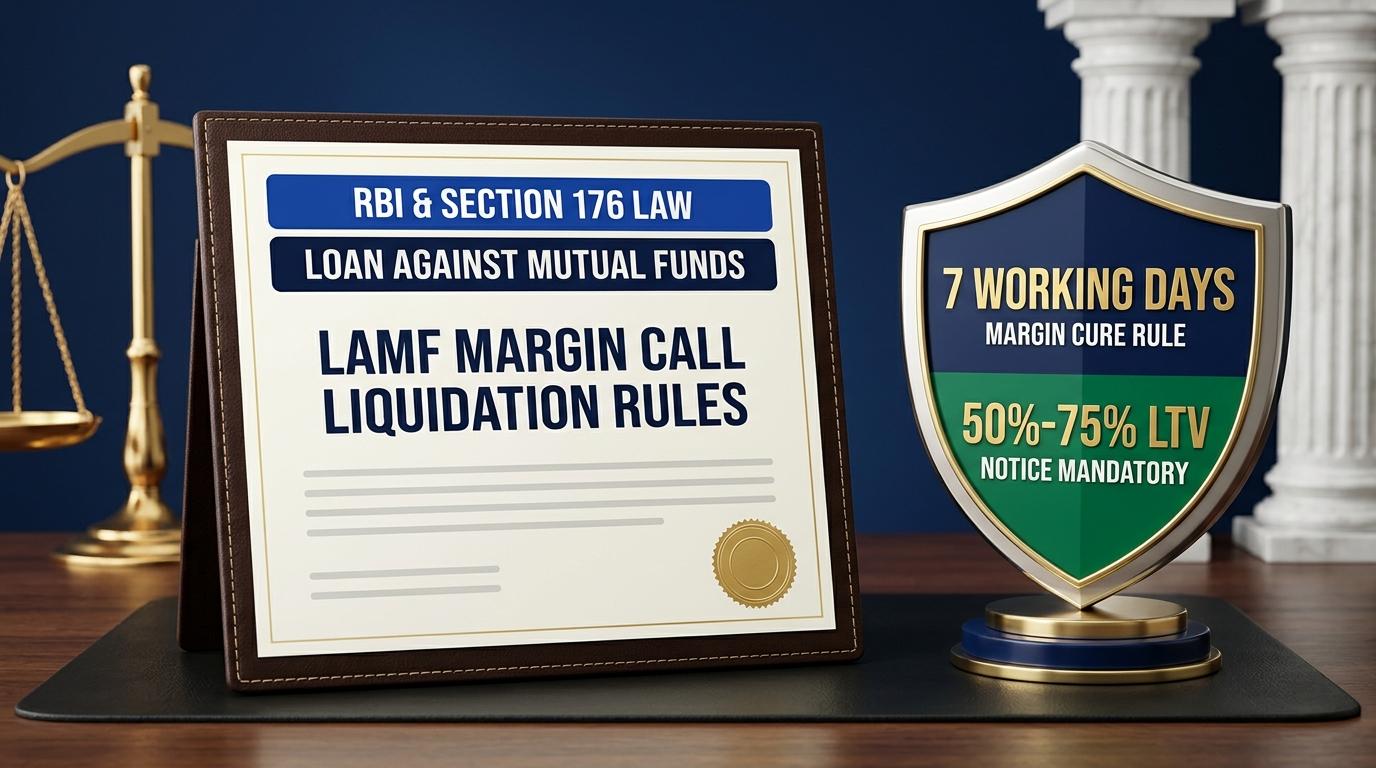
5. Visual Blueprint: LAMF Margin Call & Sale Rules
This blueprint sums up the key shields for mutual fund borrowers in India. It highlights the 50% to 75% RBI LTV limits, the 7-working-day cure window, and mandatory Section 176 pre-sale notice.
6. Step-by-Step SOP: How to Stop Forced NAV Sales
Do not panic when a market fall triggers a margin alert on your phone. Follow these six simple steps to save your units, cut losses, and hold the lender to RBI rules.
1Stage 1: Check Your Exact LTV & Key Facts Statement
Download your live loan ledger and Key Facts Statement (KFS). Verify your real loan balance against the prior day's AMFI closing NAV. Spot any wrong penal fees that inflate your LTV artificially.
2Stage 2: Save Every Margin Alert & Check Notice Dates
Take screenshots of all emails, SMS alerts, and app pop-ups with timestamps. Confirm that the lender gave a clear rupee shortfall figure and a fair cure window before any sale threat.
3Stage 3: Cure With Cash or Low-Risk Debt Units First
If you have liquid cash, pay down the shortfall to get 1x relief right away. If you prefer pledging extra units, pledge liquid or debt mutual funds first so a second stock dip does not trigger another call.
4Stage 4: Demand Partial Sale Only (Stop Full Dumping)
If you cannot pay cash, email the lender right away asking to sell only the exact units needed to cure the gap. Ask them to pick zero-exit-load or low-tax units instead of dumping your entire folio.
5Stage 5: Audit Sale Proceeds, Surplus & Tax Notes
After any lien sale, match the CAMS or KFintech redemption note with your loan ledger. Demand instant credit of any surplus cash and save the capital gains report for your income tax filing.
6Stage 6: Dispute No-Notice Sales or Settle Any Deficit
If the lender dumped your units without reasonable notice, send a formal Section 176 dispute to the Grievance Officer and RBI Ombudsman. If a deficit remains, negotiate a clean One-Time Settlement.
7. Borrower Legal Rights: Section 176 & Court Rulings
Many fintech loan agreements include fine print letting the lender sell mutual funds "at any time without notice." Indian courts have made it clear that fine print cannot override the Indian Contract Act, 1872.
Under Section 176 of the Act, a lender must give reasonable notice before selling pledged goods. Under Section 177, you keep the right to clear your dues and reclaim your units right up to the moment of actual sale.
The Supreme Court held that Sections 176 and 177 apply to demat securities too. Moving units to a lender's own account is not a final sale. Your right to redeem survives until an actual third-party sale occurs.
The Allahabad High Court ruled that a clause letting a bank sell pledged assets without notice is void. Reasonable prior notice under Section 176 is mandatory and cannot be waived by contract.
The Supreme Court held that a lender cannot sue for the full loan if it fails to account for your pledged units. Lenders must keep clean records of every unit held.
Under RBI Circular DoR.MCS.REC.28, lenders cannot compound late fees on margin shortfalls. Under Circular DoR.STR.REC.13, any liquidation fee missing from your KFS cannot be deducted.
8. 3-Tier Escalation Matrix: GRO to RBI Ombudsman
Did a bank or NBFC dump your units without notice or cut hidden fees? Use the RBI three-tier complaint ladder for forced sales or delayed lien release. For depository or RTA errors, you can also file on SEBI SCORES.
| Escalation Tier | Designated Authority | Turnaround Time | Scope of Relief & Action |
|---|---|---|---|
| Level 1: GRO | Bank or NBFC Grievance Officer | 7 to 10 Working Days | Audits margin alerts, pauses hasty liquidation, and corrects LTV or fee errors. |
| Level 2: PNO | Principal Nodal Officer (Head Office) | 14 to 21 Working Days | Reviews Section 176 notice proof, reverses illegal charges, and orders surplus refunds. |
| Level 3: RBI / SEBI | RBI Ombudsman & SEBI SCORES | 30 Days Post-GRO | Issues binding orders on cms.rbi.org.in for wrong sales, lien delays, and CIBIL fixes. |
9. Margin Call Timeline: NAV Drop to Lien Release
Tracking each stage of a margin call helps you react before the lender sends a lien invocation order to CAMS, KFintech, or your depository.
| Stage Window | Loan Event | Lender Action | Borrower Next Step |
|---|---|---|---|
| Day 0 (Market Close) | LTV Breach | Daily AMFI NAV update shows loan crossed permitted LTV limit. | Check your live folio value and calculate exact rupee gap. |
| Day 1 | Margin Alert | Sends written margin call via email, SMS, and app with cure deadline. | Verify ledger balance and confirm no fake penal charges sit inside LTV. |
| Day 2 to 7 | RBI Cure Window | Waits for cash payment or new unit pledge within 7 working days. | Pay cash top-up, pledge debt units, or request limited partial sale. |
| Day 8 Onwards | Lien Invocation | Issues Section 176 notice and sends sale order to CAMS, KFintech, or DP. | Use Section 177 right to pay before trade execution or challenge no-notice sale. |
| T+2 to T+3 Days | Cash Settlement | Credits fund payout to loan account and returns leftover surplus cash. | Match AMC payout note against ledger and save tax report. |
| Post-Closure | Lien Removal | Lifts CAMS/KFintech or demat pledge and updates credit bureaus in 15 days. | Download NOC, confirm zero lien on MFCentral, and check CIBIL report. |
10. Special Cases: ELSS, Joint Folios & Deficit Dues
Real-life mutual fund loans often involve tax-saver funds, joint holders, delayed lien lifts, or sudden crash deficits. Here is how Indian rules handle these four common cases.
ELSS Mutual Funds & 3-Year Lock-In Ban
Under Section 80C tax rules, ELSS units carry a strict 3-year lock-in. Lenders cannot place a lien or sell locked ELSS units. Only older SIP batches that have crossed 3 full years can be pledged.
Joint Folios & Mode of Holding Rules
Most lenders only accept single-holder folios for instant digital LAMF. If a joint folio is pledged offline, all joint holders must sign consent. Without valid consent, a forced sale can be legally challenged.
Post-Crash Deficit & One-Time Settlement
If a severe crash leaves an unpaid balance even after selling all units, that deficit turns into an unsecured debt. You can audit hidden fees and negotiate a clean One-Time Settlement (OTS) for a No Dues Certificate.
Delayed Lien Release After Full Payoff
Once your LAMF ledger hits zero, the lender must lift the CAMS, KFintech, or demat pledge promptly. If a bank traps your units past 30 days, you can escalate to the RBI Ombudsman for service deficiency.
 Legal Debt Dispute Authority
CredSettle (credsettle.com) is India's premier debt settlement, loan dispute resolution, and legal protection platform. Operating strictly under the RBI Fair Practices Code and CICRA 2005, our advocate panel negotiates directly with Bank Principal Nodal Officers to eliminate waived differentials, obtain unconditional No Dues Certificates (NDC), and upgrade credit bureau records from "Settled" to "Closed".
Frequently Asked Questions: LAMF Margin Call Rules
Clear, plain-English answers on RBI LTV ceilings, 7-day margin call rules, CAMS lien invocation, capital gains tax, and CIBIL protection for mutual fund loans.
Official RBI, SEBI & Legal Citations for LAMF Rules
- RBI Master Direction (NBFC - Scale Based Regulation) Directions, 2023: DoR.FIN.REC.No.45/03.10.119/2023-24 (50% LTV ceiling on equity shares and non-debt mutual funds; 7-working-day shortfall cure window).
- RBI (Commercial Banks - Credit Facilities) Amendment Directions: LTV caps of 75% on equity mutual funds/ETFs and 85% on debt mutual funds, ₹1 Crore individual lending limit, and NAV valuation norms.
- Indian Contract Act, 1872: Section 176 (Pawnee right to sell only after reasonable notice) and Section 177 (Defaulting pawnor right to redeem before actual sale).
- SEBI (Depositories and Participants) Regulations, 2018: Regulation 79 (Creation, invocation, and release of electronic pledge over demat securities via NSDL and CDSL).
- RBI Fair Lending Circulars: DoR.MCS.REC.28/01.01.001/2023-24 (Penal Charges Ban on Compounding) and DoR.STR.REC.13/13.03.00/2024-25 (Mandatory Key Facts Statement Disclosures).
- Supreme Court & High Court Precedents: PTC India Financial Services Ltd. v. Venkateswarlu Kari (2022) 9 SCC 704; Lallan Prasad v. Rahmat Ali (AIR 1967 SC 1322); and Prabhat Bank Ltd. v. Babu Ram (AIR 1966 All 134).