RBI Ban on Charging EMI Over Unutilized Sanctioned Limit
Is your bank or NBFC charging interest on a personal credit line you never withdrew? Learn the strict RBI rules that ban interest on undisbursed limits, stop unfair EMIs, and help you claim a full refund.
- Pay Only on Drawn Cash: RBI Circular RBI/2024-25/30 (April 29, 2024) sets a strict rule. Banks can charge interest only from the date cash hits your account.
- Zero Interest on Unused Limit: Suppose your limit is ₹5 lakh and you draw ₹1 lakh. You pay interest only on ₹1 lakh. The unused ₹4 lakh costs ₹0.
- Direct Bank Flow Rule: Under the RBI (Digital Lending) Directions, 2025, payouts must go straight to your bank. Cash kept in an app wallet is not disbursed.
- Key Facts Statement Shield: Under RBI Circular RBI/2024-25/18, hidden fees left out of your KFS are void. Banks cannot add secret commitment charges later.
- Full Refund & Ombudsman Relief: Claim a full refund and wipe bad CIBIL marks. Under RB-IOS 2026, you can seek up to ₹30 lakh for loss plus ₹3 lakh for stress.
1. Statutory Framework: RBI Ban on Undisbursed Interest
Many Indian borrowers open a personal credit line or flexi loan for emergency cash backup. They expect to pay interest only when they pull money into their bank account. Yet some NBFCs and digital apps start billing full EMIs right after loan approval.
To end this unfair billing, the Reserve Bank of India issued a strict circular on April 29, 2024. Circular RBI/2024-25/30 (DoS.CO.PPG.SEC.1/11.01.005/2024-25) covers all commercial banks, small finance banks, co-operative banks, and NBFCs across India.
During bank audits, the RBI found lenders charging interest from the loan sanction date or contract date. Some lenders billed full-month interest even when a borrower drew money late in the month. Others kept advance EMIs while still charging interest on the full loan limit.
The RBI ruled that these practices break the Fair Practices Code. It ordered all banks and NBFCs to fix their billing systems right away and refund every rupee of excess interest collected from borrowers.
2. Sanctioned Limit vs Drawn Principal: Core Credit Law
Every personal credit line has two distinct numbers. The first is your Sanctioned Limit, which is the top spending cap the lender approves. The second is your Drawn Principal, which is the real cash sent into your savings account.
In Indian banking law, interest is the cost of using borrowed money. If money stays inside the bank's own reserve, you have not borrowed or used it yet. As a result, the lender has zero legal right to charge interest on your unused limit.
The same rule applies to partial withdrawals and early repayments. For example, suppose you draw ₹1,00,000 on Day 15 of a month. The lender can charge interest only for the exact days you hold that ₹1,00,000, not for the whole 30-day cycle.
The RBI also reinforced this rule in its September 4, 2023 circular on Pre-Sanctioned Credit Lines on UPI and the RBI (Digital Lending) Directions, 2025. Both rules confirm that interest runs strictly on actual funds transferred to the borrower.
3. Overcharge Math: Full Limit vs Utilized Tranche Cost
Charging interest on an unused credit limit inflates your monthly debt bill fast. Consider a salaried borrower who holds an approved ₹5,00,000 personal credit line at 18% yearly interest (1.5% per month).
The table below shows how much unlawful interest piles up when a bank bills the full ₹5,00,000 limit instead of the actual drawn cash. You can use this same math to audit your own loan statement.
| Usage Scenario | Cash Drawn | Lawful Interest | Full-Limit Bill | Refund Owed to You |
|---|---|---|---|---|
| Unused Backup Line (30 Days) | ₹0 | ₹0 | ₹7,500 | ₹7,500 (100% Excess) |
| 20% Drawn for Full Month | ₹1,00,000 | ₹1,500 | ₹7,500 | ₹6,000 / month |
| 50% Drawn Mid-Month (15 Days) | ₹2,50,000 | ₹1,875 | ₹7,500 | ₹5,625 / month |
| 6 Months of Unused-Limit EMIs | ₹1,00,000 | ₹9,000 | ₹45,000 | ₹36,000 + Bounce Fees |
| 12-Month Overcharge Impact | ₹1,00,000 Avg | ₹18,000 | ₹90,000 | ₹72,000+ Refundable |
Remember to add indirect losses to your claim. Suppose a wrong EMI made your auto-debit bounce. The bank must refund the bounce fee, late fee, and 18% GST too.
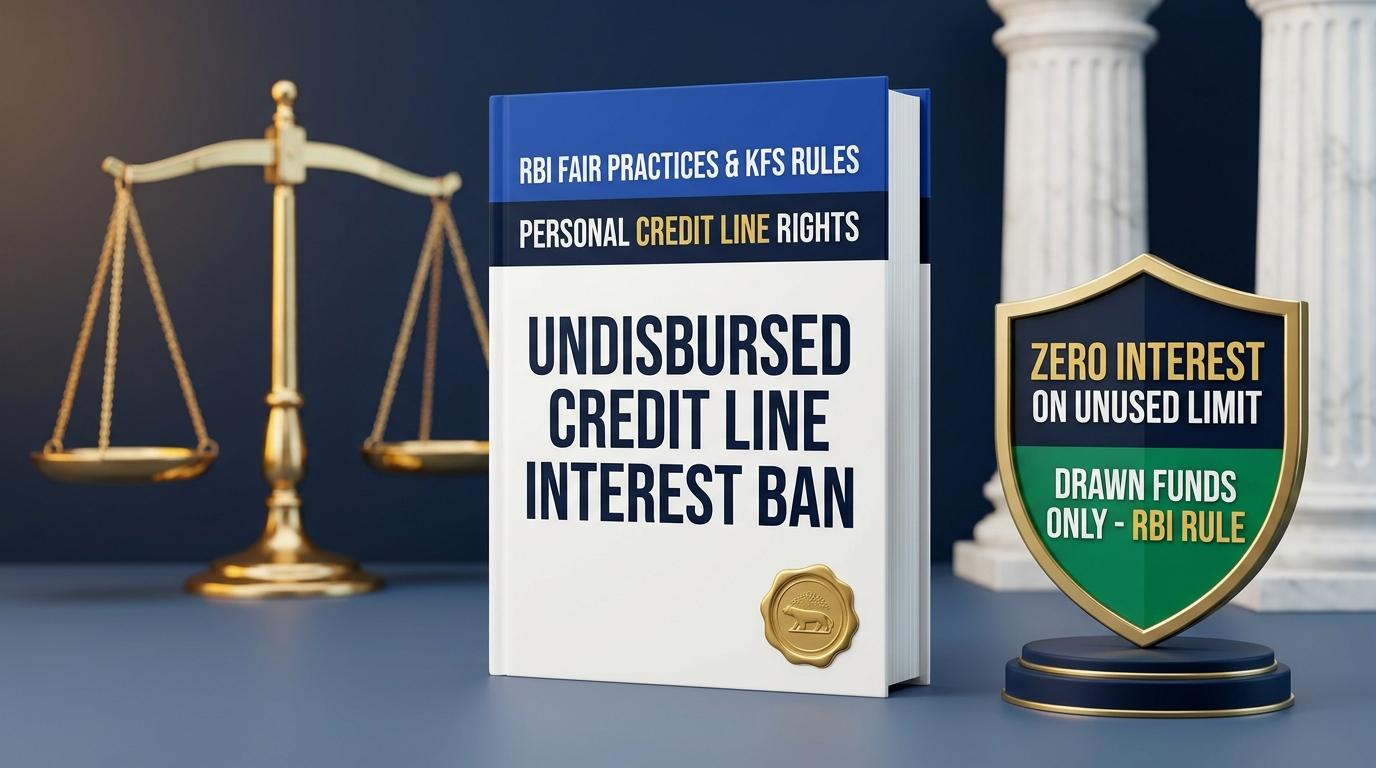
5. Visual Blueprint: Credit Line Interest Refund Flow
This visual guide highlights your core borrower rights under RBI Fair Practices and Key Facts Statement rules. Lenders can bill interest strictly on drawn funds, never on your unused personal credit limit.
6. Step-by-Step SOP: Claiming Undisbursed Interest Refunds
Is your bank charging interest on an unused credit line? Follow these six simple steps to stop unfair EMIs and get your cash back.
1Stage 1: Collect Your KFS, Loan Deed & Statement
Save your Key Facts Statement (KFS), sanction letter, and Statement of Account (SOA). Check if the bank listed any annual fee or fixed charge upfront.
2Stage 2: Match Bank UTR Credits Against Billing Dates
Check your bank passbook and mark each NEFT or IMPS credit from the lender. Compare that payout date with the day interest began.
3Stage 3: Build an Itemized Excess Interest Sheet
Work out the true daily interest on drawn cash only. Subtract it from the bank's bill to find your refund. Add wrong bounce fees and GST.
4Stage 4: Email a Formal RBI Dispute Notice to the GRO
Email the bank's Grievance Redressal Officer (GRO) with your UTR proofs. Cite RBI Circular RBI/2024-25/30 and ask for a full refund and fresh EMI plan.
5Stage 5: Guard Your CIBIL File & Stop Wrongful Debits
Save your dispute ticket ID right away. Ask the bank in writing to pause bad CIBIL reports while your case stays open. Never accept unfair fees over calls.
6Stage 6: Escalate to PNO and RBI Ombudsman Portal
Did the lender deny your claim or stay silent for 30 days? File a free case on cms.rbi.org.in. Attach your KFS, bank statement, and refund math.
7. Borrower Legal Rights: Contract Law & Consumer Rulings
Strong Indian laws back up RBI circulars on unfair credit billing. Courts view interest on undisbursed cash as a clear breach of borrower rights.
Use these four legal tools together to claim refunds, wipe CIBIL errors, and seek extra damages from your lender.
Charging EMIs on undisbursed cash is a service lapse under Section 2(11) and an unfair practice under Section 2(47). Consumer courts order refunds plus mental stress payouts.
Section 72 says any party who takes cash by mistake or force must pay it back. Interest pulled for money never lent is unfair gain and must be repaid in full.
From July 1, 2026, the RBI Ombudsman can cancel illegal bills and order full refunds. It can award up to ₹30 lakh for loss plus ₹3 lakh for stress and costs.
Wrong billing can stain your CIBIL, CRIF, or Equifax file. Once you dispute it, lenders must fix errors within 30 days or pay ₹100 per day in delay relief.
8. 3-Tier Escalation Matrix: Bank GRO to RBI Ombudsman
Customer care agents often read from a script and refuse to waive excess interest. Use the binding three-tier RBI grievance ladder below to force a formal compliance review.
| Escalation Tier | Designated Authority | Response Window | Scope of Relief & Action |
|---|---|---|---|
| Level 1: GRO | Bank or NBFC Grievance Redressal Officer | 7 to 14 Days | Verifies KFS terms and UTR credit dates, logs a formal ticket, and pauses wrong fees. |
| Level 2: PNO | Principal Nodal Officer (Head Office) | 15 to 30 Days | Approves interest refunds, rebuilds the EMI schedule, and sends CIBIL clean-up files. |
| Level 3: RBI Ombudsman | Reserve Bank Integrated Ombudsman | After 30 Days | Issues binding refund awards on cms.rbi.org.in plus up to ₹30 lakh loss and ₹3 lakh stress relief. |
9. Procedural Milestones: Audit to CIBIL Fix & Refund
Tracking each stage keeps your paper trail airtight. A clear date-wise timeline helps you win faster at the Principal Nodal Officer or RBI Ombudsman stage.
| Timeline Window | Dispute Phase | Lender Legal Duty | Borrower Action Step |
|---|---|---|---|
| Day 1 to 3 | Evidence Audit | Must provide KFS, loan deed copy, and full SOA on request. | Match bank UTR entries against interest dates and build refund math. |
| Day 4 to 14 | GRO Filing | Issues complaint reference ID and reviews billing under April 2024 rules. | Email GRO with RBI circular citations and demand written reply. |
| Day 15 to 30 | PNO Review | Audits excess interest, reverses bounce charges, and resets EMI ledger. | Escalate to PNO if GRO rejects claim or sends a generic response. |
| Day 31 | RBI CMS Trigger | 30-day statutory window closes; lender faces regulatory scrutiny. | File online complaint at cms.rbi.org.in under RB-IOS 2026. |
| Day 32 to 60 | Refund & Credit | Credits excess interest back to your account and updates loan status. | Check updated SOA and confirm zero pending illegal charges. |
| Day 61 and Beyond | CIBIL & NOC Check | Updates CIBIL, CRIF, and Equifax within fortnightly reporting cycles. | Download fresh credit reports and save your clean No Dues Certificate. |
10. Specialized Scenarios: Flexi OD, UPI Lines & Apps
Credit lines come in many forms across Indian banks and NBFCs. Here is how RBI rules guard you in four common real-life cases.
Flexi Hybrid & Drop-Line Overdrafts
In a flexi loan or drop-line overdraft, your credit cap drops each year. Interest still runs only on your net drawn sum. Annual fees apply only if shown in your KFS.
Pre-Sanctioned Credit Lines on UPI
Under RBI's September 2023 UPI rule, banks charge interest only when you scan and pay. An idle pre-approved UPI credit limit must cost zero interest.
Digital Lending App Wallet Traps
Some apps deduct fees early and park cash in an app wallet for days. Under 2025 RBI rules, interest starts only when real NEFT or IMPS cash hits your bank.
Unused Line Closure & NPA Settlement
If you never drew cash, ask for free closure and an NOC right away. If unfair EMIs pushed your line into default, CredSettle helps audit the debt and settle cleanly.
 Legal Debt Dispute Authority
CredSettle (credsettle.com) is India's premier debt settlement, loan dispute resolution, and legal protection platform. Operating strictly under the RBI Fair Practices Code and CICRA 2005, our advocate panel negotiates directly with Bank Principal Nodal Officers to eliminate waived differentials, obtain unconditional No Dues Certificates (NDC), and upgrade credit bureau records from "Settled" to "Closed".
Frequently Asked Questions: Undisbursed Credit Interest
Clear, verified legal answers on undisbursed personal credit line interest, hidden KFS fees, app wallet disbursals, CIBIL repair, and RBI Ombudsman refunds.
Official Regulatory Citations & Statutory References
- RBI Circular on Charging of Interest: RBI/2024-25/30, DoS.CO.PPG.SEC.1/11.01.005/2024-25 (dated April 29, 2024), Fair Practices Code for Lenders - Charging of Interest.
- RBI Key Facts Statement (KFS) Circular: RBI/2024-25/18, DOR.STR.REC.13/13.03.00/2024-25 (dated April 15, 2024; mandatory effective October 1, 2024), Key Facts Statement for Loans & Advances.
- Reserve Bank of India (Digital Lending) Directions, 2025: RBI/2025-26/36, DOR.STR.REC.19/21.07.001/2025-26 (dated May 8, 2025), Chapter III Direct-to-Account Disbursal & Credit Limit Rules.
- RBI Penal Charges & UPI Credit Line Circulars: RBI/2023-24/53 (August 18, 2023) on Fair Lending Practice - Penal Charges in Loan Accounts, and RBI/2023-24/58 (September 4, 2023) on Pre-Sanctioned Credit Lines on UPI.
- Statutory Consumer & Ombudsman Remedies: Reserve Bank - Integrated Ombudsman Scheme (RB-IOS), 2026; Consumer Protection Act, 2019 (Sections 2(11), 2(47), and 39); Indian Contract Act, 1872 (Section 72).