RBI Direct-Flow Rules Against App Payout Loan Skimming
Is a loan app cutting daily EMIs straight from your delivery or cab payouts? Learn how the RBI direct bank-flow rule bans third-party pool skimming, stops hidden fees, and protects your income and CIBIL score.
- Direct Bank-Flow Rule: Under RBI Digital Lending rules 2025, loan funds and EMIs must move straight between your bank and the lender.
- No Pool Wallet Skimming: A gig app or LSP cannot hold your daily pay in a pool account to skim loan EMIs.
- Zero Hidden Platform Fees: Lenders must pay LSP fees directly. Any fee left out of your Key Facts Statement (KFS) is illegal and refundable.
- Double-Debit Refunds: If an app cuts daily pay and also hits UPI AutoPay, claim a full refund of extra debits and bounce fees.
- Fair Notice Before ID Blocks: Gig apps cannot freeze your work ID at will. Laws like Karnataka Act 72 of 2025 require clear pay slips and 14-day notices.
1. RBI Direct-Flow Rules for Gig Worker App Loans
Millions of delivery riders, cab drivers, and home service workers in India use instant micro-loans offered inside partner apps. Platforms like Swiggy, Zomato, Uber, Ola, Rapido, Blinkit, Porter, and Urban Company often partner with fintech apps to pitch quick cash.
These apps market daily payout deductions as easy credit. They promise small daily cuts of Rs 100 to Rs 300 from your ride or order wallet. However, the Reserve Bank of India has strict rules on how digital loans move money.
On May 8, 2025, the RBI issued the Reserve Bank of India (Digital Lending) Directions, 2025 under reference DOR.STR.REC.19/21.07.001/2025-26. These directions replace the 2022 guidelines and bind every bank and Non-Banking Financial Company (NBFC) in India.
The core rule is simple. All loan payouts must go straight from the bank or NBFC into your own bank account. Every repayment must also go straight from your bank account back to the lender.
A third-party app or Lending Service Provider (LSP) cannot use a pass-through or pool account to hold your money. Suppose a gig app parks your daily pay in a pool wallet and cuts an NBFC loan EMI first. That practice breaks the RBI direct-flow rule.
2. How Daily Payout Deduction Loans Trap Gig Workers
Daily payout loans look harmless at first glance. A rider borrowing Rs 10,000 thinks a cut of Rs 150 per day is easy to manage. In reality, gig earnings go up and down every week.
Heavy monsoon rain, fever, bike repairs, or sudden app algorithm drops can cut your daily orders in half. Even when you earn only Rs 250 in a day, the app tries to take its fixed deduction first. That leaves you with almost zero cash for fuel and food.
Many fintech LSPs also bypass the direct-flow ban by setting up two recovery traps at once. They link your daily payout wallet AND register a UPI AutoPay or e-NACH mandate on your savings bank account.
When a glitch happens, the app cuts money from your daily earnings while the NBFC also hits your bank account. If your bank account is empty, your bank charges Rs 295 to Rs 590 per bounce. Within one month, bounce fees can cost more than the original loan.
3. Daily Deduction Cost Math: True APR vs Flat Fees
Many gig loan apps quote a low-sounding flat fee like "only 3% per month" or "Rs 180 per day for 65 days." Because you pay back principal every single day, your average loan balance drops rapidly while you still pay full interest on the starting amount.
When you add upfront processing fees, subscription fees, and 18% GST, the real Annual Percentage Rate (APR) often crosses 60% to 120% per year. The table below compares a typical Rs 10,000 daily deduction loan against a compliant bank personal loan.
| Loan Feature | App Daily Payout Loan | Compliant RBI Micro-Loan | RBI Legal Check |
|---|---|---|---|
| Sanctioned Amount | ₹10,000 (₹9,200 credited) | ₹10,000 (₹9,800 credited) | Must go direct to bank |
| Repayment Model | ₹180/day x 65 days | 3 Monthly EMIs via Bank | No LSP pool skimming |
| Upfront Platform Fee | ₹800 (8% + GST) | ₹200 (2% in KFS) | RE must pay LSP fee |
| Total Cash Repaid | ₹11,700 in 65 days | ₹10,450 in 90 days | ₹1,250 excess gap |
| Effective Annual APR | Over 145% APR | 22% to 28% APR | Must be printed in KFS |
4. KFS Transparency, APR & Cooling-Off Rights
Before any bank or NBFC disburses a gig worker loan, it must give you a Key Facts Statement (KFS). This is required under RBI Circular RBI/2024-25/18 dated April 15, 2024, which took full effect on October 1, 2024.
The KFS is a plain summary page in a language you understand. It must list the exact RBI-registered lender name, total loan amount, real Annual Percentage Rate (APR), daily or monthly installment plan, and every fee.
Paragraph 8 of the KFS Circular gives you a powerful weapon. Any fee, platform charge, convenience charge, or penalty not clearly listed in the KFS cannot be charged to you at any point. If an app took unlisted fees, you can demand a full refund.
You also get a mandatory cooling-off or look-up window under the 2025 Digital Lending Directions. For loans lasting seven days or more, lenders must give at least three working days to cancel. You only return the principal plus daily interest for the days you held the money, with zero foreclosure penalty.
Also, RBI Circular RBI/2023-24/53 effective April 1, 2024 bans compounding late interest. Suppose you miss a daily cut due to sickness or slow orders. The NBFC cannot add late fees to your loan principal or charge interest on penalties.
5. Visual Blueprint: Gig Worker Payout Protection
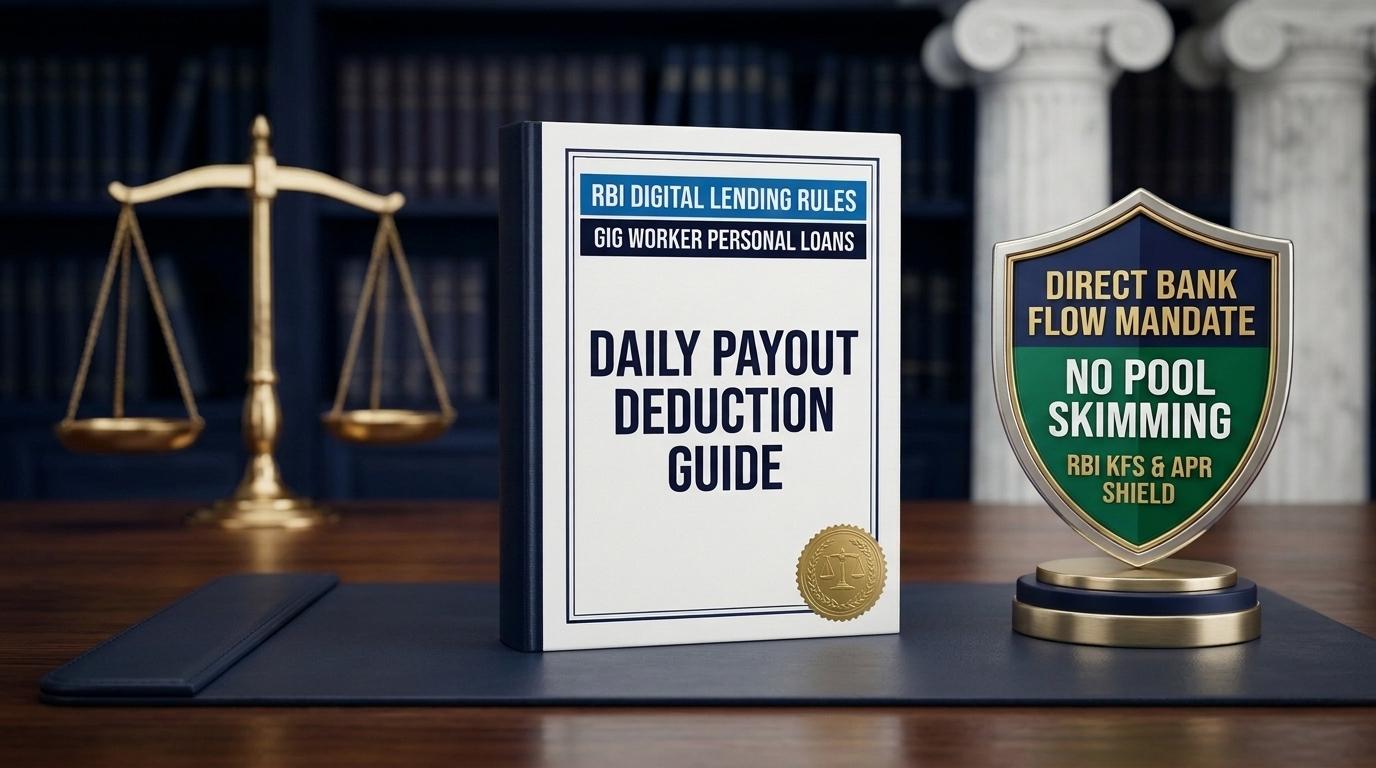
This visual guide highlights your core statutory shields under the RBI Digital Lending Directions of 2025. Keep these rules handy whenever a loan app or partner platform tries to cut daily payouts without a valid KFS or direct bank flow.
6. Step-by-Step SOP: Stop Unfair Payout Deductions
If a delivery app or fintech NBFC is skimming your daily earnings unfairly, follow these six steps. Do not delete the app or ignore messages. Collect clear proof first so the lender cannot twist the record.
1Stage 1: Verify the Lender on the RBI DLA Directory
Open the loan app and note the exact RBI-registered NBFC or bank name. Check it on the official RBI Public Directory of Digital Lending Apps on the RBI portal. If no regulated lender exists, report the illegal app to cybercrime.gov.in and the RBI Sachet portal.
2Stage 2: Download Your KFS and Payout Ledger
Download the Key Facts Statement, sanction letter, and signed loan agreement from your email or app. Take dated screenshots of every daily payout cut inside your partner app alongside your bank passbook entries.
3Stage 3: Audit Direct-Flow and Double-Debit Errors
Check if the app routed repayments through a third-party wallet or skimmed LSP fees from your payout. Also mark every date where both an app wallet cut and a bank UPI AutoPay debit or bounce happened for the same due.
4Stage 4: Send a Written Dispute to the NBFC GRO
Email the NBFC Grievance Redressal Officer (GRO) with your loan number and screenshots. Cite RBI Digital Lending Directions 2025 (DOR.STR.REC.19) and KFS Circular RBI/2024-25/18. Demand a stop to third-party skimming, refund of unlisted fees, and reversal of duplicate bounce charges.
5Stage 5: Pause Unsafe AutoPay and Seek Restructure or OTS
Suppose injury or low orders stop you from paying daily. Email the NBFC to ask for a smaller weekly or monthly plan, or a One-Time Settlement (OTS). Keep every offer in writing so you have proof.
6Stage 6: Escalate to the RBI Ombudsman and Verify CIBIL
If the NBFC does not fix the issue within 30 days, file a free online complaint on cms.rbi.org.in. Once you close or settle the account, collect your No Dues Certificate (NDC) and confirm your CIBIL update within 15 days.
7. Gig Worker Laws: ID Blocks & Statutory Rights
For years, aggregators treated delivery riders and cab partners as independent contractors with few income protections. Today, central and state laws give gig workers clear legal shields against opaque deductions and sudden ID blocks.
Knowing these laws helps you stand firm against threats. Recovery agents cannot shut down your work ID or file a fake police case over an unpaid micro-loan.
Sections 2(35) and 2(61) formally recognize gig workers and platform workers under Indian central law. The statute creates welfare boards and stops platforms from treating workers as legally invisible.
Karnataka Act No. 72 of 2025 bans secret earnings cuts. Platforms must explain every deduction before payout, give 14 days written notice before ID deactivation, and provide an Internal Dispute Resolution Committee (IDRC).
Under Section 2(46), one-sided click-wrap loan terms that allow hidden fees or sudden payout seizures qualify as unfair contracts. Borrowers can claim refunds and damages for deficiency of service under Section 2(11).
Missing an unsecured personal loan EMI is a civil contract matter, not a crime. Recovery agents cannot arrest you, block your Aadhaar or PAN, call after 7:00 PM, or harass your family and delivery customers.
8. 3-Tier Escalation: NBFC GRO to RBI Ombudsman
App chat support rarely fixes illegal payout cuts or bounce fees. Under RBI rules, the regulated bank or NBFC owns full legal blame for its Lending Service Provider. Use this three-step escalation path to force action.
| Escalation Tier | Designated Authority | Turnaround Time | Scope of Relief & Action |
|---|---|---|---|
| Level 1: NBFC GRO | Lender Grievance Redressal Officer | 7 to 14 Working Days | Audits app wallet deductions, stops duplicate UPI AutoPay hits, and shares your full KFS. |
| Level 2: PNO & IDRC | Principal Nodal Officer / Platform IDRC | 15 to 30 Calendar Days | Reverses hidden platform charges, lifts wrongful ID blocks, and approves restructure or OTS. |
| Level 3: RBI Ombudsman | Reserve Bank Integrated Ombudsman | 30 Days Post-Filing | Issues binding orders on cms.rbi.org.in to refund illegal fees, fix CIBIL, and penalize direct-flow breaches. |
9. Loan Default to Debt Resolution Milestones
Because daily payout loans have short tenors, missed cuts escalate faster than regular bank loans. Under RBI Circular RBI/2024-25/60 effective January 1, 2025, lenders also report account status to credit bureaus every 15 days. Here is what happens at each stage.
| Milestone Window | Account Status | Lender / App Action | Borrower Protection Step |
|---|---|---|---|
| Day 1 to 7 Missed | Early Arrears | App shows negative wallet or retries bank UPI AutoPay mandate. | Screenshot payout ledger and report any double debit immediately. |
| Day 15 (Fortnight) | First Bureau Cycle | NBFC uploads overdue Days Past Due (DPD) data to CIBIL and CRIF. | Email the GRO to request a temporary pause or smaller weekly schedule. |
| Day 31 to 60 | SMA-1 / SMA-2 | Third-party recovery callers start calling; flat penal charges apply. | Log any after-hours or abusive calls; check if penalties match KFS. |
| Day 90 | NPA Classification | Loan becomes Non-Performing Asset; NBFC sends demand or recall notice. | Send formal hardship letter and initiate legal OTS negotiation. |
| Day 120 to 180 | Settlement Window | NBFC considers principal-focused One-Time Settlement (OTS) waivers. | Verify official OTS letter on NBFC letterhead before paying. |
| Post-Settlement (+15 Days) | NDC & Bureau Sync | Lender issues No Dues Certificate and updates CIBIL in next 15-day cycle. | Check CIBIL report and submit NDC to lift any partner app flag. |
10. Specialized Cases: Fleet Leases & Platform Shifts
Not every deduction inside a gig partner app follows the exact same contract. Here is how Indian law treats four common real-world situations gig workers face.
EV / Bike Lease-to-Own vs Unsecured Cash Loan
An EV rental or hypothecated two-wheeler loan carries a lien on the vehicle. An unsecured daily payout personal loan does not. No recovery agent can legally seize your personal bike or phone to recover an unsecured cash advance.
Switching Gig Apps (Swiggy to Zomato / Uber to Rapido)
Switching platforms stops daily app wallet cuts, yet your NBFC loan stays active. Ask the NBFC for a direct UPI or NEFT pay link. Paying straight to the lender helps you avoid bounce fees and CIBIL drops.
COD Floating Cash vs NBFC Loan Balance
Platforms can pause your ID if you hold un-deposited Cash on Delivery (COD) customer cash. Keep COD cash strictly separate from third-party NBFC loans. Deposit COD cash directly so the platform cannot freeze your account over mixed balances.
Medical Emergency, Accident & Monsoon Income Drop
If a road accident, illness, or seasonal rain drop cuts your work days, send hospital bills or app earning screenshots to the NBFC. Documented hardship gives strong grounds for fee waivers, lower EMIs, or an affordable OTS settlement.
 Legal Debt Dispute Authority
CredSettle (credsettle.com) is India's premier debt settlement, loan dispute resolution, and legal protection platform. Operating strictly under the RBI Fair Practices Code and CICRA 2005, our advocate panel negotiates directly with Bank Principal Nodal Officers to eliminate waived differentials, obtain unconditional No Dues Certificates (NDC), and upgrade credit bureau records from "Settled" to "Closed".
Frequently Asked Questions: Gig Worker Payout Loans
Get plain answers on RBI direct-flow rules, daily wallet skimming, and KFS fee refunds. We also cover partner ID blocks and safe OTS steps for riders and cab drivers.
Official Regulatory Citations & Statutory References
- Reserve Bank of India (Digital Lending) Directions, 2025: Notification DOR.STR.REC.19/21.07.001/2025-26 (May 8, 2025), Direct Fund Flow Mandate, Prohibition of Third-Party Pool Accounts, LSP Fee Rules, and Public Directory of DLAs.
- Reserve Bank of India KFS Circular: RBI/2024-25/18, DOR.STR.REC.13/13.03.00/2024-25 (April 15, 2024), Mandatory Key Facts Statement, APR Disclosure, Cooling-Off Window, and Ban on Unannounced Charges.
- Reserve Bank of India Fair Lending Practice Circular: RBI/2023-24/53, DoR.MCS.REC.28/01.01.001/2023-24 (Effective April 1, 2024), Prohibition on Capitalization and Compounding of Penal Charges.
- Reserve Bank of India Credit Information Reporting Directions: RBI/2024-25/60 (Effective January 1, 2025), Mandatory Fortnightly (15-Day) Reporting to CIBIL, Experian, Equifax, and CRIF High Mark.
- Gig Worker & Consumer Protection Statutes: Code on Social Security, 2020 (Sections 2(35) & 2(61)); Karnataka Platform-Based Gig Workers (Social Security and Welfare) Act, 2025 (Act No. 72 of 2025); Consumer Protection Act, 2019 (Sections 2(11) & 2(46)).