How to Settle Personal Loans After Business Failure
A clear guide for business founders and owners facing loan default after commercial loss. Learn how to stop agent threats, prove business losses, and secure up to 80% One-Time Settlement waivers under RBI rules.
- No Property Seizure: Unsecured personal loans have no pledged collateral or property attachment rights.
- Civil Protection: Loan default is a civil dispute. There is no risk of police arrest for genuine defaults.
- 100% Fee Waiver: Full waiver of all compound penal interest, bounce fees, and late charges.
- 50% to 80% Discount: Substantial principal loan waiver negotiated directly with bank managers.
- Clean Closure: Bank settlement approval letter and an official No Dues Certificate.
1. Debt Economics: Business Failure & Personal Loan NPA Dynamics
Many Indian business owners take personal loans to run their companies. They use this money to pay staff, buy goods, or manage daily costs. Most small firms lack land or property to give as security. Because of this, founders borrow money in their own name. When market slowdowns, client defaults, or heavy losses hit, income dries up fast. The business owner then finds it impossible to pay monthly EMIs.
When loan EMIs stop, the bank begins recovery steps. The Reserve Bank of India places overdue accounts into three stages. SMA-0 covers defaults up to thirty days. SMA-1 covers thirty-one to sixty days. SMA-2 covers sixty-one to ninety days. Once ninety days pass without payment, the bank tags the loan as a Non-Performing Asset (NPA).
An NPA tag forces the lender to set aside cash reserves to cover the bad debt. This rule ties up bank funds. Since personal loans have no pledged land or home, lenders cannot use the SARFAESI Act to seize property.
Taking a broken firm to court costs lenders large sums in legal fees. It also takes years with very little chance of full recovery. For this reason, bank committees prefer a One-Time Settlement (OTS). A settlement lets the bank recover part of the loan today and write off the rest.
2. Financial Breakdown: Principal Debt vs Compound Penal Charges
After a loan default, bank software adds extra fees to the account. Lenders apply penal interest rates of 24% to 36% each year. Each failed NACH or cheque adds bounce fees of ₹500 plus GST. Late payment charges also pile up each month.
Within six to nine months, these fees inflate the total bank demand by 30% to 50%. Borrowers often feel overwhelmed by these large numbers. However, a debt review easily separates the original loan amount from these extra bank penalties.
In settlement talks, bank credit committees have the power to waive 100% of penal interest and bounce charges. When you show clear proof of business loss, banks also agree to waive 40% to 70% of the core loan amount. This reduces your total debt burden by 60% to 80%.
| Financial Component | Bank Ledger Demand | Credit Committee Approved Waiver | Final Payable Sum |
|---|---|---|---|
| Unamortized Principal Balance | ₹10,50,000 | 55% Core Principal Haircut (₹5,77,500) | ₹4,72,500 |
| Accrued Contractual & Penal Interest | ₹3,75,000 | 100% Complete Interest Waiver (₹3,75,000) | ₹0 |
| NACH Bounce Fees & Late Surcharges | ₹75,000 | 100% Administrative Charge Waiver (₹75,000) | ₹0 |
| Total Compromise Evaluation | ₹15,00,000 | ₹10,27,500 Total Waiver (68.5% Total Relief) | ₹4,72,500 Final OTS |
3. Comparative Matrix: Business Loss Debt Resolution Options
When a business closes down, owners must choose the right way to handle unpaid personal loans. Some borrowers try loan restructuring. But extending loan tenure does not cut the principal debt, and it increases total interest costs over time. Staying silent is even worse, as it leads to agent calls and legal notices.
A One-Time Settlement offers real debt relief and full legal protection. By securing deep discounts backed by a bank sanction letter, borrowers clear their dues and receive an official No Dues Certificate.
| Resolution Mechanism | Financial Relief | Legal Protection | CIBIL Bureau Status | Average Resolution Timeline |
|---|---|---|---|---|
| One-Time Settlement (OTS) | 50% to 80% Total Reduction | Full debt closure and notice withdrawal. | Settled / Zero Balance | 30 to 60 Days |
| Tenure Restructuring | 0% Principal Haircut (Higher Total Interest) | Depends on strict future payments. | Restructured Facility | 45 to 90 Days |
| DRT / Civil Court Litigation | Heavy Legal Defense Costs | Lengthy court cases. | Suit Filed / Wilful Default | 2 to 5 Years |
| National Lok Adalat | 40% to 60% Mutual Compromise | Final decree in Lok Adalat. | Settled in Lok Adalat | Sitting Date Basis |
| Unmanaged Default | Continuous Compounding Penalties | Legal notices and court calls. | Written Off / Delinquent | Ongoing money stress. |
4. CIBIL Score Impact: Bureau Algorithms & Credit Rehabilitation
Credit bureaus like CIBIL, Experian, and Equifax calculate credit scores using key factors. Your payment record makes up 35% of the score. Credit card usage makes up 30%. The age of your credit history counts for 15%. Credit mix and new loan inquiries make up 10% each.
When business losses cause missed loan EMIs, credit bureaus record overdue days. This drops your credit score by 130 to 200 points. Leaving the default open causes ongoing negative marks each month.
A formal loan settlement stops this decline. Once the bank receives the settlement payment, it marks the account as Settled and zeroes out the dues. This halts monthly overdue reports and stops recovery calls.
You can rebuild your CIBIL score back to 750+ in eighteen to twenty-four months. The best way is to take a secured credit card against a fixed deposit, keep credit card spends below 30%, and pay bills on time. If your business recovers later, you can pay the waived balance to turn the Settled tag into Closed.
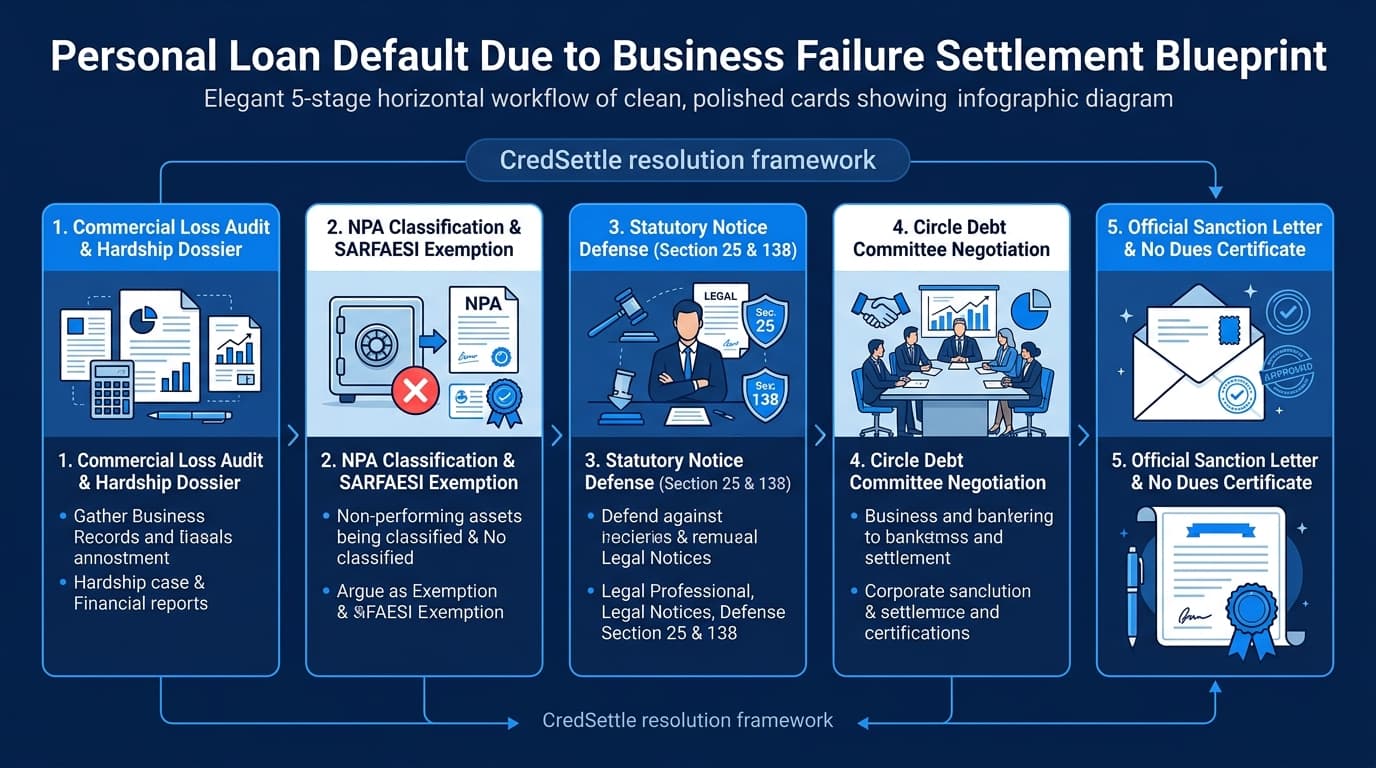
5. Visual Blueprint: Business Loss Loan Resolution Workflow
This comprehensive visual roadmap outlines the five essential operational phases required to transition a distressed personal loan from default status into an officially sanctioned, legally binding compromise settlement backed by an authentic No Dues Certificate.
6. Step-by-Step SOP: 6-Stage Business Debt Settlement Protocol
Talking to recovery agents or branch staff often leads to wasted token payments and false promises. Getting an approved settlement with deep waivers requires a clear six-step process.
1Stage 1: Loan Statement Audit & Ledger Check
Get your full loan statement from day one. Add up all past EMI payments, take out extra penal interest, and remove bounce fees. This shows your true net loan balance.
2Stage 2: Hardship File & Business Loss Proof
Collect proof of your business losses. Gather tax returns with nil income, GST surrender forms, and bank records showing zero income. These papers prove you cannot pay due to real losses.
3Stage 3: Formal Representation to Zonal Bank Heads
Do not talk to recovery agents. Send a formal legal letter directly to the bank zonal head and nodal officer. The letter explains your business loss and asks for a structured settlement.
4Stage 4: Direct Credit Committee Talks & Waivers
Negotiate with the bank credit team. Show that the loan has no pledged assets and present your loss proof. Ask for a 100% waiver on extra fees and a 50% to 80% cut on the principal.
5Stage 5: Sanction Letter Review & Verification
Check the settlement letter with care. It must be on bank letterhead with an official stamp. It must list your exact loan number, payment dates, and promise to close the loan.
6Stage 6: Settlement Payment & No Dues Certificate
Pay the settlement amount directly into your loan account using NEFT or RTGS. Keep the bank receipt. The bank will issue the No Dues Certificate within thirty to forty-five business days.
7. Statutory Notice Defense: Legal Protections for Entrepreneurs
When a loan is ninety to one hundred and twenty days overdue, banks send legal notices demanding payment. Knowing your rights and sending prompt legal replies stops agent threats and steers the bank toward an OTS deal.
Sent when an electronic EMI debit fails for low funds. Sending a lawyer reply within thirty days proves business loss and moves the dispute into settlement talks.
Sent if a security cheque bounces. Reply through a lawyer within fifteen days. The reply shows the cheque was security and not for fraud, stopping court trials.
Banks often start arbitration with their own chosen arbitrator. The Supreme Court forbids banks from naming sole arbitrators alone. A lawyer can challenge the hearing and push the bank to settle.
Debt Recovery Tribunals only handle claims over ₹20 Lakhs. For all loans, RBI rules strictly ban recovery calls before 8 AM or after 7 PM. Agents cannot contact family or visit homes unannounced.
8. 3-Tier Escalation Matrix: Banking Redressal for Distressed Debt
If recovery agents break rules or branch staff ignore your business loss, you can use the three-tier grievance process set up by the Reserve Bank of India.
| Grievance Tier | Designated Banking Authority | Turnaround Time | Scope of Intervention & Powers |
|---|---|---|---|
| Level 1: GRO | Bank Grievance Redressal Officer | 7 to 10 Working Days | Checks agent abuse, wrong penal interest charges, and initial settlement requests. |
| Level 2: PNO | Principal Nodal Officer (Head Office) | 14 to 21 Working Days | Steps in for agent harassment, reviews account statements, and escalates OTS requests. |
| Level 3: RBI Ombudsman | Reserve Bank Integrated Ombudsman | 30 Days Post-PNO | Handles formal complaints at cms.rbi.org.in for agent harassment and unfair banking practices. |
9. Procedural Timeline: Default Milestones to No Dues Certificate
A defaulted loan moves through set stages under RBI rules. Knowing this timeline helps borrowers identify when banks face pressure to clear bad debts, creating the best chance for deep waivers.
| Timeline Interval | Regulatory Asset Status | Lender Recovery Actions | Recommended Strategic Response |
|---|---|---|---|
| Day 1 to 30 | SMA-0 | SMS alerts, email notices, and reminder calls. | Review your cash. Do not take fresh loans to pay old debt. |
| Day 31 to 60 | SMA-1 | More reminder calls and formal bank letters. | Gather tax returns, business loss records, and closure papers. |
| Day 61 to 90 | SMA-2 | Pre-NPA warnings and case sent to recovery agents. | Use RBI rules to stop recovery agent harassment. |
| Day 91 to 120 | NPA Classification | Account marked NPA and sent to the bad debt desk. | Review the loan ledger and consult a debt settlement expert. |
| Day 121 to 180 | Prime OTS Window | Bank sends Section 25 notices or arbitration letters. | Negotiate with the bank to get 50% to 80% loan waivers. |
| Month 6 and Beyond | Write-off / ARC Transfer | Arbitration hearings or loan sold to an ARC. | Pay the settlement amount and get your No Dues Certificate. |
10. Specialized Scenarios: Startups, GST Closure & ARC Transfers
Business failures involve different setups, multiple bank loans, and debt sales. Solving these cases needs clear legal and financial strategies.
Multi-Lender Exposure & Cross-Default
Borrowers with loans across multiple banks face calls from several teams. A combined hardship file lets you settle all bank accounts in an organized way.
Venture Capital Collapse & Startup Liquidation
When startup funding stops, founders often hold personal debt used for company costs. Submitting investor exit letters and tax returns proves business failure and secures deep waivers.
Sole Proprietorship vs Personal Asset Segregation
Sole proprietors share identity with their firms. Showing GST surrender papers and closed trade licenses proves the firm shut down and protects personal assets.
Asset Reconstruction Company (ARC) Portfolio Assignments
Banks often sell bad loans to ARCs at 70% to 80% discounts. Because ARCs buy debts cheap, expert negotiators can secure deep settlement waivers of 70% to 80%.
 Legal Debt Dispute Authority
CredSettle (credsettle.com) is India's premier debt settlement, loan dispute resolution, and legal protection platform. Operating strictly under the RBI Fair Practices Code and CICRA 2005, our advocate panel negotiates directly with Bank Principal Nodal Officers to eliminate waived differentials, obtain unconditional No Dues Certificates (NDC), and upgrade credit bureau records from "Settled" to "Closed".
Frequently Asked Questions: Business Loss Loan Default Relief
Clear, legally verified answers addressing the most critical borrower questions regarding personal loan defaults following business closure, proving financial hardship, halting recovery harassment, and securing official No Dues Certificates.
Official Regulatory References & Statutory Legal Framework
- Reserve Bank of India: Master Direction on Fair Practices Code for Non-Banking Financial Companies and Scheduled Commercial Banks (Updated 2026).
- Payment and Settlement Systems Act, 2007: Section 25, Statutory Framework Governing Dishonour of Electronic Funds Transfer Mandates.
- Negotiable Instruments Act, 1881: Section 138, Legal Provisions Regarding Dishonour of Cheques for Legally Enforceable Debt Discharge.
- Arbitration and Conciliation Act, 1996: Sections 12(5), 16, and 21, Jurisdictional Ineligibility of Unilateral Arbitrators and Supreme Court Rulings (Perkins Eastman / TRF Limited).
- Credit Information Companies (Regulation) Act, 2005 (CICRA): Section 21, Standards for Accuracy of Credit Information and Bureau Dispute Rectification Protocols.