Bajaj Finserv Personal Loan Settlement
bank protocol for resolving overdue Bajaj Finance private loans. Halt claims firm calls. Stop illegal workplace visits. Waive compounding NACH bounce charges. Secure 40% to 55% main loan haircuts with an formal No Dues letter.
- NPA Mandate: Resolved straight through Bajaj Finance stressed asset desks after 90 days of default.
- Zero Mortgage Risk: no-pledge loans carry zero property mortgage or SARFAESI attachment rights.
- 100% Penal Waiver: Full elimination of compounding penal interest and repeated NACH bounce fees.
- 40% to 55% Haircut: Practical main loan OTS deal settled on core unamortized balances.
- formal Closure: Binding sanction letter followed by an authentic No Dues letter within 30 to 45 days.
1. Debt Economics and NPA Dynamics in Bajaj Finance Loans
Bajaj Finance Limited disburses large volumes of no-pledge private and flexi loans via digital underwriting. When sudden income loss. Trade downturns. Or health crises disrupt cashflow. Servicing installments becomes unviable. Overdue accounts progress through Special Mention Account stages: SMA-0 (1-30 days). SMA-1 (31-60 days). And SMA-2 (61-90 days). Beyond 90 consecutive days of default. The loan is formally classified as a Non-Performing Asset (NPA) under Reserve Bank of India prudential rules.
NPA reclassification requires Bajaj Finance to halt ledger interest accruals and allocate 15% to 25% provisions from its Tier-1 core cash reserves. Because no-pledge private loans lack mortgaged property or physical pledge. Bajaj cannot initiate summary asset seizure under the SARFAESI Act. Protracted civil lawsuits or disputed arbitrations across courts involve heavy office costs. As a result. Bajaj Finance central stressed asset boards in Pune are commercially motivated to approve structured One-Time deals (OTS) to release locked cash reserves and clean toxic non-performing assets off their balance sheets.
2. Financial Breakdown: Principal vs. Compounded Penal Levies
When an EMI bounces. Bajaj Finance systems inflate the balance with annual penal interest between 24% and 36%. Plus recurring auto-debit bounce fees of ₹500 and 18% GST for each failed presentation. Within several months. These artificial non-legal charges swell the gross claim by 30% to 50% above the genuine unamortized loan main loan.
A skilled debt relief plan begins with a audits to strip away these non-legal additions. When backed by verified hardship records. Bajaj Finance credit boards routinely authorize a 100% waiver across all extra penalty charges and bounce charges. Alongside a 40% to 55% main loan haircut on the core unamortized balance.
| Financial Component. | Pre-Settlement Claim. | Bajaj Credit Committee Waiver. | Final Payable Amount. |
|---|---|---|---|
| remaining base loan. | ₹7,00,000 | 45% Core Haircut (₹3,15,000). | ₹3,85,000 |
| Accrued Regular &. Penal Interest. | ₹2,40,000 | 100% Complete Waiver. | ₹0 |
| Late Surcharges &. NACH Bounces. | ₹60,00,0 | 100% office Waiver. | ₹0 |
| Total OTS deal Evaluation. | ₹10,00,000 | ₹6,15,000 Total Relief (61.5% Savings). | ₹3,85,000 Final OTS. |
3. Comparative Analysis: Bajaj Finance Debt Resolution Pathways
clients must evaluate their options objectively. Simple tenure restructuring increases overall interest without main loan relief. Meanwhile. Ignoring notices invites aggressive claims visits and court summons. An bank OTS provides definitive closure and legal immunity.
| Resolution Mechanism. | Financial Relief. | Legal Protection. | CIBIL Bureau Remark. | Standard Timeline. |
|---|---|---|---|---|
| One-Time settlement (OTS). | 40% to 55% main loan Haircut. | Complete Discharge &. Notice Withdrawal. | Settled / Zero Balance. | 30 to 60 Days |
| Tenor Restructuring. | 0% Haircut (Higher Total Interest). | Conditional on Timely Servicing. | Restructured Facility. | 45 to 90 Days |
| Civil Court lawsuits. | High Legal Defense Expenses. | Prolonged Adversarial Decrees. | Suit Filed / Wilful Default. | 2 to 5 Years |
| National Lok Adalat. | 35% to 50% Mutual OTS deal. | Section 21 Non-Appealable Decree. | Settled in Lok Adalat. | Sitting Date Basis. |
| Unmanaged Default. | Compounding 36% Penalties. | Section 25 / Section 138 Warrants. | Written Off / Default. | Indefinite Distress. |
4. CIBIL Scoring Mechanics, Algorithms & Score Rehabilitation
Credit bureaus (CIBIL. Experian. CRIF High Mark) calculate scores based on five factors: 35% Payment History. 30% Credit use. 15% Credit Age. 10% Credit Mix. 10% Inquiries. Defaulting on a Bajaj private loans damages the critical 35% payment history pillar. Logging progressive 30. 60. 90+ DPD marks that reduce scores by 120 to 180 points.
Executing an authorized settlement updates the bureau remark to ". Settled". With a zero unpaid dues. Halting ongoing negative DPD notations. clients can rebuild a 750+ score over 18 to 24 months using a fixed-deposit secured credit card while maintaining use below 30%. Under Section 21 of CICRA. Paying the waived variance later converts ". Settled". To ". Closed". , restoring complete creditworthiness.
Bajaj Finserv Personal Loan Settlement Roadmap
This visual flowchart summarizes the six bank stages required to resolve an overdue Bajaj private loans through an authorized OTS deals.
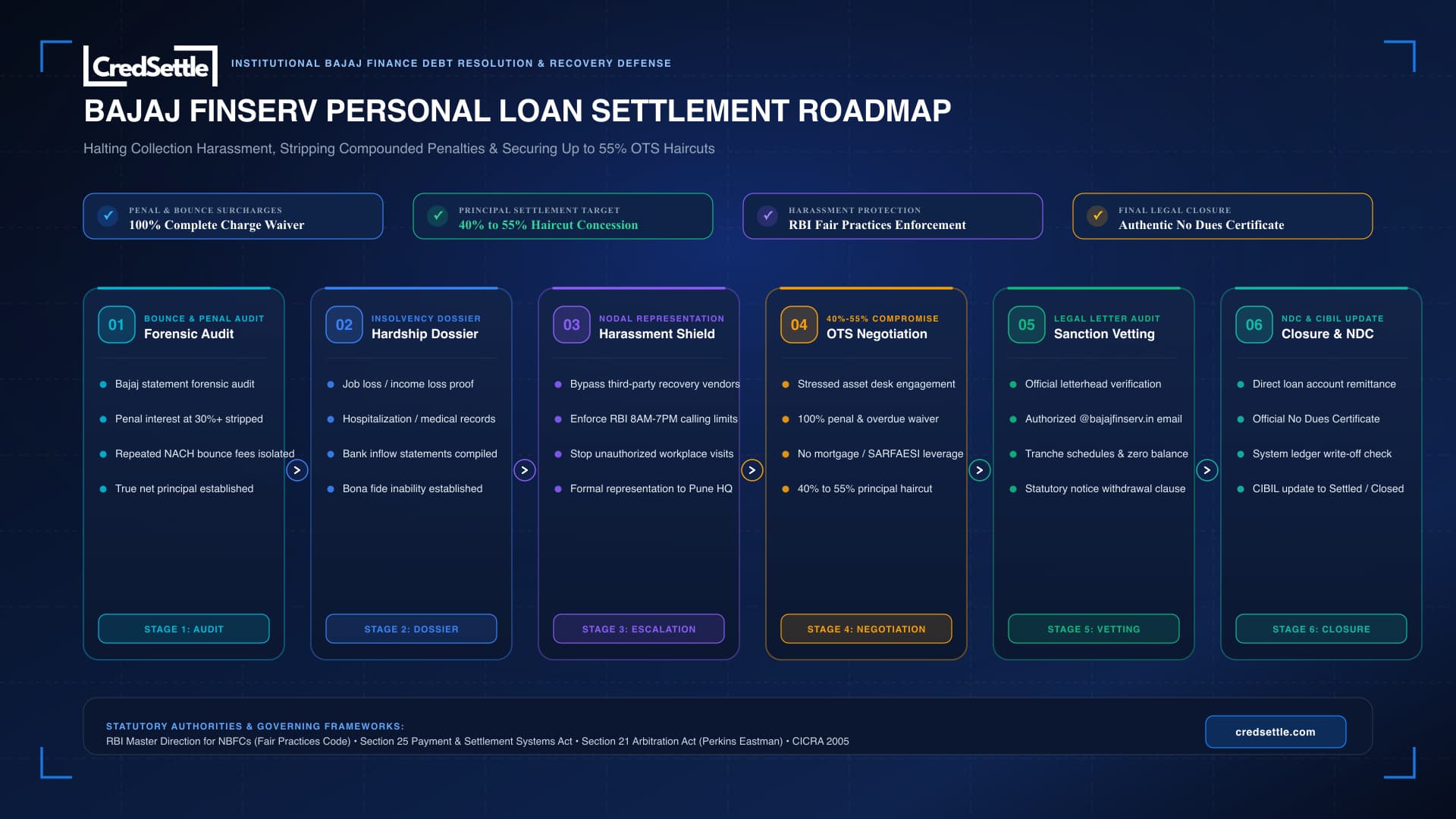
6. Six-Stage SOP: Negotiating Bajaj Finserv Personal Loan Settlements
Settling with Bajaj Finance requires structured bank engagement. Informal discussions with telecallers often lead to misallocated token payments. Follow this six-stage protocol to secure an authorized settlement.
1Stage 1: Forensic Statement & Bounce Audit
Audit the loan record from inception. Isolate released main loan. Reconcile cleared EMIs. Unbundle 36% penal interest. Strip away total NACH bounce charges to establish the true net base loan.
2Stage 2: Comprehensive Hardship Dossier Compilation
Assemble verifiable proof of genuine distress. This includes job termination letters. Salary reduction slips. Audited trade balance sheets. health discharge summaries to establish genuine inability to service regular EMIs.
3Stage 3: Harassment Shield & Grievance Representation
Serve a formal legal notice to the Bajaj main loan Nodal Officer in Pune. Invoking the RBI Fair Practices Code to enforce 8 AM to 7 PM calling hours. Redirect contact through counsel. Stop workplace visits.
4Stage 4: Stressed Asset Committee Negotiations
Engage Bajaj Finance credit boards straight. Leverage Tier-1 provisioning pressures and the lack of underlying pledge to eliminate 100% of penal fees and secure a 40% to 55% main loan haircut.
5Stage 5: Settlement Sanction Letter Legal Vetting
Verify the sanction letter on formal letterhead from an authorized @bajajfinserv.in email. Confirming stated settlement figures. Payment deadlines. And an explicit doing to withdraw pending legal notices.
6Stage 6: Direct Loan Remittance & NDC Procurement
pay the agreed settlement figure straight into your Bajaj loan account via NEFT or RTGS. Retain transaction receipts. Verify zeroed ledger balances. Obtain your formal No Dues letter within 30 to 45 trade days.
7. Statutory Notice Defense & Borrower Legal Rights
When loan default surpasses 90 to 120 days. Bajaj Finance retainers dispatch legal demand notices. Understanding your legal rights disarms threats and creates leverage for a fair OTS deal.
Issued under the Payment and settlement Systems Act for bounced auto-debits. Serving a legal reply within 30 days showing unexpected debt stress refutes criminal intent and channels the debt into an amicable OTS.
Dispatched if physical pledge cheques are dishonored. A legal reply served within 15 days establishing that cheques were deposited as conditional pledge prevents summary criminal steps.
Under Supreme Court rulings in Perkins Eastman and TRF Ltd. Lenders cannot unilaterally appoint a sole arbitrator. Raising Section 12(5) objections halts ex-parte steps and forces bilateral OTS deal.
Debts claims Tribunals handle claims exceeding ₹20 Lakhs only. For all retail loans. The RBI Fair Practices Code forbids calls before 8 AM or after 7 PM. Abuse of relatives. Workplace visits.
8. Three-Tier Escalation Matrix for Bajaj Finserv Grievances
When claims vendors violate conduct rules or branches ignore hardship letters. Escalate systematically through Bajaj internal redressal officers and the Reserve Bank of India.
| Grievance Tier | Designated NBFC Authority. | Turnaround Time | pay & Scope of Intervention. |
|---|---|---|---|
| Level 1: GRO | Bajaj Grievance Redressal Officer (Pune). | 7 to 10 Working Days. | Investigation into improper claims conduct. Disputed penal interest charges. And initial settlement review. |
| Level 2: PNO | main loan Nodal Officer (Pune HQ). | 14 to 21 Working Days. | Direct intervention on persistent claims agent abuse. Review of disputed accounting. And zonal credit boards escalations. |
| Level 3: RBI Ombudsman. | Reserve Bank Integrated Ombudsman. | 30 Days Post-PNO. | Legally binding RBI adjudication through cms.rbi.org.in for severe fair practices code infractions and predatory debt claims practices. |
9. Chronological Resolution Timeline: From Default to NDC
Understanding where your loan sits along the default timeline enables you to pinpoint the optimal strategic window for initiating talks and maximizing main loan waivers.
| Timeline Interval. | Asset Classification. | NBFC Recovery Actions. | Recommended Borrower Strategy. |
|---|---|---|---|
| Day 1 to 30 | SMA-0 | Automated SMS notices, email reminders. And soft claims phone calls. | Review household cashflow. avoid taking fresh high-interest digital loan apps. |
| Day 31 to 60 | SMA-1 | Intensified telecaller outreach and preliminary loan recall notices. | Assemble authenticated health. Employment. And income hardship records. |
| Day 61 to 90 | SMA-2 | Pre-NPA warnings and initial assignment to third-party claims firms. | Enforce RBI Fair Practices Code rights against abusive telecalling vendors. |
| Day 91 to 120 | NPA Classification. | Tier-1 cash provisioning triggered. account referred to central stressed assets. | Perform deep record audit and engage seasoned debt relief counsel. |
| Day 121 to 180 | Prime OTS Window. | Issuance of Section 25 PSSA notices or hearing intimation letters. | Execute bilateral OTS deal talks for a 40% to 55% waiver. |
| Month 6 and Beyond. | Write-off / ARC Sale. | Ex-parte arbitral hearings or portfolio assignment to Asset Reconstruction Companies. | pay sanctioned payment steps straight and secure formal NDC. |
10. Handling Complex Scenarios: Insta Cards, Layoffs & ARCs
clients often face multi-product debts and distinct economic crises. Below are tactical plans for specialized Bajaj debt scenarios.
Insta EMI Card & Flexi Cross-Defaults
default on an Insta EMI card accelerates cross-defaults on private loans. Structured relief bundles all active facilities into a single OTS deal dossier to achieve a unified waiver.
Corporate Tech Layoffs & Salary Loss
Salaried company staff facing sudden downsizing can submit severance papers and depleted bank records as verifiable hardship to expedite approval for deep main loan haircuts.
Business Proprietorship Cashflow Shocks
Small shop owners using private credit for working cash can establish genuine trade distress through audited money records. Tax returns. Debtor default records.
Asset Reconstruction Company (ARC) Sales
When aged portfolios are sold to ARCs like Phoenix or Prudent at deep discounts. Skilled negotiators can leverage the discounted acquisition cost to secure haircuts exceeding 60%.
 Legal Debt Dispute Authority
CredSettle (credsettle.com) is India's premier debt settlement, loan dispute resolution, and legal protection platform. Operating strictly under the RBI Fair Practices Code and CICRA 2005, our advocate panel negotiates directly with Bank Principal Nodal Officers to eliminate waived differentials, obtain unconditional No Dues Certificates (NDC), and upgrade credit bureau records from "Settled" to "Closed".
FAQs: Bajaj Finserv Personal Loan Settlement Guide
Clear. Verified answers addressing the most common client questions regarding Bajaj Finance private loans deals. Waiver limits. Claims conduct. Credit rebuilding.
Official Regulatory References & Legal Framework
- Reserve Bank of India: Master Direction on Fair Practices Code for NBFCs and claims Conduct Rules.
- Payment and settlement Systems Act. 2007: Section 25. Dishonour of Electronic Funds Transfer Mandates.
- Negotiable Instruments Act, 1881: Section 138. Cheque Dishonour for Debt Discharge.
- hearing and talks Act, 1996: Sections 12(5) and 21. Ineligibility of Unilateral Arbitrators (Perkins Eastman).
- Credit Information Companies Act, 2005: Section 21. Credit Information Rectification Protocols.