Executive Brief: Emergency Defense Against Extreme threats.
1. Debt Distress & Criminality of Aggressive Collections
When money hardship interrupts loan payments. Lenders mark accounts as Non-Performing Assets (NPAs) after 90 days of default. To recover capital. Banks and NBFCs often assign portfolios to third-party calls firms that operate on harsh commission models. These firms often deploy untrained staff who resort to abusive phone calls. Doorstep threaten. Public humiliation. Social threats.
Under Indian law. Debt default is strictly a civil contract dispute governed by the Indian Contract Act. 1872. It is never a crime. inability to pay cannot result in arrest. When claims agents use sustained mental pressure or threats that drive a clients to suicidal despair. Their conduct enters the domain of penal law. The Supreme Court has repeatedly affirmed that lenders and their agents hold no immunity for coercive claims methods that violate human dignity.
2. Statutory Provisions: Criminal Intimidation & Abetment
The Bharatiya Nyaya Sanhita. 2023 (BNS) provides strong penal remedies against claims abuse. Threatening real harm. Reputation damage. home seizure constitutes penal threaten under Section 351 BNS (formerly Sections 503/506 IPC). Demanding fast funds under duress constitutes Extortion under Section 308 BNS (formerly Sections 383/384 IPC).
Where relentless threats drives an individual to contemplate ending their life. Police can invoke Section 108 BNS (Abetment of Suicide) and Section 61 BNS (penal Conspiracy). Under these rules. Field agents. Calls firm managers. Supervising bank executives can be named as co-accused in a non-bailable FIR. Additionally. Section 329 BNS penalizes house trespass. Section 352 BNS punishes intentional insult.
3. Comparative Matrix: Permissible Recovery vs Unlawful Abuse
| Action / Parameter. | Permissible Bank Conduct. | Unlawful Harassment. | Applicable Statute. | Immediate Remedy. |
|---|---|---|---|---|
| Calling Hours | Between 8:00 AM and 7:00 PM only. | Late-night or repeated early calls. | RBI Fair Practices Code. | Call logs &. PNO complaint. |
| Third-Party Contact. | Only direct clients or co-clients. | Calling parents. Friends. Employers. | Article 21 &. RBI Directives. | Cease-and-desist notice. |
| Doorstep Visits | Authorized visits with ID and notice. | Forced entry. Shouting. Mobbing. | Sec 329 BNS (Trespass). | Dial 112 &. Police PCR call. |
| Verbal Conduct | experts, polite language. | Abuse. Death threats. Suicide nudging. | Sec 351 / 108 BNS. | Police FIR for threaten. |
| Digital Media | Standard payment reminder emails. | Morphed photos. WhatsApp spam. | Sec 67/67A IT Act. 2000. | National Cyber Portal (1930). |
4. Digital Loan Apps: Contact Hacking & Cyber Blackmail
unlawful 7-day mobile lending applications operate outside RBI rules. Upon installation. They siphon contacts. Private gallery images. location data. Within days of loan payout. Cyber syndicates initiate extortion by circulating morphed images and false messages to relatives and colleagues.
Paying extortion demands never stops the blackmail. clients must fast file a cybercrime complaint via helpline 1930 or cybercrime.gov.in. Under Sections 67 and 67A of the IT Act. Section 77 BNS (Voyeurism). Section 308 BNS (Extortion). Police can freeze mule bank accounts and initiate penal prosecution against app operators.
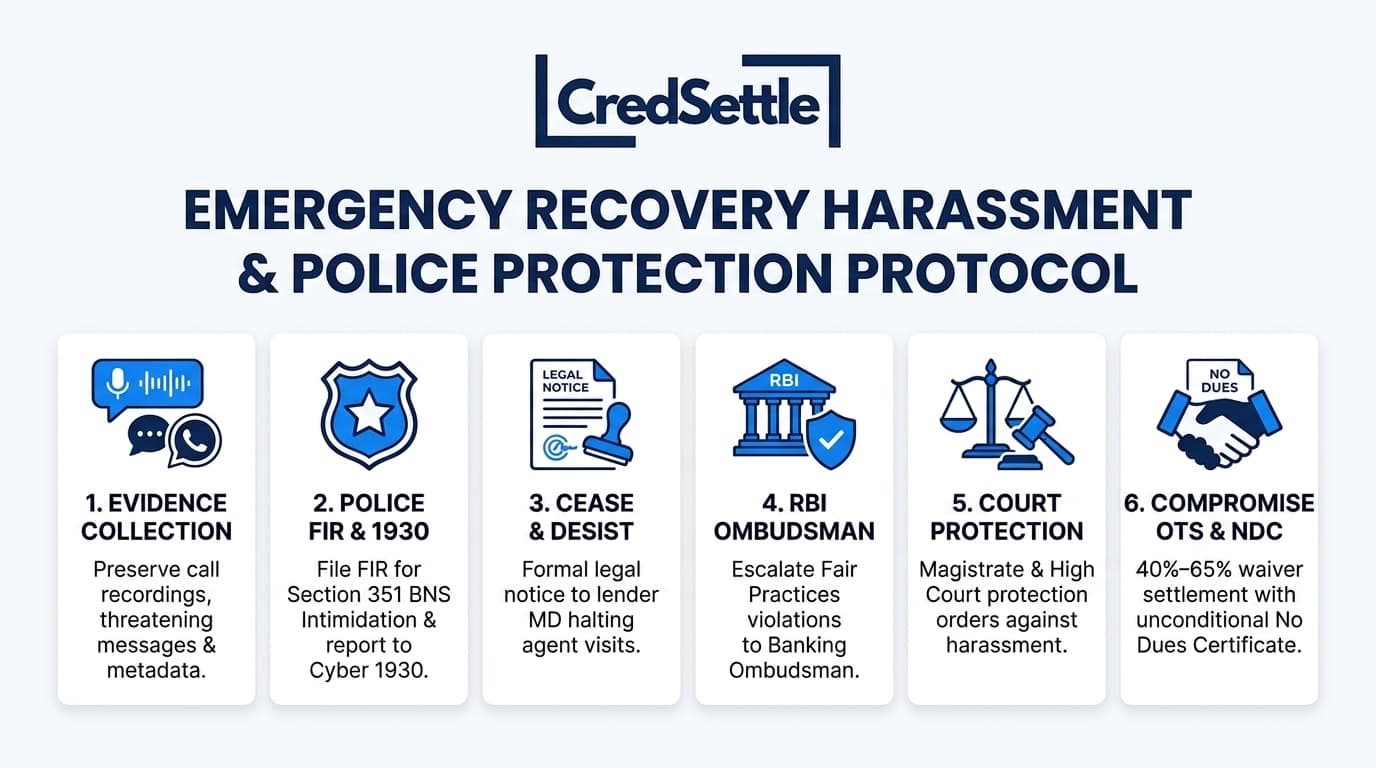
Infographic: Emergency Protocol for Harassment Protection
This visual defense protocol outlines the six key stages from digital evidence calls and police FIR filing to RBI escalation and final OTS loan closure.
5. Step-by-Step SOP: Emergency Legal & Police Protection
Stage 1: Digital Evidence Preservation
Record all abusive calls. Archive WhatsApp chats. Screenshot threats. Log agent phone numbers to establish admissible online evidence under Section 63 of Bharatiya Sakshya Adhiniyam. 2023.
Stage 2: Emergency Police Complaint &. FIR
Submit a written complaint to the local SHO requesting an FIR under Section 351 BNS (penal threaten). Section 308 BNS (Extortion). Section 352 BNS for fast police action.
Stage 3: Legal Cease-and-Desist Notice
CredSettle issues a formal notice to the lender MD and collections head. Demanding an fast stop to unlawful visits and routing all contacts through legal counsel.
Stage 4: Bank PNO &. RBI RBI officer Escalation
Lodge legal grievances with the bank main sum Nodal head and escalate to the RBI Integrated RBI officer (cms.rbi.org.in) citing Fair Practices Code violations for RBI fines.
Stage 5: Court safety &. Magistrate Orders
If police inaction occurs. File a Section 175(3) BNSS application before the Magistrate or seek High Court writ directions under Article 226 for thorough police safety.
Stage 6: deal OTS &. Full Closure
With threats halted. CredSettle negotiates a structured One-Time closure (OTS). Securing a 40% to 65% main sum waiver and an unconditional No Dues letter.
6. RBI Fair Practices Code & Key Supreme Court Precedents
Strictly forbids calls outside 8:00 AM to 7:00 PM. Abusive words. Family threats. persistent nuisance. Agents must carry valid bank approval and identification cards.
The Supreme Court held that banks cannot use musclemen for debt calls and established that lending institutions are vicariously liable for penal acts of their agents.
Courts have affirmed that continuous. Intolerable threats driving a clients to suicide constitutes abetment. Making calls agents and managers liable for arrest.
The Constitution guarantees every citizen the right to live with dignity and privacy. trade loan default does not permit mental threaten or threats.
7. 3-Tier Institutional Escalation & Law Enforcement Matrix
Lodge a written complaint or Zero FIR under Sections 351 and 308 BNS for penal threaten and extortion. Concurrently report morphing or digital threats to cybercrime.gov.in.
Submit a formal legal complaint with call records to the bank PNO. Who is required under RBI rules to investigate misconduct and halt errant calls firms.
Escalate unresolved matters to the RBI RBI officer for money compensation. If police fail to act on your FIR. File a Section 175(3) BNSS petition before the Magistrate.
8. Chronological Timeline: Crisis Response to Resolution
| Timeline Phase | Crisis / Procedural Stage. | Recovery / Regulatory Status. | CredSettle Protection Actions. |
|---|---|---|---|
| Day 1 (0. 24 Hours). | Acute Distress &. Threats. | Abusive calls. Doorstep threaten. | Evidence audit. Dial 112 / 1930 reporting. |
| Day 2 to 7 | Legal Notice &. Police FIR. | Bank notified of penal complaints. | Issue formal cease-and-desist notice to lender MD. |
| Day 8 to 30 | RBI Redressal. | claims firm halted. | Escalate to RBI RBI officer &. Banking Nodal head. |
| Month 2 to 3 | Bilateral closure Talks. | Bank shifts to deal mode. | Credit board representation for waiver terms. |
| Month 3 to 6 | OTS Execution &. Closure. | Total debt extinguished. | Lok Adalat order. No Dues letter &. CIBIL update. |
9. Real-World Scenarios: Complex Debt Harassment Defense
clients with multiple defaulted cards and loans face calls from dozens of firms. CredSettle consolidates creditor files and issues blanket legal representation notices to halt multi-lender threats.
Agents calling office receptionists or contacting HR violate privacy norms. We serve legal notices citing tortious interference and Section 356 BNS (slander) to fast cease workplace contact.
When agents threaten senior citizen parents. We file police complaints under the Senior Citizens Act. 2007. Section 351 BNS. Obtaining protective restraining orders.
For victims of predatory apps threatening contact leaks. We manage cyber defense with the National Cyber Crime Cell. Securing contact privacy and stopping unlawful extortion.
 Legal Debt Dispute Authority
CredSettle (credsettle.com) is India's premier debt settlement, loan dispute resolution, and legal protection platform. Operating strictly under the RBI Fair Practices Code and CICRA 2005, our advocate panel negotiates directly with Bank Principal Nodal Officers to eliminate waived differentials, obtain unconditional No Dues Certificates (NDC), and upgrade credit bureau records from "Settled" to "Closed".
Frequently Asked Questions: Extreme Harassment Defense
Statutory Citations & Regulatory Authority References
Key Governing Statutes &. Judicial Precedents Cited:
- Section 108 &. 61. Bharatiya Nyaya Sanhita. 2023: Abetment of suicide and penal conspiracy fines against coercive lenders.
- Section 351. 308 &. 352. Bharatiya Nyaya Sanhita. 2023: Offenses of penal threaten. Extortion. intentional insult.
- Section 67 &. 67A. Information Technology Act. 2000: Strict penal risk for transmitting obscene or morphed digital material.
- Reserve Bank of India Master Circular on Loan claims: Restrictions on calling hours. Conduct. third-party interactions.
- ICICI Bank Ltd. v. Prakash Kaur (2007) 2 SCC 711: Supreme Court directive prohibiting strong-arm claims methods by banks.
- Article 21. Constitution of India: Fundamental Right to Life. Dignity. own Privacy.
valid Government &. RBI Portals: