Stop Course Loan EMIs When Coaching Institute Defaults
Did your EdTech app or coaching centre shut down while an NBFC still takes EMIs? Learn how to use RBI Digital Lending rules, CCPA refund orders, and consumer law to cancel the loan and protect your CIBIL score.
- Hidden Personal Loan Trap: Most "Zero-Cost Course EMIs" are real third-party NBFC personal loans. They show up on your CIBIL report right away even if classes stop.
- 10-Day Pro-Rata Refund Rule: Under Ministry of Education 2024 rules and CCPA norms, "No Refund" clauses are void. Coaching centres must refund unused course fees within 10 days.
- RBI KFS & Cooling-Off Shield: Under RBI Digital Lending Directions 2025, every lender must give a signed Key Facts Statement (KFS) and a penalty-free cooling-off window to exit.
- Joint Liability in Consumer Court: When an NBFC wires money straight to a coaching firm under a tie-up, consumer courts can hold both jointly liable under Section 65 of the Contract Act.
- Safe Auto-Debit Exit: Never stop e-NACH silently without proof. Put both the institute and NBFC on written dispute notice first to guard your CIBIL and avoid Section 25 bounce trouble.
1. Statutory Framework: RBI & Consumer Rules for Course Loans
Across India, thousands of students and parents sign up for test prep, coding bootcamps, and EdTech apps every month. Many pay through instant NBFC loans pitched as easy monthly plans. Trouble starts when the coaching centre shuts down, teachers leave, or the promised classes never happen.
Even after the institute locks its doors, the partner NBFC keeps taking monthly EMIs from your bank account. The lender often tells you that your loan contract is separate from your coaching course. However, Indian banking rules and consumer laws give you strong ways to fight back.
First, the Reserve Bank of India issued the Digital Lending Directions, 2025 (RBI/2025-26/36) and the Key Facts Statement Circular (DOR.STR.REC.13). These rules bind every bank and NBFC that sells loans through EdTech apps or coaching desks. Lenders must be honest about costs, loan agents, and exit rights.
Second, the Consumer Protection Act, 2019 works alongside the Ministry of Education 2024 Coaching Guidelines and CCPA 2024 rules. Together, they treat sudden centre shutdowns and "no refund" traps as unfair trade practices. You can claim refunds, cancel linked loans, and stop unfair recovery calls.
2. How EdTech Zero-Cost EMI & NBFC Loan Traps Work
Most borrowers never realize they are taking a formal personal loan during course admission. Sales reps call it a "monthly tuition plan," "scholarship EMI," or "15-day risk-free trial." They rush you to share your PAN, Aadhaar OTP, selfie, and bank e-NACH on their tablet or link.
In legal terms, that sales desk acts as a Lending Service Provider (LSP) for a partner NBFC. Within minutes, the NBFC opens an unsecured personal loan in your or your parent's name. Instead of paying you, the NBFC wires the entire 1-year or 2-year course fee straight to the institute's bank account.
How does the NBFC offer "Zero-Cost EMI"? Behind the scenes, the EdTech company gives the NBFC an upfront discount called subvention. For example, on a ₹1,20,000 course loan, the NBFC may wire only ₹1,08,000 to the institute and pocket ₹12,000 upfront as its interest margin.
This hidden setup hurts you the moment classes fail. Because the institute already took the full cash up front, its support team stops replying to refund emails. Meanwhile, the NBFC demands all ₹1,20,000 from you and threatens to spoil your CIBIL score if a single EMI bounces.
3. Course Loan Exit Matrix: Refund, Cancel & OTS Math
The right way to exit an EdTech or coaching NBFC loan depends on what went wrong and when you act. A fresh loan inside the look-up window needs a very different plan than a loan tied to a bankrupt coaching brand.
Use the comparison table below to match your exact case to the strongest legal remedy, target payoff outcome, and CIBIL impact.
| Dispute Scenario | Primary Legal Shield | Target Loan Outcome | CIBIL & Cost Impact |
|---|---|---|---|
| Within Cooling-Off Window | RBI Directions 2025 | Zero-penalty loan cancellation | Closed (₹0 Penalty) |
| Mid-Course Exit / Poor Classes | MoE 10-Day & CCPA 2024 | Pro-rata fee refund to NBFC | Clean Closure on Refund |
| Coaching Institute Shut Down | Sec 65 Contract & CPA | Joint liability & EMI refund | Cancelled + CIBIL Cleared |
| No KFS / Forged Consent | RBI KFS Circular 2024 | RBI Ombudsman full reversal | Deleted + ₹100/Day Claim |
| EdTech in NCLT Insolvency | IBC Claim + NBFC OTS | 40% to 65% principal waiver | Negotiated Exit + NOC |
4. RBI KFS, Cooling-Off & Direct Disbursal Breaches
Even if a coaching centre vanishes, you have a direct weapon against the NBFC. Many EdTech loans break strict Reserve Bank of India compliance rules during signup. Spotting even one RBI breach gives you strong power before the RBI Ombudsman.
1. Missing Key Facts Statement (KFS): Under RBI Circular DOR.STR.REC.13 (mandatory from October 1, 2024), the NBFC must send you a clear KFS before disbursing a retail loan. The KFS must show the true Annual Percentage Rate (APR), processing fees, penal charges, and recovery agent details. Any fee missing from your KFS cannot be charged to you.
2. Blocked Cooling-Off Exit: Under RBI Digital Lending Directions 2025, every digital loan must carry a clear look-up period of at least one day (often three days under NBFC policy). During this period, you can cancel the loan with zero penalty by paying only principal and daily interest. If an EdTech counselor stalled your email until the window expired, the NBFC is responsible for its partner's delay.
3. Direct Disbursal & LSP Accountability: RBI rules mandate that digital loan money must go straight to the borrower's own bank account. Paying a merchant directly is only allowed under narrow end-use rules with clear, informed borrower consent. Also, under RBI rules, the NBFC bears full legal blame for any false claims or forced KYC done by its EdTech sales agent.
4. Illegal Penal Interest Compounding: Under RBI Circular DoR.MCS.REC.28 (effective April 1, 2024), lenders cannot charge extra penal interest on unpaid EMIs. They cannot charge interest on late fees either. Any flat penal fee must be fair and printed upfront in your KFS.
5. Visual Blueprint: EdTech Loan Cancellation & Exit Flow
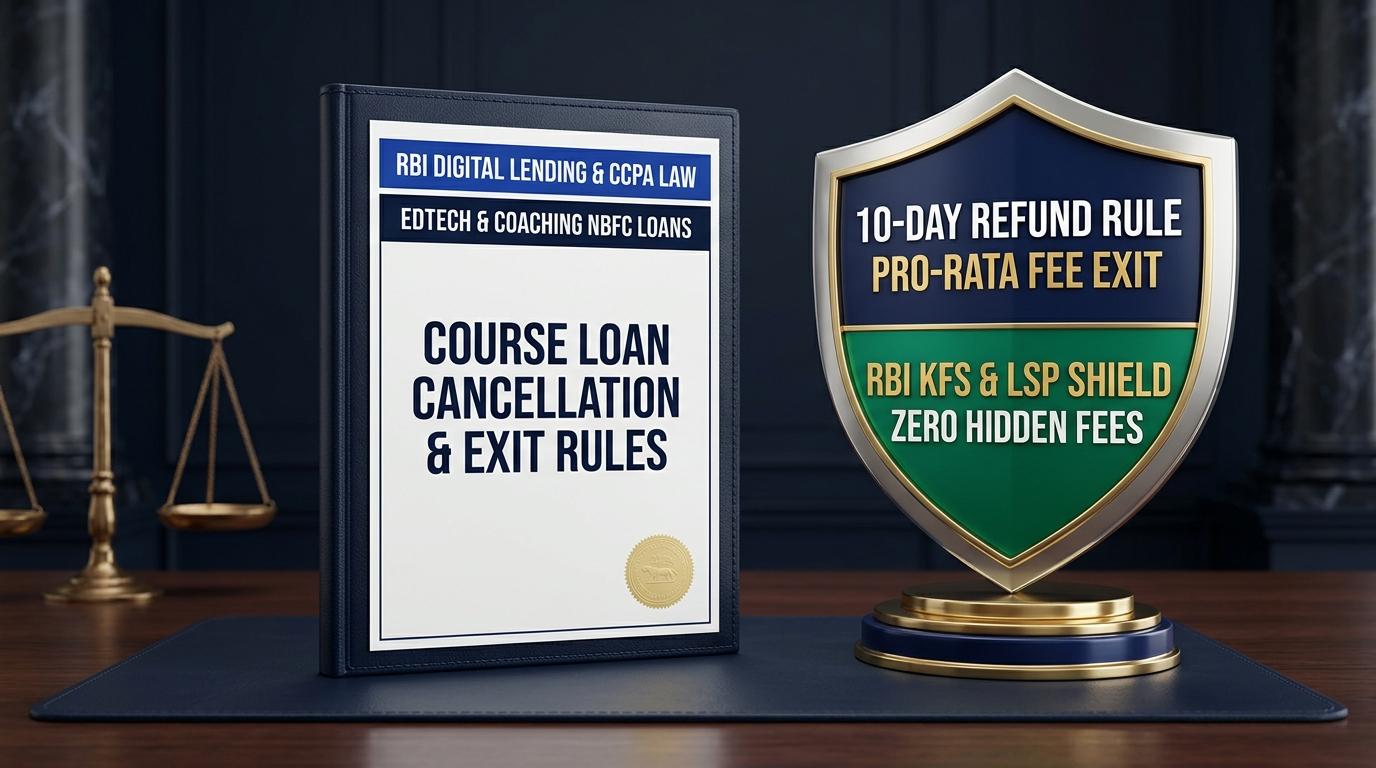
This visual chart sums up the core legal shields that protect students and parents against trapped EdTech and coaching NBFC loans in India. Use it to verify your refund rights and RBI Digital Lending defenses.
6. Step-by-Step SOP: Stopping EMIs After Institute Shutdown
If your coaching centre closed down or your EdTech course turned out to be a scam, do not panic or ignore NBFC calls. Follow these six legal steps in exact order to build an airtight case.
1Stage 1: Freeze Proof of Shutdown and Mis-Selling
Collect photos of locked coaching branches, cancelled class emails, dead app screens, and WhatsApp chats with sales agents. Save your fee receipt, brochure promises, and bank statement showing EMIs paid so far.
2Stage 2: Demand Your Signed KFS, Loan Copy, and UTR Trail
Email the NBFC Grievance Officer right away. Demand a free copy of your signed loan agreement, Key Facts Statement (KFS), LSP partner details, and bank UTR proof showing who got your loan money.
3Stage 3: Serve a Joint Legal Notice to EdTech and NBFC
Send one formal legal notice to both the coaching institute and the NBFC. Cite Section 65 of the Indian Contract Act, Ministry of Education 10-day pro-rata refund rules, and RBI Digital Lending compliance breaches.
4Stage 4: Revoke Auto-Debit Only After Putting Dispute on Record
Never let your e-NACH or UPI AutoPay bounce quietly without written notice. After serving your dispute notice, instruct your bank to pause or cancel the mandate so further funds do not drain while your case runs.
5Stage 5: File on NCH, RBI CMS Portal, and e-Jagriti
Log a grievance on National Consumer Helpline (1915) first. Escalate NBFC breaches on cms.rbi.org.in after 30 days, and file a joint petition on e-jagriti.gov.in asking for an interim stay on EMIs and CIBIL hits.
6Stage 6: Collect Official NOC and Audit All Four Credit Bureaus
Once the loan is cancelled, refunded, or settled via OTS, get a signed No Dues Certificate (NOC). Check CIBIL, Experian, CRIF, and Equifax within 15 to 30 days to ensure zero overdue remarks remain.
7. Legal Rights: Joint Liability & Consumer Court Rulings
Coaching brands and NBFCs rely on two standard excuses: "Fees are non-refundable" and "The loan is a separate contract." Indian consumer commissions have rejected both excuses in major cases across the country.
Under Section 2(46) and Section 2(47) of the Consumer Protection Act, 2019, one-sided "no refund" clauses are unfair contracts. When an institute shuts down, the core purpose of the contract fails under Section 65 of the Indian Contract Act.
The National Commission ruled that taking multi-year lump-sum fees with blanket "no refund" terms is an unfair trade practice. Coaching institutes cannot keep unearned money for unrendered classes and must pay a pro-rata refund.
If a student drops out on their own and the seat stays empty, courts check actual cost loss. However, if the coaching centre itself stops classes or shuts down, full pro-rata refund and compensation apply without exception.
When an NBFC ties up with an institute, uses its sales staff for KYC, and wires fees straight to the institute, both act together. Consumer courts can hold both jointly and severally liable to refund EMIs and close the loan.
Under Section 38(8) of CPA 2019, District Commissions can pass an interim stay blocking EMI recovery and CIBIL hits during trial. Under RBI rules, NBFC agents cannot threaten arrest or contact your college, family, or boss.
8. 3-Tier Escalation Matrix: NBFC GRO to RBI & e-Jagriti
If customer care agents keep passing the blame between the EdTech app and the NBFC, move up this formal three-tier redressal ladder.
| Escalation Tier | Designated Authority | Turnaround Time | Scope of Intervention & Relief |
|---|---|---|---|
| Level 1: GRO Desk | NBFC GRO & Institute Refund Officer | 7 to 15 Days | Audits missing KFS, cooling-off logs, and triggers merchant clawback from escrow. |
| Level 2: NCH & PNO | National Consumer Helpline & NBFC PNO | 15 to 30 Days | Registers official docket on consumerhelpline.gov.in (1915) and forces Head Office review. |
| Level 3: RBI & Court | RBI Ombudsman & e-Jagriti Commission | 30+ Days | Files RBI Digital Lending breach at cms.rbi.org.in and joint refund suit on e-jagriti.gov.in. |
9. Procedural Milestones: Course Default to Clean CIBIL
Timing matters in EdTech loan disputes. Acting in the first 10 to 30 days stops extra EMI losses and helps you secure RBI and consumer law relief faster.
| Milestone Window | Legal Phase | Lender & Institute Duty | Borrower Action Protocol |
|---|---|---|---|
| Day 1 to 3 | Cooling-Off Window | NBFC must allow penalty-free loan exit under RBI look-up rules. | Email written loan cancellation right away to both NBFC and EdTech. |
| Day 4 to 10 | 10-Day Refund Window | Institute must release pro-rata refund under Ministry of Education rules. | Save shutdown proof, demand KFS and UTR trail, and log NCH ticket. |
| Day 11 to 30 | Formal Legal Notice | NBFC GRO must reply to KFS, agent mis-selling, and refund claims. | Serve joint legal notice and revoke auto-debit safely after notice. |
| Day 31 to 45 | RBI & Court Filing | NBFC faces RBI Ombudsman probe and Consumer Commission notice. | File on cms.rbi.org.in and e-jagriti.gov.in seeking interim EMI stay. |
| Day 46 to 90 | Resolution / OTS | Negotiates merchant clawback, loan cancellation, or waiver OTS. | Verify formal cancellation letter or verified OTS letter before paying. |
| Post-Closure (15-30d) | CIBIL Clean-Up | Must report zero dues on 15-day cycle or pay ₹100/day dispute penalty. | Secure NOC and audit CIBIL, Experian, CRIF, and Equifax reports. |
10. Specialized Scenarios: NCLT Insolvency, Co-Signers & Apps
Many EdTech loan cases involve extra legal twists like corporate insolvency, parent co-signers, or bounce notices. Here is how Indian law handles these four real-world cases.
EdTech Company in NCLT Insolvency (CIRP)
If the EdTech firm enters IBC insolvency, new court cases against it pause under a Section 14 moratorium. File your fee claim with the Interim Resolution Professional (IRP). Meanwhile, challenge RBI breaches or negotiate a 40% to 65% OTS waiver directly with the solvent NBFC.
Parent Co-Borrowers & Salaried Guarantors
Because most students lack income, coaching loans are booked in a parent's name. Every unpaid EMI hits the parent's CIBIL score too. Always include both student and parent names on the legal notice and e-Jagriti complaint.
Section 25 PSSA e-NACH Bounce Notices
After you stop auto-debit, an NBFC may send a notice under Section 25 of the Payment and Settlement Systems Act, 2007. Never ignore it. Reply within 15 days through an advocate citing failure of consideration and your active consumer dispute.
"Pay After Placement" & Fake ISA Loans
Some job-guarantee bootcamps pitch an Income Share Agreement (ISA) that secretly activates an NBFC personal loan on day one. Under CCPA 2024 rules and RBI KFS norms, hidden job guarantees and undisclosed APR loans can be legally disputed.
 Legal Debt Dispute Authority
CredSettle (credsettle.com) is India's premier debt settlement, loan dispute resolution, and legal protection platform. Operating strictly under the RBI Fair Practices Code and CICRA 2005, our advocate panel negotiates directly with Bank Principal Nodal Officers to eliminate waived differentials, obtain unconditional No Dues Certificates (NDC), and upgrade credit bureau records from "Settled" to "Closed".
Frequently Asked Questions: EdTech & Coaching NBFC Loans
Plain, clear answers to key questions on stopping coaching EMIs, RBI cooling-off exits, joint consumer court claims, and protecting your CIBIL score.
Official Regulatory Citations & Statutory References
- Reserve Bank of India (Digital Lending) Directions, 2025: RBI/2025-26/36 (DOR.STR.REC.19/21.07.001/2025-26), dated May 8, 2025, governing direct disbursal, LSP liability, and cooling-off periods.
- RBI Key Facts Statement (KFS) Circular: DOR.STR.REC.13/13.03.00/2024-25, dated April 15, 2024 (mandatory from October 1, 2024) for all retail and NBFC term loans.
- RBI Credit Information Compensation Circular: RBI/2023-24/72 (DoR.FIN.REC.48/20.16.003/2023-24), prescribing ₹100 per day compensation for credit bureau delays past 30 days.
- Ministry of Education Coaching Guidelines (2024): Guidelines for Registration and Regulation of Coaching Center, mandating 10-day pro-rata fee refunds upon mid-course exit.
- Consumer Protection Act, 2019 & CCPA Coaching Guidelines (2024): Sections 2(11), 2(46), 2(47), and 38(8), prohibiting misleading claims, unfair non-refundable clauses, and enabling interim stays.
- Indian Contract Act, 1872 & NCDRC Precedents: Sections 56 and 65 (Failure of Consideration), FIITJEE Ltd. v. Dr. Minathi Rath (NCDRC, 2011), and FIITJEE Ltd. v. Harish Soni (NCDRC, 2015).