
Key Summary: Settling a ₹20 Lakh Loan in India
Yes, you can settle a ₹20 Lakh personal loan in India. When you face severe financial hardship (job loss, medical emergency, business failure), banks are often willing to accept a one-time settlement (OTS) that is significantly lower than the principal outstanding. A ₹20 Lakh loan could potentially be settled for anywhere between ₹8 Lakhs to ₹12 Lakhs, depending on the days past due (DPD), the borrower's proving of hardship, and strategic legal negotiation to stop recovery harassment.
Defaulting on a high-value unsecured personal loan of ₹20 Lakhs can be an incredibly stressful experience. The constant calls from recovery agents, the fear of legal notices, and the anxiety about your financial future can be overwhelming. However, a ₹20 Lakh personal loan is considered an unsecured debt, which means the bank has no collateral to seize. This provides you with significant leverage if you approach the situation methodically and legally.
Can You Settle a ₹20 Lakh Personal Loan?
Absolutely. The concept of a loan settlement exists specifically for scenarios where the borrower genuinely lacks the financial capacity to repay the full amount. Banks would rather recover a portion of the loan amount than write off the entire sum as a complete loss. When a ₹20 lakh loan becomes a Non-Performing Asset (NPA), it hurts the bank's profitability and requires them to provision capital against it.
Important considerations for high-value loans:
- Higher scrutiny: Since the amount is large (₹20 Lakhs), the bank will scrutinize your financial hardship claims much more closely than they would for a ₹2 Lakh loan.
- Senior escalation: Settlement negotiations for high-value loans are typically handled by senior branch managers, regional heads, or nodal officers, not regular collection agents.
- Legal notices are common: You should expect to receive formal legal notices (like arbitration notices or Section 138 notices if you submitted security cheques) simply because of the loan's size.
The Timeline of Consequences and Settlement
Settling a loan is not an overnight process. It requires strategic patience. Here is a breakdown of what happens when you default on a ₹20 lakh loan and when settlement becomes possible.
| Time from Default | Account Status | Bank Action & Settlement Prospect |
|---|---|---|
| 1 - 30 Days | SMA-0 (Special Mention Account) | Reminder calls and SMS. Bank insists on full EMI payment with late fees. Settlement is rarely offered here. |
| 31 - 90 Days | SMA-1 & SMA-2 | Aggressive recovery agent calls. Notice of default may be sent. Still difficult to get a favorable settlement offer. |
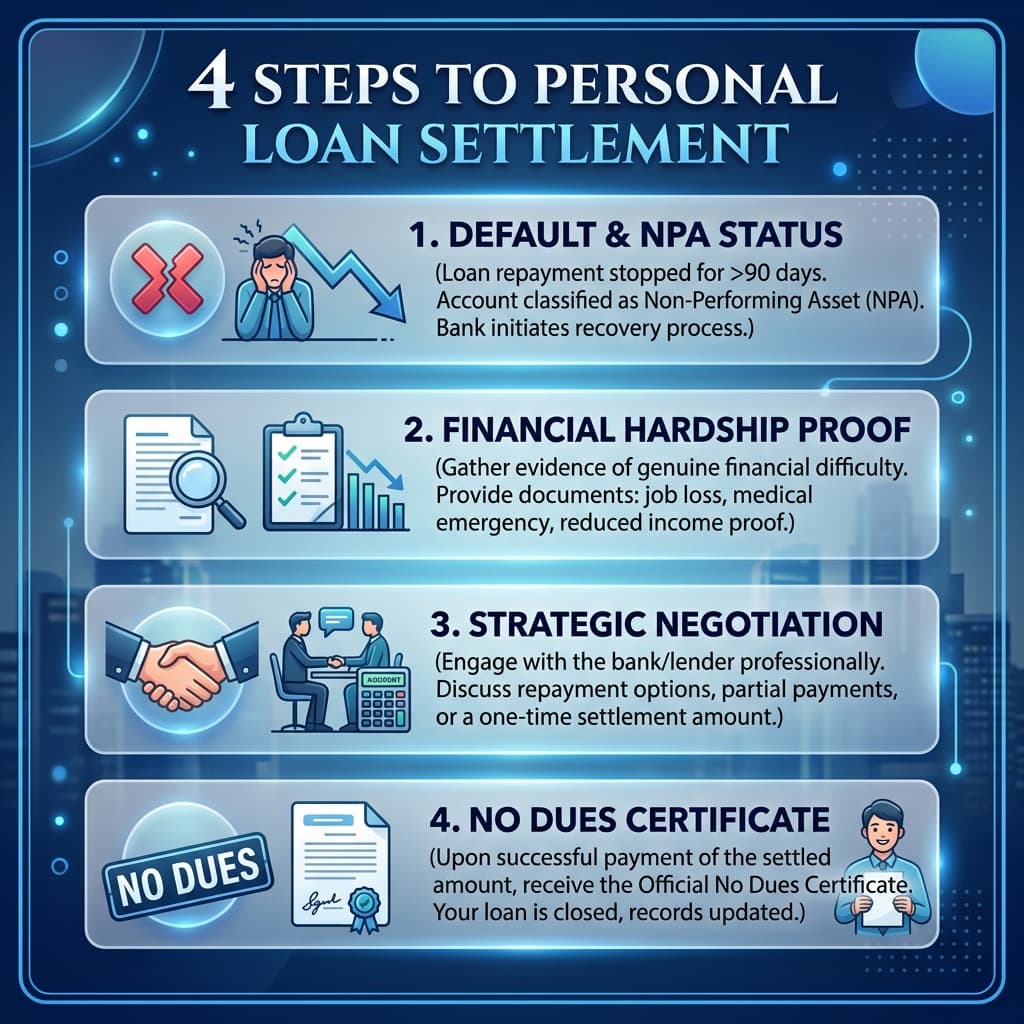
| 90+ Days | NPA (Non-Performing Asset) | The turning point. The loan is marked as a loss. Formal legal notices sent. The bank is now open to discussing One Time Settlement (OTS). |
| 180+ Days | Doubtful / Loss Asset | Maximum negotiation leverage. Banks are highly motivated to recover whatever possible and close the account. |
Impact on CIBIL and Financial Future
A critical aspect of a one-time settlement is its impact on your credit history. When you settle a ₹20 Lakh loan for a lower amount (e.g., ₹10 Lakhs), the bank takes a loss of ₹10 Lakhs.
Status Update: The bank will report this to CIBIL and other credit bureaus, updating your loan account status to "Settled" or "Post Write-off Settled", rather than "Closed".
The consequence: A "Settled" status negatively impacts your credit score. Your CIBIL score will drop, and you will find it extremely difficult to obtain new unsecured loans (like personal loans or credit cards) for the next 2 to 4 years. However, this is often a necessary trade-off to escape a massive debt trap that you cannot realistically repay.
Can the Bank Take Legal Action for ₹20 Lakhs?
Because ₹20 Lakhs is a substantial amount, banks will deploy their legal teams to put pressure on you. However, you must understand your rights. A personal loan is an unsecured loan.
No Arrest Warrants for Default
Inability to pay a loan is a civil breach of contract, not a criminal offense. The police cannot arrest you for defaulting on a loan, nor can they file an FIR for cheating (unless you submitted fraudulent documents to obtain the loan).
Arbitration Notices
You may receive an arbitration notice from a lawyer appointed by the bank. This is a private dispute resolution mechanism, not a court order. You have the right to challenge it legally.
Cheque Bounce (Section 138)
If you provided post-dated cheques as security that bounced, the bank can file a case under Section 138 of the Negotiable Instruments Act. This is a criminal offense, but it is bailable, and courts usually encourage out-of-court settlements.
Eligibility for a Massive Waiver
Banks do not hand out settlement waivers just because you ask for one. You must prove that you are facing genuine financial hardship and absolutely cannot pay the full ₹20 Lakhs. To secure a good settlement, you need to provide evidence of:
- Loss of Employment: Termination letters, resignation emails, or proof of a shuttered business.
- Medical Emergencies: Extensive hospital bills or diagnosis reports draining your savings.
- Zero Assets: Bank statements showing depleted accounts and lack of liquid assets to liquidate.
- Over-leveraged: Proof of multiple other loans and EMIs that exceed your monthly income.
Negotiation Strategy for a ₹20 Lakh Loan
Negotiating a high-value loan requires extreme caution. A mistake here could cost you lakhs of rupees. Here are the golden rules for negotiation:
The Golden Rules of Settlement
- Start Low: Never accept the first offer. If they offer ₹15 Lakhs, counter with ₹5 Lakhs. Meet in the middle.
- Demand Written Proof: Never pay a single rupee based on a verbal promise or WhatsApp message from a recovery agent. Always demand a formal settlement letter on official bank letterhead.
- Ensure the "Full and Final" Clause: The settlement letter must explicitly state that the agreed amount is in "Full and Final Settlement" of the loan account, and no further dues remain.
- Obtain the NDC: After making the payment, ensure you receive the No Dues Certificate (NDC) or No Objection Certificate (NOC) from the bank within 15-30 days.
How to Start the Settlement Process
Dealing with a ₹20 Lakh default requires professional legal shielding. Recovery agents will try to harass your family, visit your workplace, and mentally break you into paying. You do not have to fight this alone. By hiring legal experts specializing in debt resolution, you can completely halt the harassment while they negotiate the settlement on your behalf, legally and formally.
With the right legal defense, a seemingly impossible ₹20 Lakh debt burden can be systematically dismantled and settled within your financial capacity, allowing you to reclaim your peace of mind and rebuild your life.