

Debt Settlement vs. Debt Consolidation in India

Explore your best option for managing debt in India effectively.

AJ

Ashish Jhangra

Reviewed by CredSettle Team

17-08-2026
7 min read
Debt Settlement vs. Debt Consolidation in India
0.0/5
Client Rating
0Cr+
Debt Settled
0+
Happy Clients

Share this insight

Help someone else stay informed about debt relief.

KEY TAKEAWAYS

Debt settlement can reduce your total debt amount, but may affect credit scores.

Debt consolidation simplifies payments but requires discipline to avoid future debt.

Evaluate financial goals and current debt situation before choosing a method.

Consider legal implications and consult with a financial advisor in India.

Understand all terms and conditions of any debt management plan.

Understanding Debt Settlement

Debt settlement in India is a strategic process where a debtor negotiates with creditors to settle a debt for less than what is owed. This method can be particularly beneficial when dealing with overwhelming unsecured debts such as credit card dues and personal loans. Notably, debt settlement is distinct from debt consolidation, which involves merging multiple debts into a single loan with a usually lower interest rate.

In the Indian context, debt settlement carries certain legal implications. The Reserve Bank of India (RBI) guidelines permit banks to offer one-time settlement schemes under specific conditions. However, the debtor must be cognizant of the potential impact on their credit score, as settled debts may be reported to credit agencies.

Legal precedents highlight the role of the Debt Recovery Tribunal (DRT) in adjudicating disputes arising from settlement agreements. Case studies, such as those involving the Insolvency and Bankruptcy Code (IBC), illustrate how distressed borrowers can navigate these complex waters.

For individuals facing creditor harassment, engaging with professional services like anti-harassment services can provide relief. Additionally, leveraging expert negotiation assistance for loan settlements or personal loan settlement can significantly impact the outcome. By understanding the nuances of debt settlement, debtors can make informed decisions and potentially alleviate their financial burdens effectively.

Understanding Debt Consolidation

In India, debt consolidation is a financial strategy that involves amalgamating multiple debts into a single loan with a potentially lower interest rate. This approach is particularly beneficial for those facing high-interest debts, such as credit cards or personal loans. By consolidating, individuals can streamline their repayment process and reduce the overall financial burden.

Legally, debt consolidation is viewed as a contractual agreement between the borrower and the lender, often requiring adherence to specific terms and conditions set forth by financial institutions. The Reserve Bank of India (RBI) regulates these financial agreements, ensuring transparency and fairness in the process. It is essential to evaluate the terms carefully to avoid common pitfalls such as hidden fees or an extended repayment period that may inadvertently increase the total interest paid over time.

While debt consolidation offers a simplified payment plan, it is not a one-size-fits-all solution and may not address the underlying issues of financial mismanagement. Borrowers should assess their repayment capabilities and explore legal options, including seeking professional advice to negotiate better terms. CredSettle provides essential services for loan settlement and credit card settlement, which can be integral in achieving financial stability.

Historically, debt consolidation has proven effective for many in managing finances, but it requires careful consideration and planning. Understanding the legal framework and available resources can significantly influence the success of this financial strategy.

Benefits and Drawbacks of Each Method

When deciding between debt settlement and debt consolidation in India, it's crucial to weigh the benefits and drawbacks of each method. Understanding these can guide you to the most suitable option for your financial situation, especially within the Indian legal context.

Debt Settlement

Debt settlement involves negotiating with creditors to pay a lump sum, often less than the total owed. This strategy can alleviate financial stress quickly. Companies like CredSettle offer proficient services in this arena, providing relief from creditor harassment. However, this approach can negatively affect your credit score and may involve legal proceedings if not handled effectively. Additionally, according to Indian regulations, any forgiven amount could be considered taxable income.

Debt Consolidation

Conversely, debt consolidation merges multiple debts into a single loan with a lower interest rate. This method simplifies payments and can reduce overall interest. However, it requires a good credit score to secure favorable terms. In India, failing to meet repayment schedules could lead to legal actions under the Debt Recovery Tribunal (DRT). Additionally, the process may involve fees, such as processing charges from banks or NBFCs, impacting the cost-benefit analysis.

Both options have distinct impacts on your financial profile. Exploring comprehensive services like NBFC Loan Settlement can offer further insights into tailored solutions for debt relief in India.

Comparison of Debt Settlement vs. Debt Consolidation

Understanding the differences between debt settlement and debt consolidation is crucial for Indian borrowers struggling with financial obligations. Both options have unique legal and financial implications.

Parameter

Debt Settlement

Debt Consolidation

Who It's For

Designed for those unable to repay full debt amounts, possibly facing legal action through the Debt Recovery Tribunal (DRT).

Ideal for individuals with multiple high-interest debts seeking to streamline payments.

What It Does

Negotiation with creditors to pay a reduced, lump-sum amount, potentially requiring credit card or loan settlement.

Combines multiple debts into one loan with a lower interest rate.

Impact

Can significantly affect credit scores but offers immediate debt relief.

Maintains credit score integrity while reducing monthly financial burdens.

Cost

Possible fees for services like anti-harassment but saves on overall debt amount.

Includes processing fees and interest over the new loan term.

The choice between these options may depend on personal financial circumstances, future goals, and the ability to manage repayments. Exploring options such as personal loan settlement or NBFC loan settlement might also offer viable solutions.
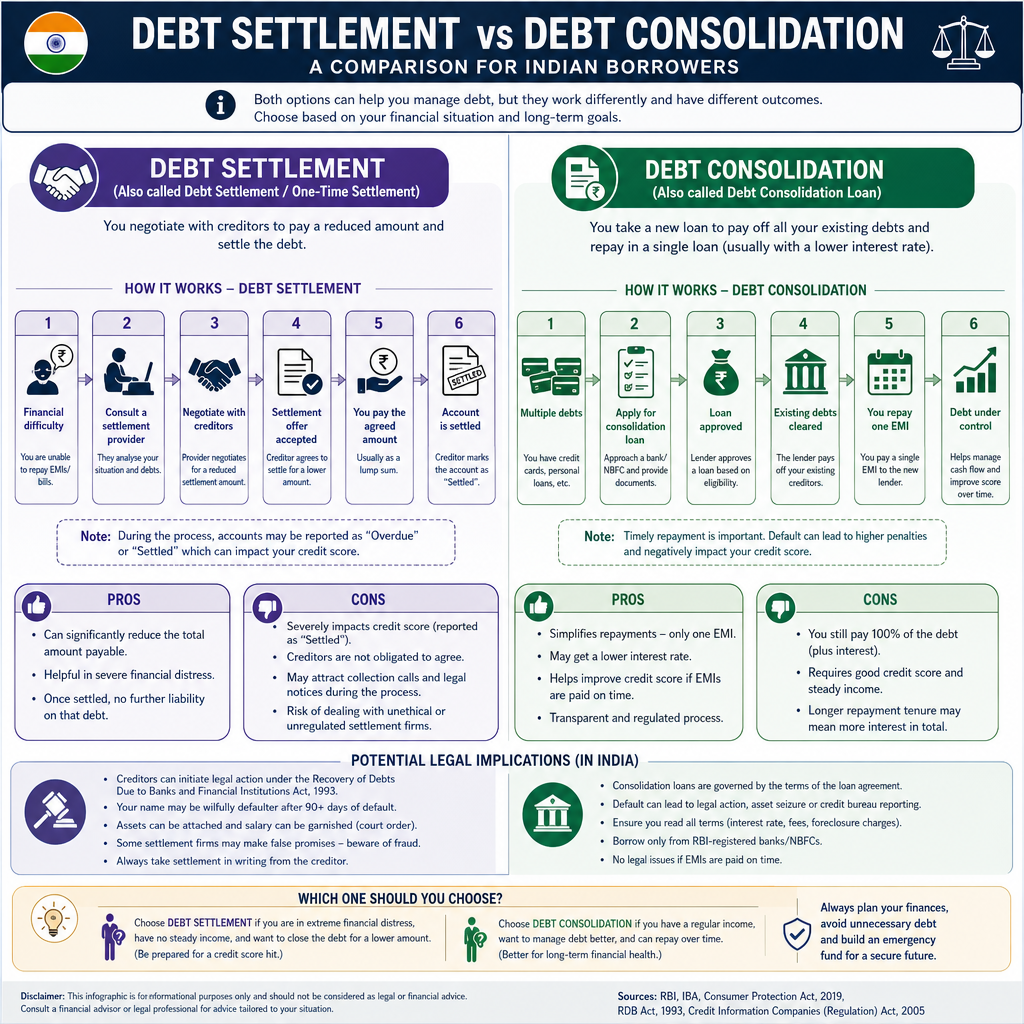

INFOGRAPHIC

Infographic summary

How to Choose the Right Option for You

Deciding between debt settlement and debt consolidation in India requires a thorough understanding of your financial landscape. Consider these critical factors.

Assessing Financial Health

Start by evaluating your financial situation, including monthly income, total debt, and credit score. Debt settlement, often used to negotiate and reduce debt, might suit those with significant financial distress. Alternatively, debt consolidation, which combines multiple debts into one loan, requires a healthier credit score and steady income to secure favorable terms.

In India, debt settlement may involve interactions with the Debt Recovery Tribunal (DRT) or National Company Law Tribunal (NCLT). Understanding these legal proceedings is essential to navigate potential pitfalls. On the other hand, debt consolidation often involves obtaining a new loan from banks or Non-Banking Financial Companies (NBFCs). Familiarize yourself with the Reserve Bank of India (RBI) guidelines governing these financial entities.

Evaluating Long-Term Impact

Consider the long-term impact on your credit history. Debt settlement can negatively affect your credit score but may provide immediate relief. Debt consolidation might preserve your credit score if managed well. For more on reducing harassment from creditors while considering settlement, visit CredSettle's Anti-Harassment Services.

By comprehending these elements, you can make an informed decision that aligns with your financial goals and obligations.

When navigating debt solutions in India, it's crucial to understand the legal landscape. The primary legal framework governing debt-related matters includes the Reserve Bank of India's (RBI) guidelines and the Securitisation and Reconstruction of Financial Assets and Enforcement of Security Interest (SARFAESI) Act, 2002. These regulations aim to protect both creditors and debtors, ensuring fair practices.

Debt Settlement: This process involves negotiating with creditors to reduce the total debt amount. Legally, it's important to document any agreements in writing. Be aware that settling debts can impact your credit score. For those facing harassment from creditors, legal protection is available, and services such as anti-harassment can be valuable.

Debt Consolidation: This approach merges multiple debts into a single loan, typically at a lower interest rate. Legal considerations include understanding the loan terms and the potential implications under the Indian Contracts Act, 1872. If using an NBFC for consolidation, verify their registration with the RBI. You may explore NBFC loan settlement options for more tailored solutions.

Overall, individuals must remain vigilant of legal rights and obligations. Consulting with legal experts or financial advisors can mitigate risks and ensure compliance with Indian laws.

Sources & References

POPULAR SEARCHES

Frequently Asked Questions

A One-Time Settlement (OTS) is a negotiated agreement where you pay a reduced lump sum to settle your debt. CredSettle negotiates with lenders on your behalf to secure the best possible settlement terms while ensuring RBI compliance.

Yes, debt settlement is completely legal in India. CredSettle ensures all settlements are conducted in accordance with RBI guidelines and regulatory frameworks, protecting your rights throughout the process.

CredSettle provides legal intervention and communication services to stop harassment from recovery agents. We file formal complaints with RBI, NCH, and Cyber Police when necessary, and issue cease and desist notices to protect your rights.

Yes, settling a debt will likely reflect as "Settled" on your credit report, which can temporarily lower your CIBIL score. However, this is often a better alternative to default or bankruptcy, and you can rebuild your score over time once you are debt-free.

Absolutely. Credit card debt is one of the most common types of unsecured debt we settle. We negotiate with credit card issuers to reduce the outstanding balance, often achieving significant savings.

The duration varies based on your financial situation and the lender, but most settlements are negotiated within 3 to 12 months. We work to resolve it as quickly as possible to get you back on track.

We typically operate on a success-fee model for strictly settlement services, meaning you pay our service fee only after we successfully negotiate a settlement for you. However, specific legal protection services may have different structures.

While rare, if a bank refuses initially, our legal team escalates the matter, leveraging consumer protection laws and valid financial hardship evidence to compel them to the negotiation table.

Our primary expertise is in unsecured debts (personal loans, credit cards). Secured loans are harder to settle because the lender has collateral. However, we can sometimes assist with restructuring or legal advice depending on the case.

Yes, we adhere to strict data privacy standards. Your financial information is kept confidential and is only shared with authorized parties (like your creditors) for negotiation purposes with your consent.

CredSettle Logo

CredSettle is India's trusted loan management platform. Founded to help people break free from the cycle of debt, CredSettle has counselled countless individuals struggling with personal loans, credit cards, and app loans. We ensure you get ethical, RBI-compliant resolution strategies. CredSettle charges fees only on successful settlement, not upfront. CredSettle does not handle secured loans (home loans, car loans, gold loans).

Media Mentions

Media 1
Media 2
Media 3
Media 4
Media 1
Media 2
Media 3
Media 4
Media 1
Media 2
Media 3
Media 4
Media 1
Media 2
Media 3
Media 4
Media 1
Media 2
Media 3
Media 4
Media 1
Media 2
Media 3
Media 4
Media 1
Media 2
Media 3
Media 4
Media 1
Media 2
Media 3
Media 4
Chat with us on WhatsApp